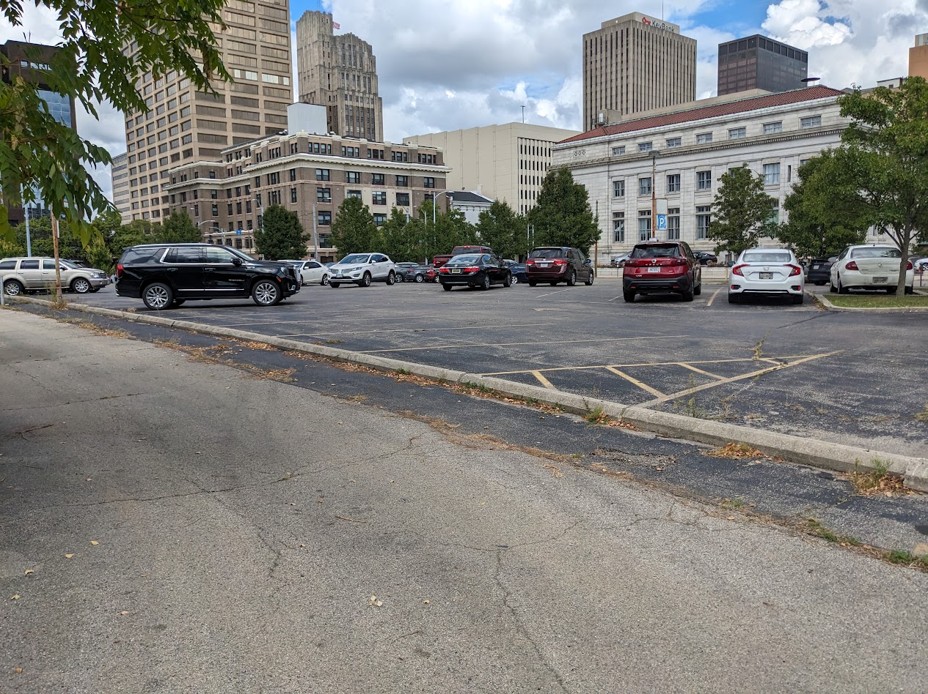
As I’ve covered downtown buildings and redevelopment project, parking has been coming up more and more, and it’s one of the most common reasons people give for skipping downtown altogether.
I recently recorded an episode of the Dayton Vistas Podcast about this, which I find to be a fascinating topic because it’s not really about parking.
It’s about downtown vibrancy, the planning choices Dayton has made in the past, and what downtown should look like in the years ahead. Central to all of that is how people get around and what the city chooses to do with its most valuable real estate in the urban core.
You can watch the episode here:
And listen to the audio version here:
I was also recently interviewed for a piece on this exact topic in Parking Today, a national trade publication. The article profiled my friend Anne Kane, who writes a column for the Dayton Daily News called Anne’s Spot, which highlights businesses, often downtown, and tells readers exactly where to park.
After that I posted about parking on my Facebook page and got a huge number of responses, and many commenters raised some great questions. So I was inspired to delve more deeply into the issues at hand.
The Parking Perception Problem in Downtown Dayton
The parking “problem,” as I’ve seen people describe it, basically comes down to this: downtown visitors usually cannot park right in front of their destination.
Suburban shopping and dining almost always come with free, unlimited parking directly next to the door. Downtown, on the other hand, can feel like a more complicated system, and people who are not used to it are not always sure where to go, what they will pay, or how far they will end up walking. So some decide not to bother, and that adds up over time.
One response to that framing is that it is more of a perception problem than an actual parking shortage. Suburban-style parking, free and directly in front of every destination, does not really exist in any urban area larger than a small town.
But nevertheless, there truly is plenty of parking downtown. The friction is that the process is less familiar to infrequent visitors than pulling into a strip mall lot.
And there are also some key points that aren’t always understood, both for parking meters and parking garages.
What Downtown Dayton’s Meters and Garages Actually Cost
A lot of this parking friction could be solved with better information. Many people do not know that downtown’s parking meters are free after 6pm and all weekend. I have shared that fact online and in person, and it is consistently a pleasant surprise, even to people trying to feed a meter on a Saturday.
David Escobar, a city engineer with the City of Dayton’s Department of Public Works, says downtown has 1,165 single-space metered parking spaces and 8 recently installed multi-space meters.
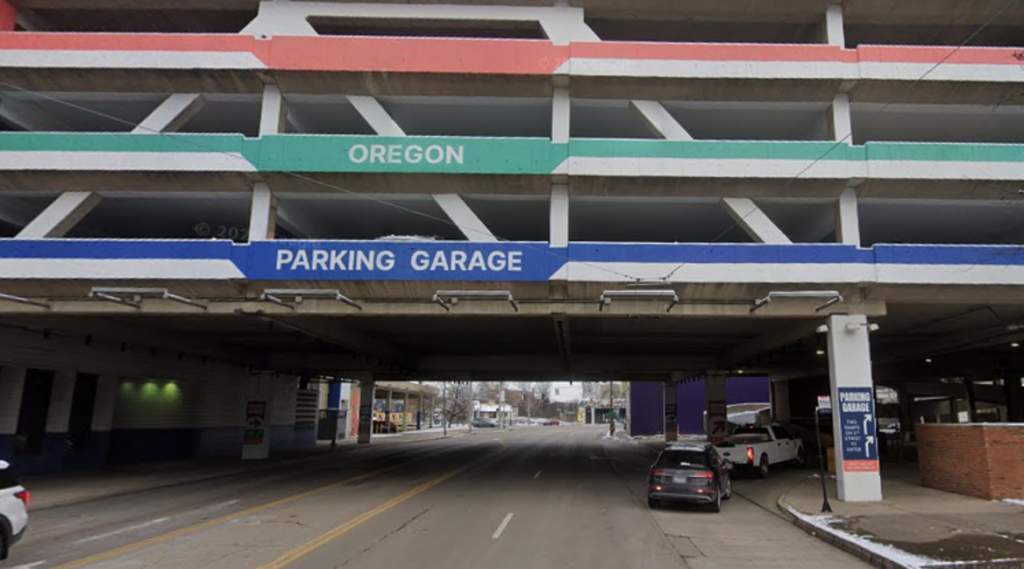
Beyond the meters, downtown also has a number of garages that are cheap, convenient, and a guaranteed option compared to circling the block looking for an open spot.
Anne’s column at the Dayton Daily News breaks down exactly where those garages are, which one to pick for a given destination, and what each one costs, in more detail than I have seen anywhere else.
Education and awareness will not solve everything. Some suburban visitors simply do not want to walk a couple of blocks from a parking spot to their destination, no matter how well the options are explained. But a larger group likely just does not know how the system works, and better marketing, clearer webpages, and improved wayfinding and signage downtown could go a long way.
Downtown Dayton Parking Distances vs. Big Box Store Parking
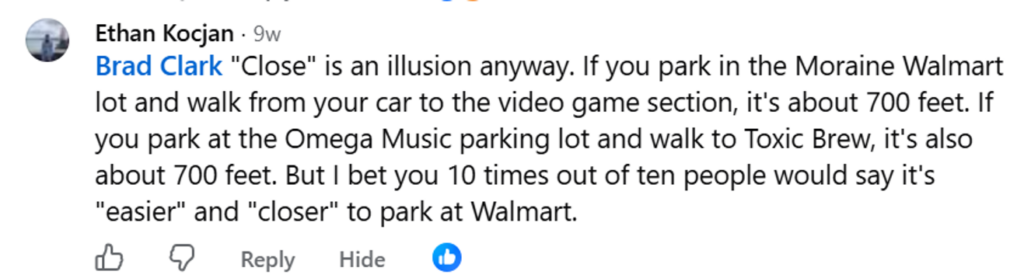
For visitors who do not want to walk, it helps to look at how far people already walk elsewhere without thinking twice about it. A large suburban parking lot often requires just as much walking, if not more, than a downtown trip.
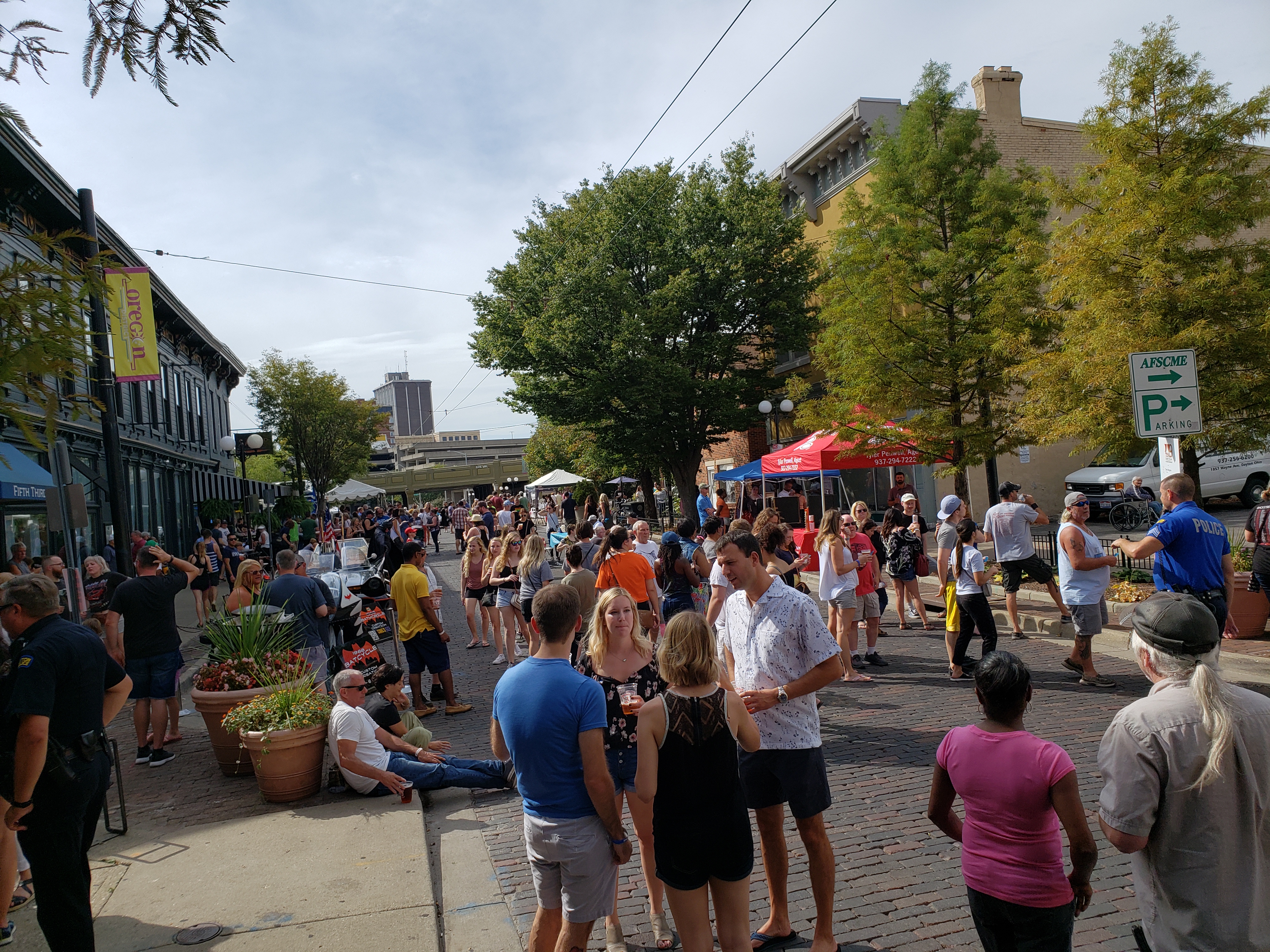
One of the comments on my Facebook used a good example comparing a trip to Walmart vs. one to the Oregon District. I think this shows that the difference is familiarity, not actual distance.
Does Downtown Dayton Have Too Much Parking?
Some in urban planning circles argue the opposite problem: that downtown has too much parking, not too little.
The Parking Reform Network found that 29% of Downtown Dayton is taken up by off-street parking. Cities analyzed nationally ranged from San Bernardino, California, at 49%, down to New York City at 1%, Washington DC at 3%, and Chicago at 4%.
The Parking Reform Network argues that an oversupply of parking actively harms downtowns. Parking tends to cluster around main streets, office districts, and historic cores, creating dead zones around a city’s most valuable and walkable areas, which limits both residential and commercial growth in exactly the places that could support the most of it.
Why the Single-Destination Parking Model Misses the Point
I believe another big part of the issue requires us to question the assumption in the original framing: that people come downtown to park as close as possible to one destination and then leave.
Single errands like always will exist of course, but they have never really been what makes a downtown work, and they are not the experience that makes these areas vibrant in the first place.
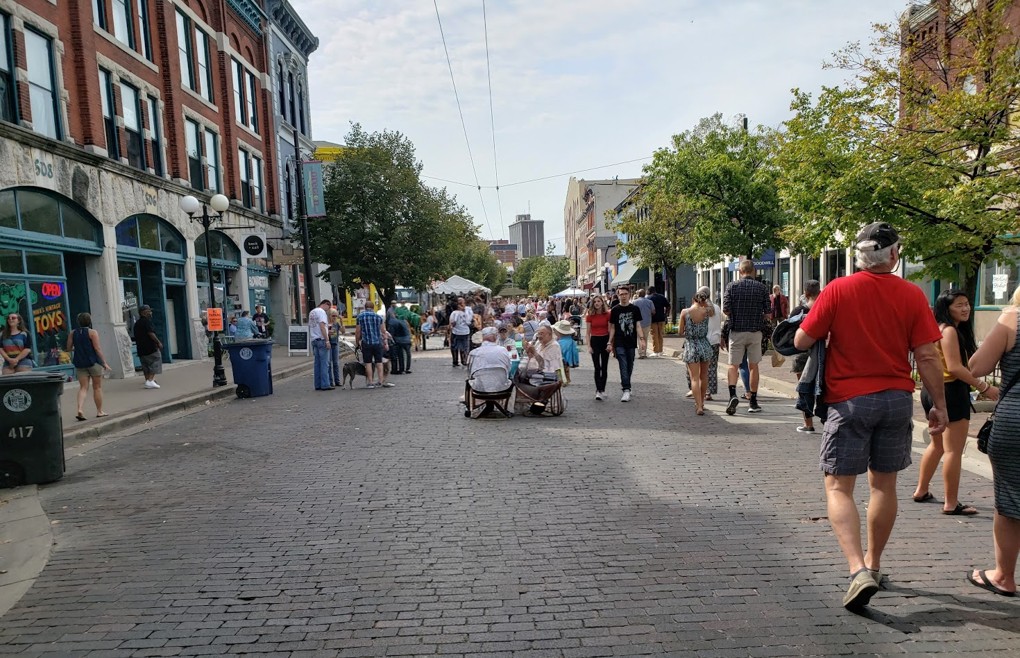
In places designed around people rather than cars, visitors also stroll; window shop; run into someone they know and chat. They might notice a new shop or bar and decide to poke their head in, or grab a coffee and just sit and people watch from a comfortable spot.
A downtown built entirely around single-destination parking works against exactly what draws people to a downtown district in the first place.
A representative for the Parking Reform Network said that “having ample parking is one thing, but having an oversupply really does damages to the likelihood someone is actually going to want to live or shop downtown. This parking is often clustered around main streets, office districts, and historical cores, creating a dead zone around the city’s most valuable and walkable areas that limits residential and commercial growth.”
Is Downtown Dayton Walkable and Vibrant Enough Yet?
That multi-destination, walkable model depends on downtown actually having enough going on to support it, and that has been a fair question for Dayton.
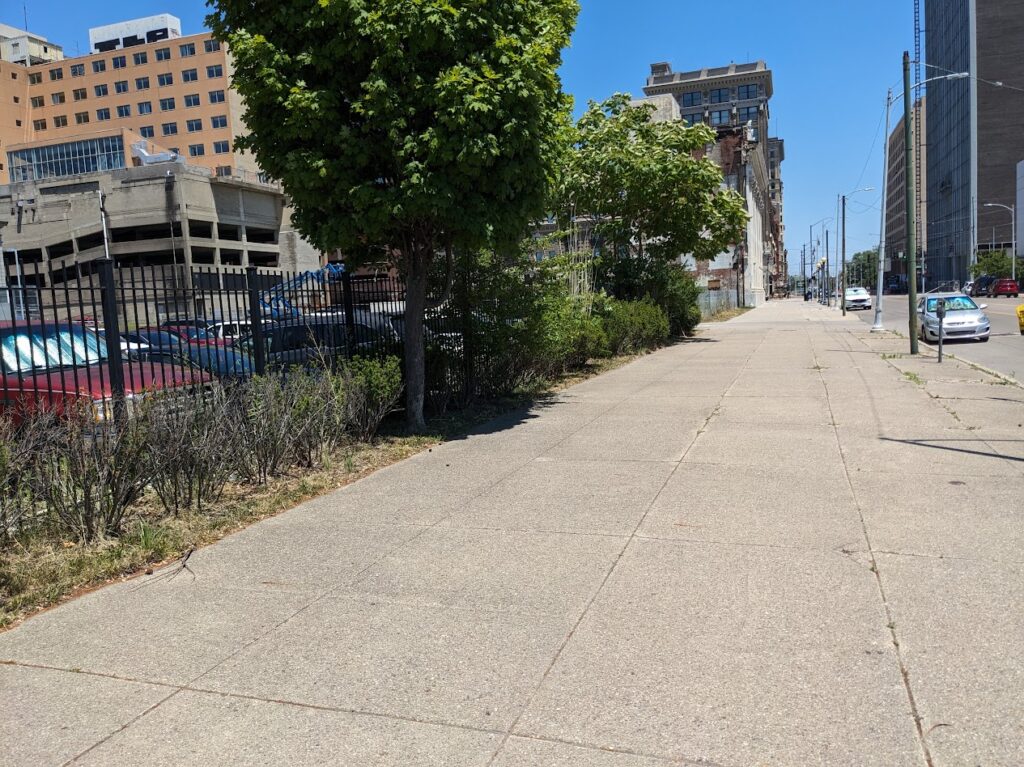
Over the past few decades, downtown has not always had the vibrancy and concentration of amenities to deliver that kind of experience. Destinations like the Schuster Center, the Dayton Dragons ballpark, and Fifth Street in the Oregon District have existed, but they have often felt isolated, separated by vacant buildings, quiet streets, and surface parking lots that make the gaps between them feel less inviting rather than more.
Jeff Speck’s book Walkable City argues that people choose to walk when a walk is useful, safe, comfortable, and interesting.
There has been a great deal of discourse about how different people define “safe” (and that’s worth its own discussion), but how many blocks downtown can we say it is useful, comfortable, and interesting to walk?
How Downtown Dayton’s Walkable Blocks Are Connecting
That picture has been improving. The past decade has brought hundreds of new apartments, rehabbed spaces for new restaurants, and several new downtown hotels. Those projects are starting to connect what were previously isolated pockets of activity into smaller walkable clusters with multiple real destinations.
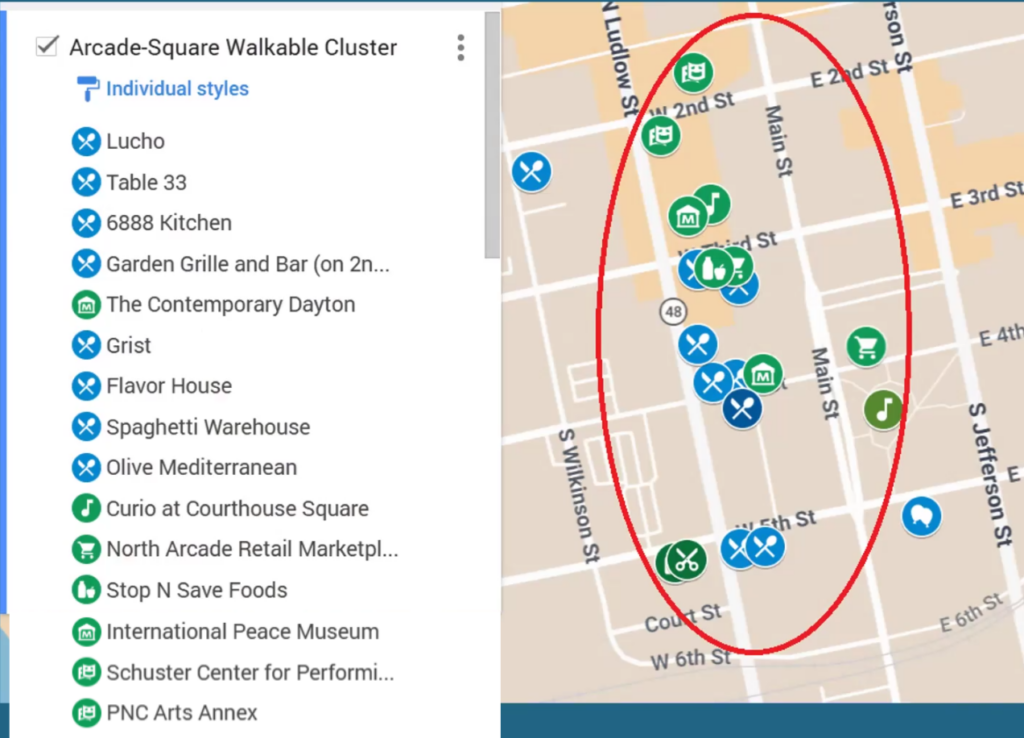
One such corridor runs from the Schuster Center at Second Street down through Courthouse Square and the Dayton Arcade to Fifth Street, linking restaurants, art galleries, museums, and retail into something close to a continuous walkable stretch. There is still a long way to go, but that connectivity is a real improvement over 10 to 15 years ago.
Downtown is likely in a transition period, gradually delivering more of a classic city experience where people feel justified paying a few dollars or walking a few blocks. That transition has been complicated by other factors.
The pandemic significantly reduced the number of office workers downtown and led to the closure of multiple businesses, a change that is still visible on the street most days of the week. Perceptions of safety, real or otherwise, factor in too, and no matter where someone falls on that debate, it’s undeniable that streets full of people are always going to feel more inviting and positive than empty ones.
What a “Parking-First” Downtown Really Would Require
Some who remain skeptical of downtown’s walkability argue for the opposite approach: prioritizing easy parking even more than it already is.
Taking that idea seriously means asking what it would actually require. For one, I think it would involve demolishing more peripheral buildings, widening streets to move suburban traffic through faster, and spacing remaining buildings and lots farther apart so every destination sits surrounded by open pavement.
That is not a hypothetical. Dayton did almost exactly that for decades starting in the 1960s, and the disconnected downtown we’ve been talking about is a direct result.
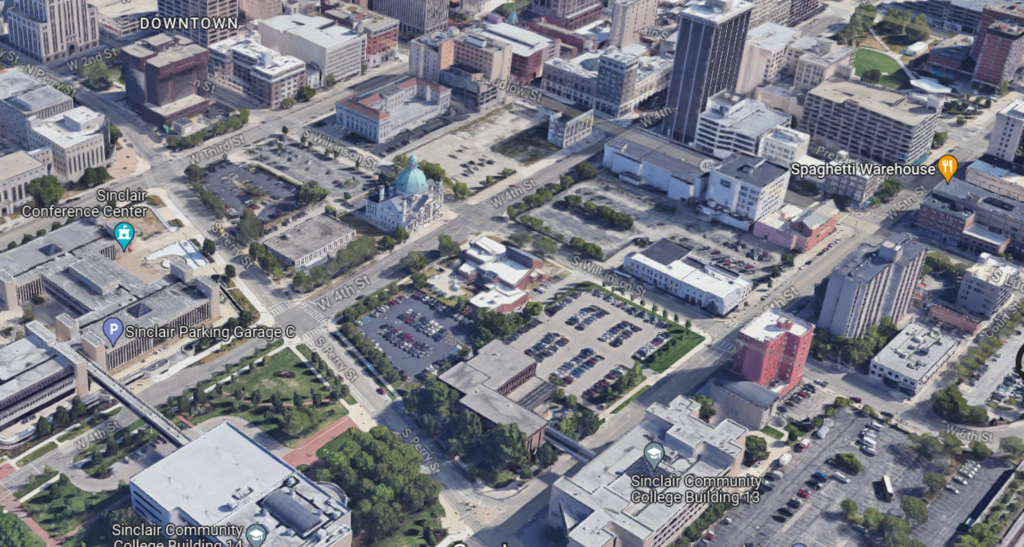
How Urban Renewal Nearly Erased Downtown Dayton for Parking Lots
The thinking behind the urban renewal era held that prioritizing parking above nearly everything else would bring downtown back.
I should be clear that at the time, downtown faced real challenges from decentralization and suburbanization, and city leaders wanted to compete with suburban shopping centers by making downtown more convenient for drivers coming in from outside the city. These goals were definitely understandable.
But the result was the demolition of close to half of downtown Dayton through major urban renewal projects. Highways were rammed through dense urban areas on downtown’s edges to move suburban traffic in, though in practice they made it just as easy for people to head the other way and abandon the urban core entirely.
And beyond the large urban renewal projects, countless blocks of interesting older buildings were broken up or razed outright to make room for more parking.
Architectural landmarks that survive today, including the Victoria Theater and the Old Post Office on West Third Street, came very close to demolition for parking and were saved only through significant preservation efforts.
Most of the rest of downtown’s historic fabric did not get that chance. Competing with the suburbs by copying their design does not work in an urban core.
The biggest unintended consequence of that era was the removal of so much of what made downtown worth visiting, leaving it more generic and less special.
Being Critical of Excess Parking Is Not Being Anti-Car
I also want to make sure I emphasize that criticizing an oversupply of parking is not the same as opposing driving. Cars are the dominant way people get around Dayton and that will always be the case.
Downtown living has grown, but a large share of the people who patronize downtown businesses still come from elsewhere and they do need convenient places to park.
The real question is whether a downtown designed almost entirely around cars and parking creates the kind of place people actually want to spend time in.
And does not mean making driving or parking “hostile” downtown, which I’ve seen come up in conversations. But that is a question of degree, not a yes or no. And I’d urge us to remember how Dayton spent decades pursuing the other extreme: bulldozing entire neighborhoods and business districts, and redesigning its highest-value streets to function like highways, optimized for passing through by car rather than for anyone actually being there.
Rebuilding a genuine concentration of buildings, activity, and people downtown is the path back back from that history.
Better Marketing, Wayfinding, and Signage for Downtown Dayton Parking
A meaningful part of the solution is still, I believe, doing a better job with the parking downtown already has.
Clearer online marketing, easier-to-browse and understand webpages listing garages and their costs, and better wayfinding and signage in person would all help close the gap between how much parking exists and how usable it feels to a first-time visitor.
I should note that the Transportation Center Garage has made real progress on this front over the past couple of years, and the city has tried some new approaches with its meters, but I fear that a large number of people still do not know how any of it works.


I’ve long believed that downtown parking needs to be free 24×7 in order to combat this competitive threat.