The invention of the cash register began not with a major corporation, but with a Dayton saloonkeeper confronting a very practical problem. In 1879, James Ritty created the first mechanical cash register as a way to prevent employee theft, a simple idea that would ultimately transform American business practices and lay the foundation for the National Cash Register Company (NCR). This article explores Ritty’s inventions and early work, as well as how John H. Patterson later expanded the idea into one of Dayton’s most influential companies, NCR. (For the full corporate and campus history, see my NCR: A Then and Now History in Dayton.)
Why Dayton Produced the First Cash Register
A little over a century ago, Dayton, Ohio was the U.S. city with the most patents per capita. Known as “the City of a Thousand Factories,” Dayton churned out a staggering variety of products but also was a center for innovation.
And the cash register was a critical invention that would reshape retail and accounting, as well as allow Dayton to forever change American industry.
James Ritty, the Saloonkeeper Who Invented the Cash Register (1879)
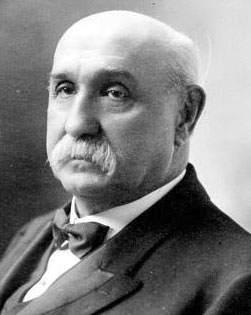 When people today think of cash registers, the names commonly associated with them are John H. Patterson and the National Cash Register Company.
But Patterson didn’t actually invent the device.
That honor goes to James Ritty, a Dayton saloonkeeper who devised the machine as a defense against employee theft, a persistent problem for business owners in the late 19th century.
Ritty’s First Cash Register and Early Patent
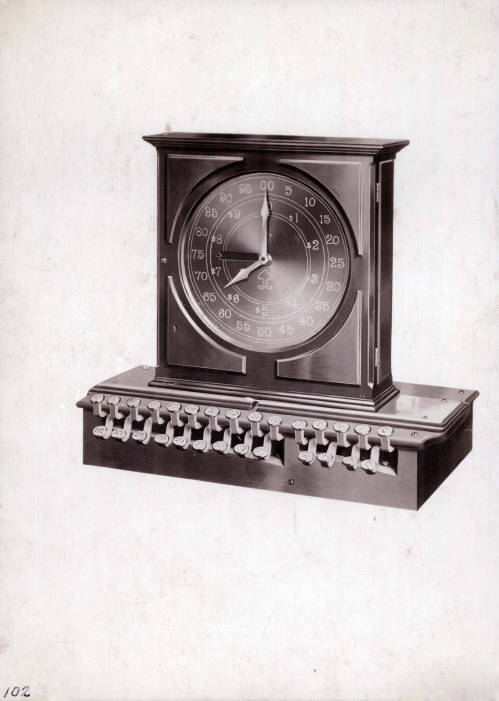
Image courtesy of Dayton Metro Library
This was the first cash register that Ritty developed along with brother John in 1879, a rather crude and inaccurate machine that didn’t even have a cash drawer.
Further iterations would improve upon the original effort, and the full-text of the patent he received on November 4, 1879 is available in its entirety online.
Ritty soon needed a larger space for production than the second floor apartment above his saloon at 10 South Main St, which is pictured below.
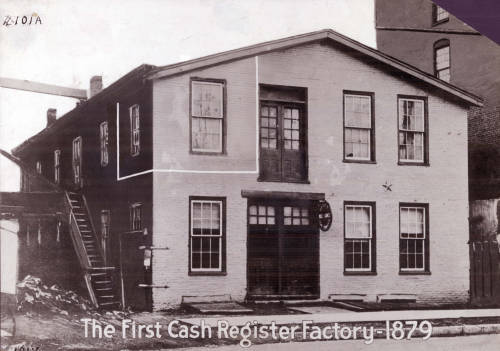
Image Courtesy of Dayton Metro Library
This is the factory building where the first cash registers were produced and sent to market. (Other sources suggest that Ritty actually set up shop here in 1881.)
Why Ritty’s Business Struggled
Like many inventors, Ritty faced challenges in scaling manufacturing, marketing his machines, and capitalizing on his patent. The device was groundbreaking, but the business infrastructure to support it was lacking.
James Ritty struggled to balance two demanding roles: running his busy saloon and managing a small but growing manufacturing operation. He soon found the dual responsibilities overwhelming and decided to step away from the business entirely.
Ritty Leaves the Cash Register Business (1881)
In 1881-82, Ritty and his brother John sold all of their interests in the cash register venture to a group of investors that included Jacob H. Eckert, a Cincinnati china and glassware salesman, and John and Frank Patterson, who at the time were involved in the coal and railroad trade. Eckert reorganized the operation as the National Manufacturing Company, continuing to refine and market Ritty’s “Incorruptible Cashier.”
Although this sale ended Ritty’s direct involvement with the cash register, he later expressed no resentment that he never personally profited from the company’s eventual success. He maintained cordial relations with John H. Patterson and was occasionally invited to NCR meetings and celebrations, where he was recognized as the originator of the device.
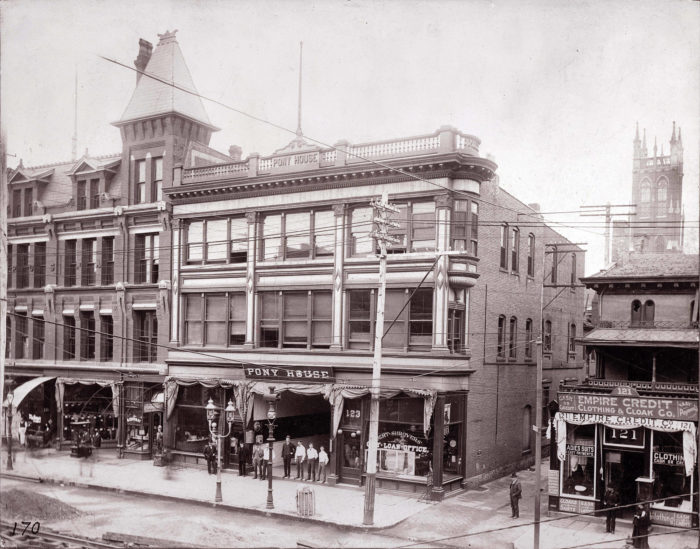
After leaving the business, Ritty returned full-time to the saloon trade and would soon open his most famous venture, the Pony House, in 1882.
This set the stage for one of these investors to take the idea much further.
John H. Patterson Takes Over the Cash Register Business (1884)
In 1884, local coal dealer John H. Patterson bought out the other investors and assumed primary ownership of the business first known as “James Ritty’s New Cash Register and Indicator” and renamed it to the National Cash Register Company (NCR).
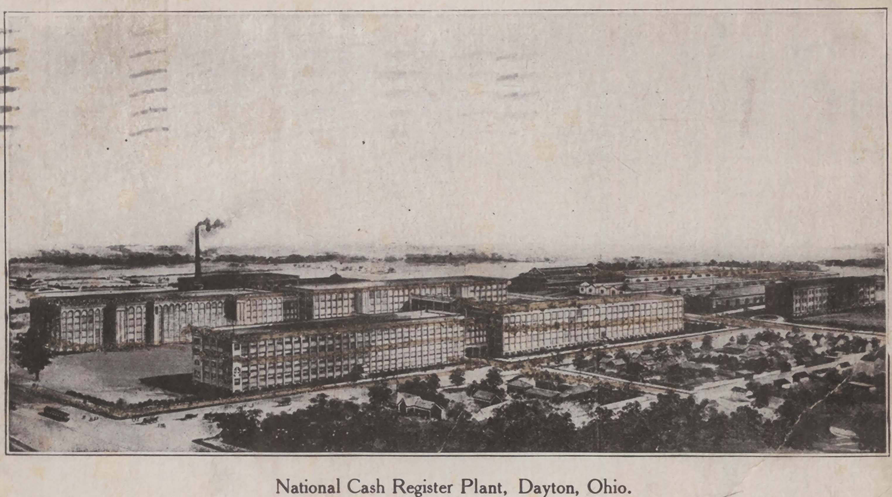
But before Patterson would go on to revolutionize practices in factory design, employee welfare, community relations, and more from NCR’s legendary corporate campus around Main and Stewart Streets, he got his business started in another part of town.
NCR’s Early Downtown Location: The Callahan Power Building
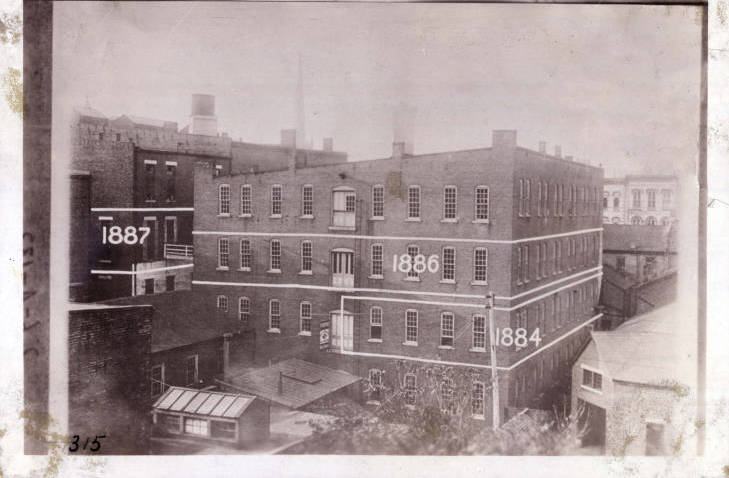
Image Courtesy of Dayton Metro Library
Pictured above is the Callahan Power Building which stood in the middle of downtown on Main Street just north of Third. It was likely constructed in the late 1870s and built “on spec” rather than purpose-built for a particular company, which was common for these types of industrial lofts at the time.
The lines in the image indicate how much space in the building was occupied by NCR at the different years. You can see from the years that the firm was expanding greatly, and soon it looked beyond the crowded downtown and to a location where it would have much more room to grow.
Move to the South Main Street Campus (1888)
In 1888 it would move south to its more familiar location, by which point the company employed 220 people.
From here the firm’s growth would continue to proceed at a blistering pace as NCR became not only a dominant force in Dayton, but also throughout the United States and even globally.
For more on NCR’s history beyond this point, I have a detailed chapter on NCR and its journey from Ritty’s humble beginnings to Patterson’s industrial juggernaut to its eventual decline in my new book Lost Dayton, published by The History Press in 2018. View Lost Dayton on Amazon.
Timeline: Early Cash Register & NCR Origins
1879 — Ritty patents first cash register
1884 — John H. Patterson assumed primary ownership of the business and renamed it National Cash Register
1888 — NCR relocates to the South Main Street campus
1890s–1900s — NCR becomes a major national manufacturer
Frequently Asked Questions About James Ritty and the Cash Register
Who actually invented the cash register?
The first mechanical cash register was invented in 1879 by James Ritty, a Dayton saloonkeeper.
Why did James Ritty invent the cash register?
Ritty wanted a reliable way to prevent employees from pocketing money — a common issue in 19th-century bars and shops.
What did the first cash register look like?
Ritty’s early machine was a simple, drawerless device with mechanical keys and indicators. Later versions became more precise before his 1879 patent.
Where was James Ritty’s workshop located?
Ritty operated his workshop at 10 South Main Street in downtown Dayton, above his saloon.
How did John H. Patterson become involved?
Patterson purchased Ritty’s business in 1883, renamed it the National Cash Register Company, and grew it into a major American manufacturer. For NCR’s full history beyond the early years, see the NCR Then & Now article.
What happened to Ritty after selling the business?
After selling his interests in the cash register business in 1881, James Ritty returned full-time to the saloon trade. In 1882 he opened the Pony House, one of Dayton’s most well-known bars of the time, featuring a massive mahogany backbar carved by craftsmen from the Barney & Smith Car Company. Although Ritty did not financially benefit from the enormous success of his invention, he remained friendly with Patterson and was often invited to NCR events. Ritty retired from the bar business in 1895, spent his later years living in the Dayton Arcade, and died in 1918. He is buried at Woodland Cemetery alongside his wife Susan and his brother John. For more on the Pony House and its surviving bar, see my detailed article on the Pony House.

Leave a Reply