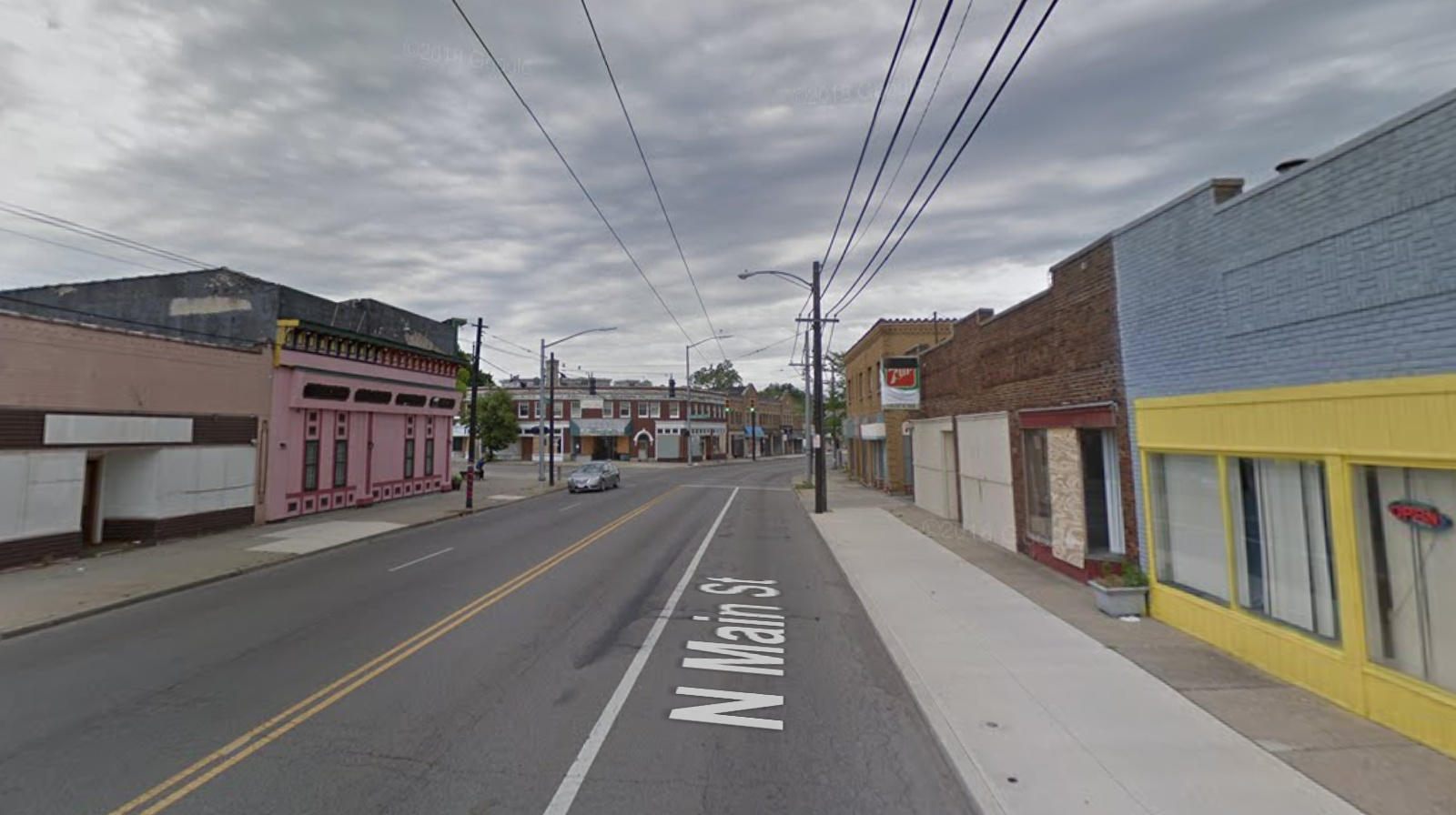
The Santa Clara Business District is one of the most intact early neighborhood commercial strips left in Dayton, but has suffered through decades of disinvestment and faces an uncertain future. This article pulls together its early history as well as more recent developments.
Update: Fire in the Santa Clara District (February 25, 2026)
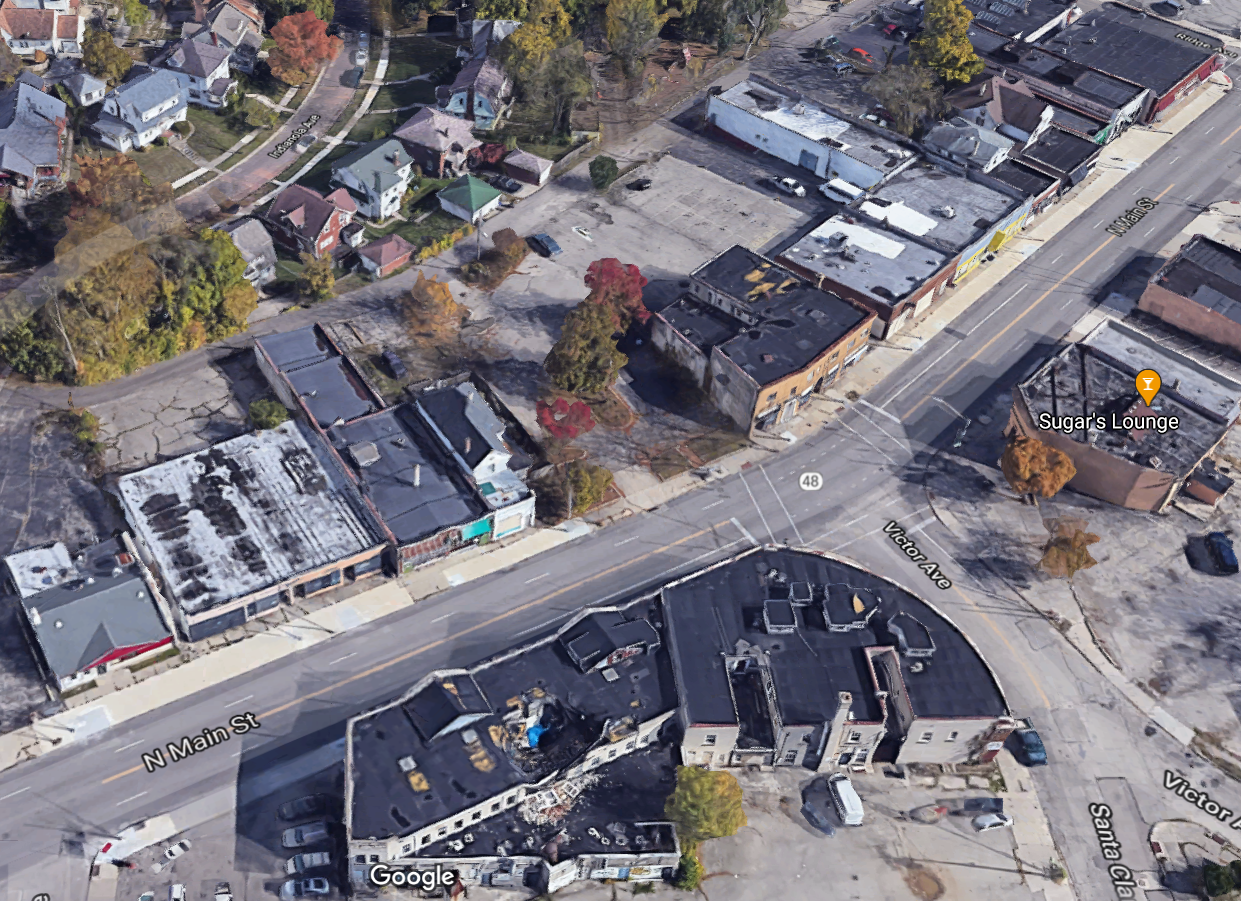
Last Friday, a historic building at the corner of North Main and Victor in the Santa Clara district caught fire.
The vacant commercial structure known as the Smith Building has been in fragile condition for years, although there was an attempt by a developer to rehab it not too long ago.
But decades of disinvestment and foreclosure challenges have left much of it in a precarious state.
In 2024, Preservation Dayton helped secure a National Register nomination for the district, supported by neighborhood leaders and a $12,000 pipeline grant from the Ohio Department of Development to open the door for historic tax credit funding.
Preservation Dayton commented on the fire, saying that “we are saddened to see the Smith Building suffer such a large blow. This building’s absent landlord allowed the property to advance through tax foreclosure until the 11th hour, and paid off the past due balance after the tax foreclosure sale had occurred. A developer with a track record has purchased the Riverdale Theatre Building next door, and we had hoped that this building could help facilitate the revival of the whole block. Now its future is in even more in limbo after the third and largest fire at the building has occurred.”
Neighborhood residents have expressed frustration about the condition of long-vacant structures in the area.
The Santa Clara Neighborhood Dayton Facebook page, which leads cleanup and safety efforts in the area, posted about the fire too, saying they had seen individuals removing metal from the building into grocery carts, and warned that these vacant structures continually being stripped for scrap is causing these fires and will ultimately destroy more buildings in the neighborhood.
They also said that “elected city officials have not been aggressive enough to deal with what is happening in our outlying neighborhoods” and that “their focus is on downtown and a few small select neighborhoods surrounding the downtown area.”
The group added that “more people need to show up and sign up to speak at the city commissioners meetings and start calling police whenever one sees people going in and out of and gathering … around blackboarded properties and garages.”
The Santa Clara Business District has a long and complex history, which I originally explored in detail. The section below provides background on how the district developed and the role buildings like the Smith Building once played.
History of the Santa Clara Business District
originally published 2019–2021
I’ve written about two architectural gems on North Main Street in Riverdale. Continuing north a few blocks we find an impressive group of commercial buildings: the Santa Clara Business District.
The business district located on North Main near Santa Clara Ave is surprisingly intact. Outside of East Fifth in the Oregon District and West Third in Wright-Dunbar, no early neighborhood commercial district with this level of density remains in Dayton.
These types of neighborhood shopping areas districts were once found in all neighborhoods in the city core, but from West Fifth Street to Troy & Valley to Brown & Warren, planned urban renewal or decades of gradual neglect have resulted in their loss.
And as urban living has once again become desirable, these quirky, compact areas have the potential to be vibrant once again, and also to help bring more resources to their communities.
History of the Riverdale and Santa Clara Neighborhoods
Upper Riverdale had begun to develop in the 1880s with the advent of the electric streetcar and many lavish homes were constructed on North Main.
As development continued north, the area took on an identity distinct from the “bedroom community” suburbs in other parts of town that remained solely residential.
Instead, this stretch of North Main would grow into a thriving commercial area that aimed to bring all downtown conveniences directly to Riverdale restaurants.
The business district sprung up extremely quickly over the course of just a few years in the middle of the “roaring 20s.”
Most of the structures are one and two story brick buildings, with two examples of commercial additions built in front of existing houses.
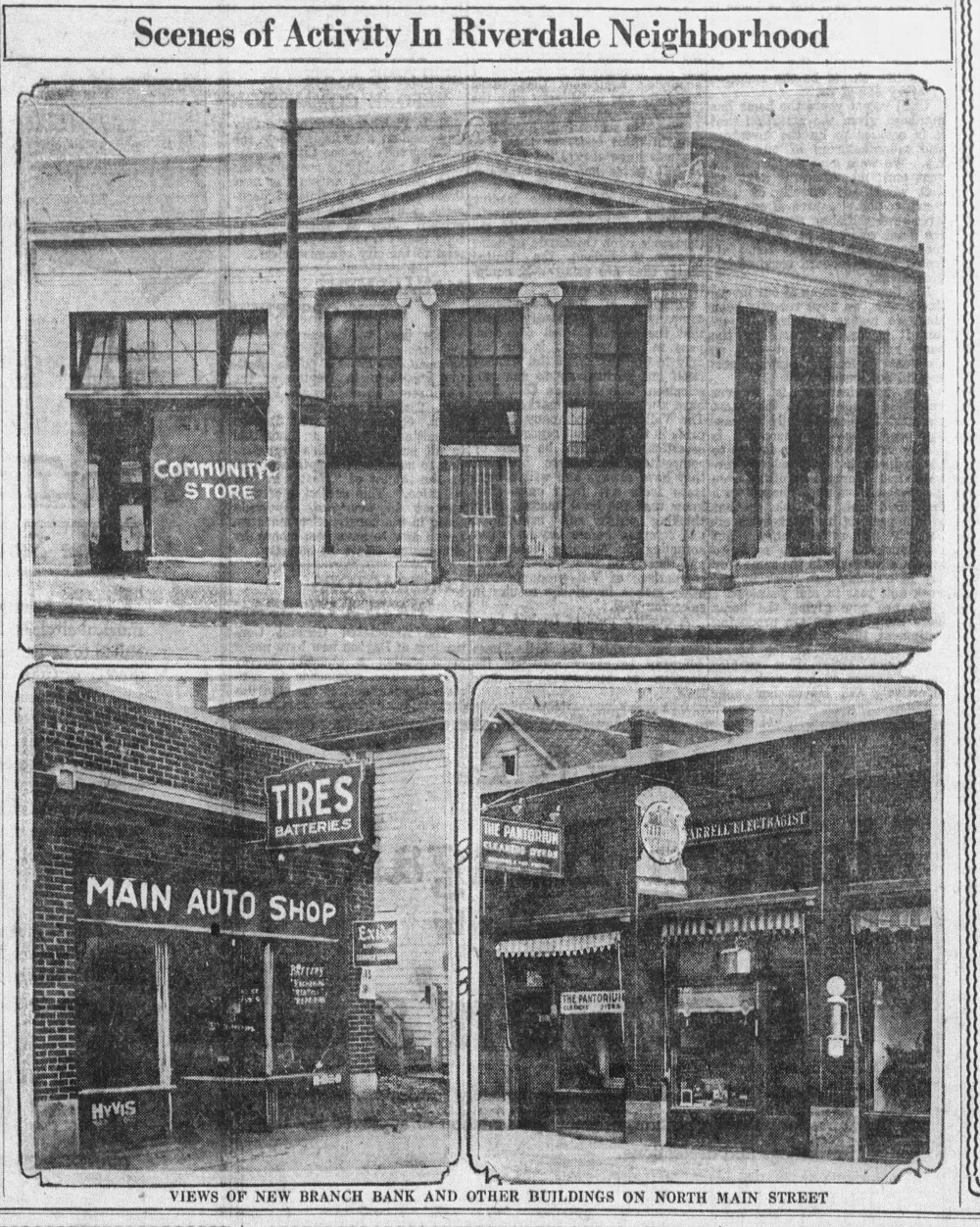
In 1925 the Dayton Savings and Trust Co built its new Riverdale Branch bank at 1919 North Main. According to The Dayton Herald, the bank was “feeling that the growth of this section warranted the installation of such a convenience.”
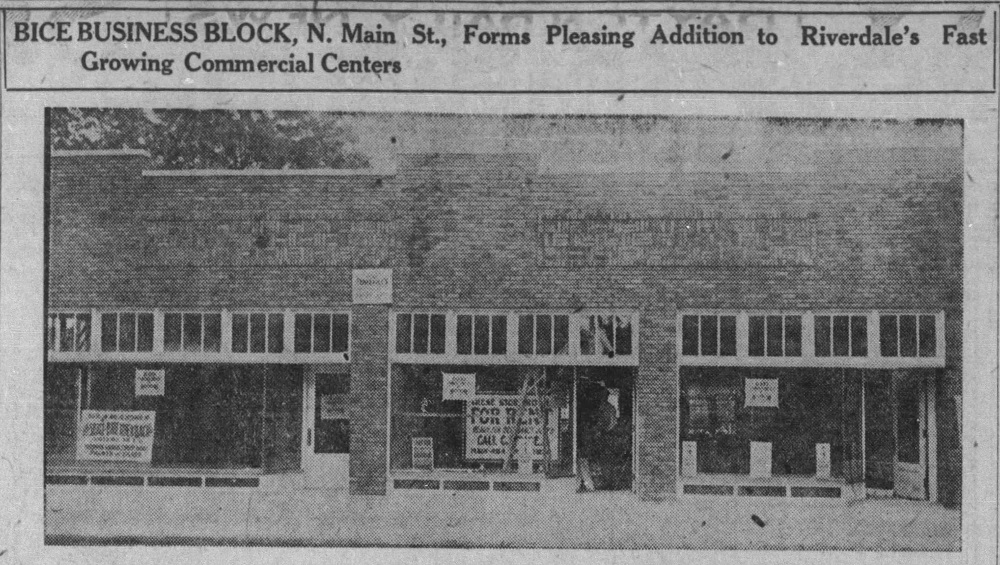
The following year (1926), the Bice Building was built just across the street from the bank, with the brick work was done by William Webbert, noted brick contractor (a William Webbert building also stands on West Third in Wright-Dunbar).
C. E. Bice constructed it to lease out to retail tenants, and he landed a big one in 1928 when a Reed-Klopp furniture store run by C. S. Noss moved in to sell its high-quality wares. Today the Steps Creative Center occupies part of the structure.
The Smith Building and Riverdale Theater
At the same time, the district’s landmark building was also under construction.
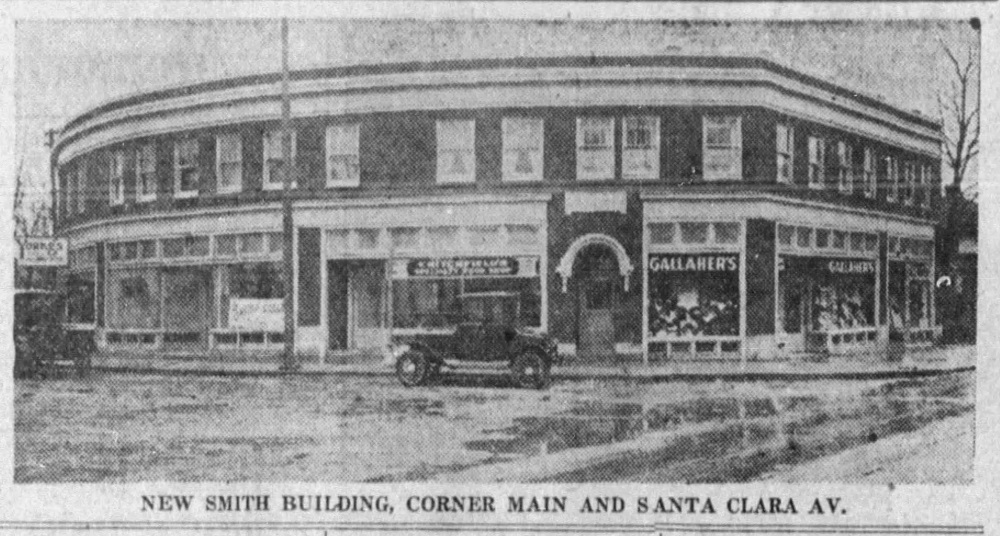
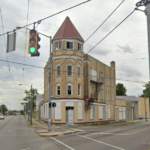
The Smith Building (1926) is a two-story art deco brick structure that nicely wraps around its corner of Main and Santa Clara and offers five storerooms and apartments above.
Leslie L. Smith, a local real estate broker, began investing in the neighborhood by constructing the single-story commercial structure at the NE corner of Main and Ridge Ave.
Smith’s ambitions grew after observing that Dayton’s growth was naturally expanding northward. “People residing in that neighborhood will have every advantage of community life,” Smith said at the time, and a wide variety of retail tenants quickly moved in to his new building.
At the time the Smith Building was the most ambitious structure in the district, but another major building would begin construction right next door the following year.
The Federation Realty Company started work on a large, two-story building which would add entertainment to the Riverdale scene, similar to a project it had just done on Xenia Ave. The brick work, stone setting and terra cotta on the structure were done by Carl J. Davis and the building as a whole cost $200,000.
The mixed-use structure included the Riverdale Theater, which seated 1,000 and featured a Page organ, as well as a recreation center including a bowling alley with eight Brunswick lanes and six billiard and pocket tables. Other storefronts were occupied by a shoe dealer, a barber shop, confectioner, and delicatessen.
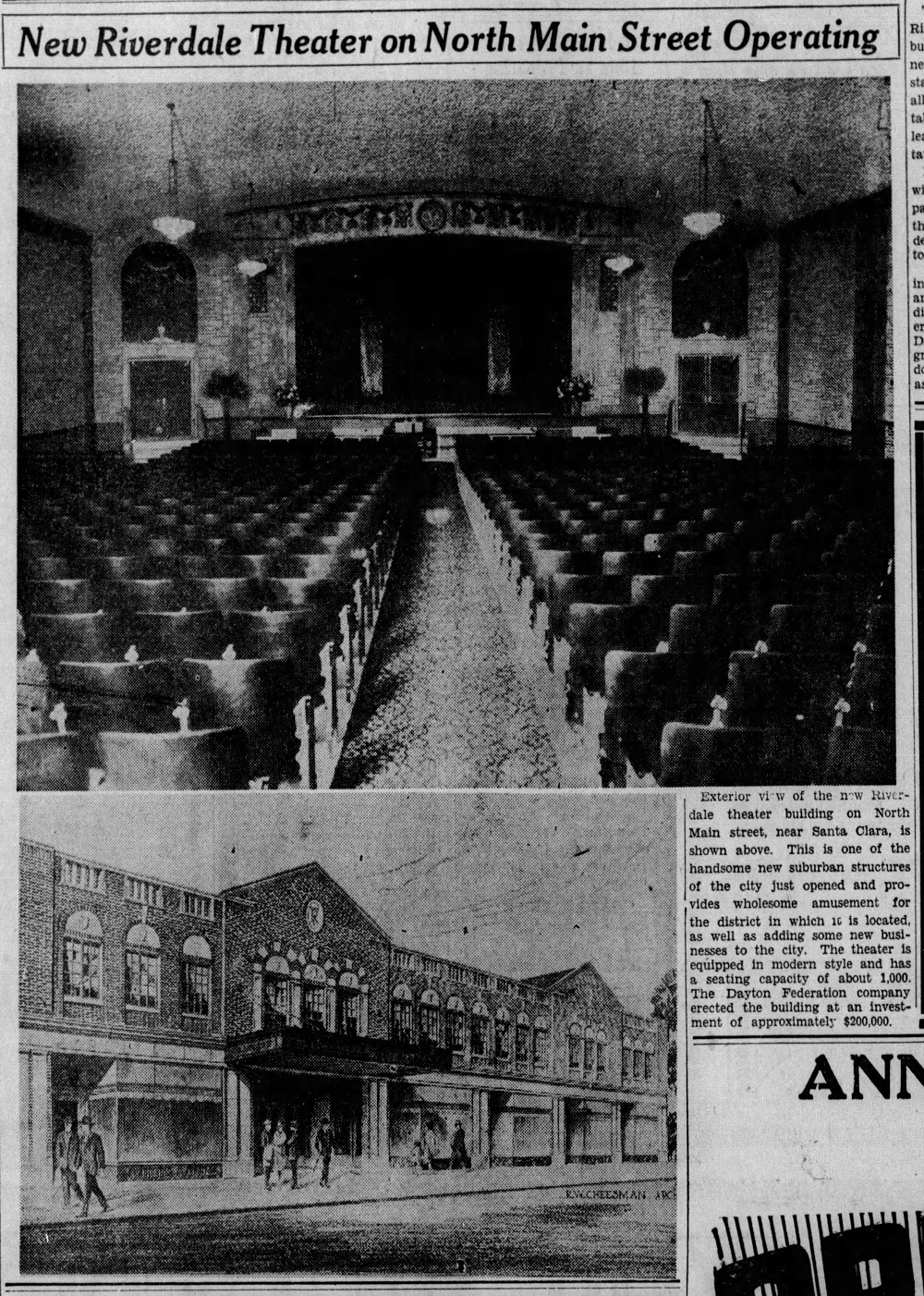
The new building was called an asset “not alone to Riverdale, but to Dayton as a whole, for as the city grows in its component parts so does it expand and become greater as a whole.”
(I believe this sentiment still to be true, only now Dayton needs to work hard to save its “component parts” like this strip before it becomes nothing but a memory.)
Another prominent Daytonian involved with the development of the Santa Clara Business District was Jacob D. Moskowitz, who earlier in life was the founder of the Kossuth Colony for Hungarian workers in Old North Dayton. He bought several lots in the 1900 block of North Main in the 1920s before they had been improved.
The Riverdale bank did not survive the Great Depression, but the building was remodeled into a Liberal Super Market in 1937.
Shopping, Entertainment, and the “Santa Clara Arts District”
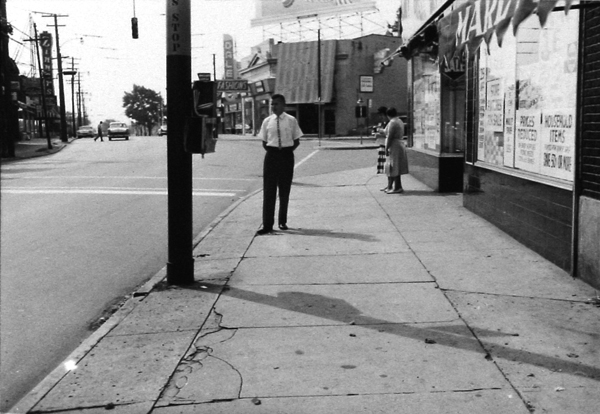
The Santa Clara Business District was a thriving area for shopping and entertainment in the 1950s.
This 1959 image looks south toward the Dale Fashions dress shop.
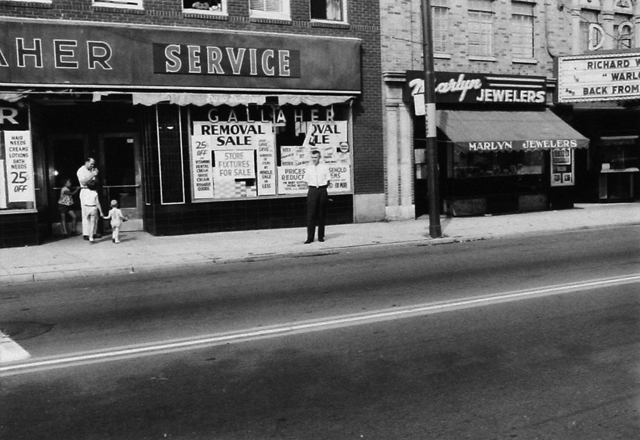
The Riverdale Theater, later the Dale Theater, was located at 1937 N Main St and opened in 1927. It closed its doors in 1959, the very year the below photo was taken which also depicts Marlyn Jewelers and Gallagher’s Drug Store:
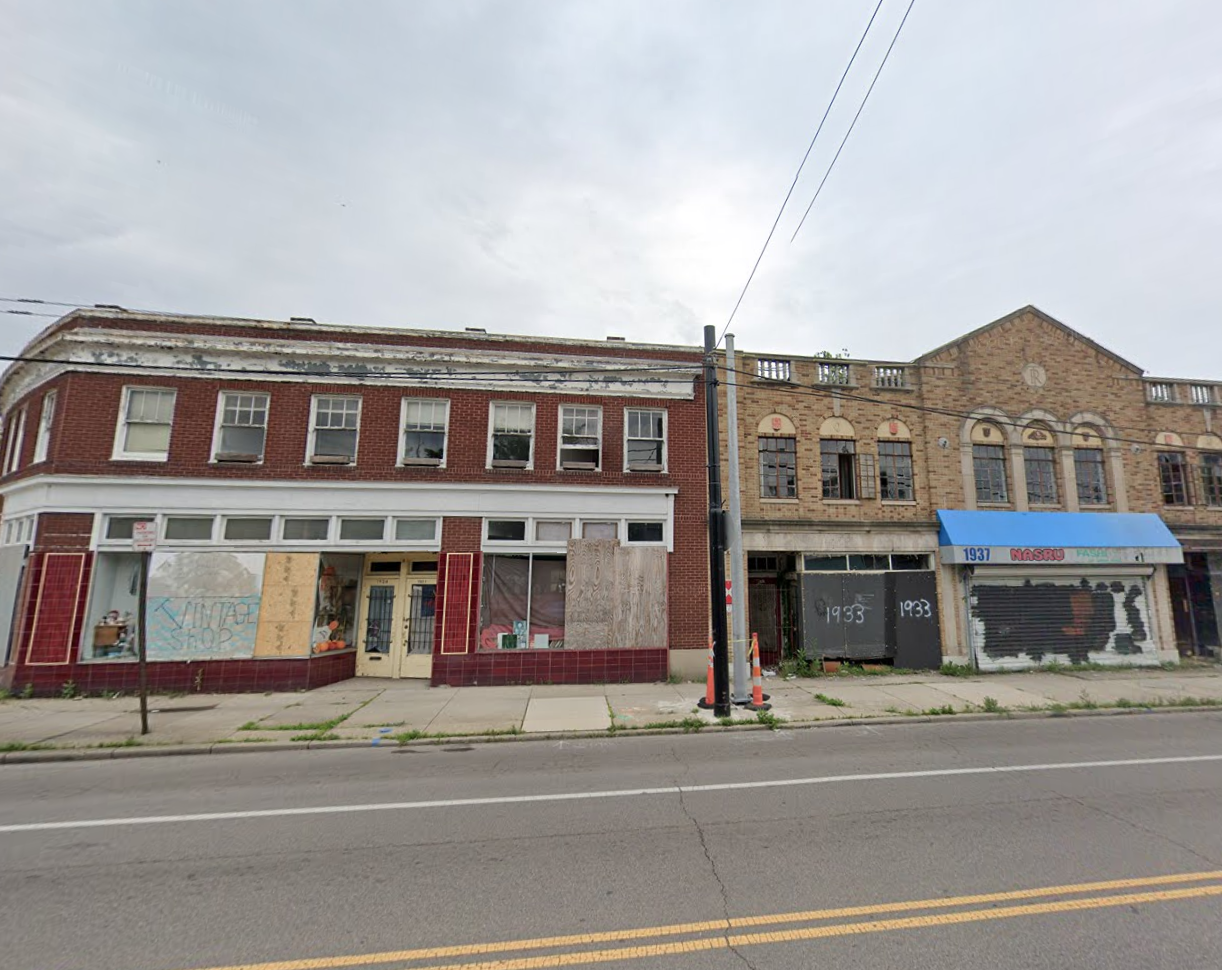
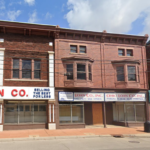
A 2019 shot of the same buildings.
The area suffered from neglect in the latter decades of the 20th century, but as recently as the 1990s this strip was known as the “Santa Clara Arts District” and lined with galleries and eateries including Milano’s and one of the district’s longest-serving businesses, the Upper Krust deli.
The Upper Krust was a longtime neighborhood mainstay (at the location of the former supermarket, 1919 N Main), known for its “Tom Turkey sandwich (and) the choice of beets, chips or apple sauce.”
Omega Music was located in the Smith Building, and in the late 1990s moved to a different storefront across North Main still in Santa Clara for a short time.
Although Santa Clara had suffered from divestment and vacancy for decades, the city designated the area a “Town Center” in the early 90s which opened up city resources to help spur development, the same strategy that propped up the Oregon District.
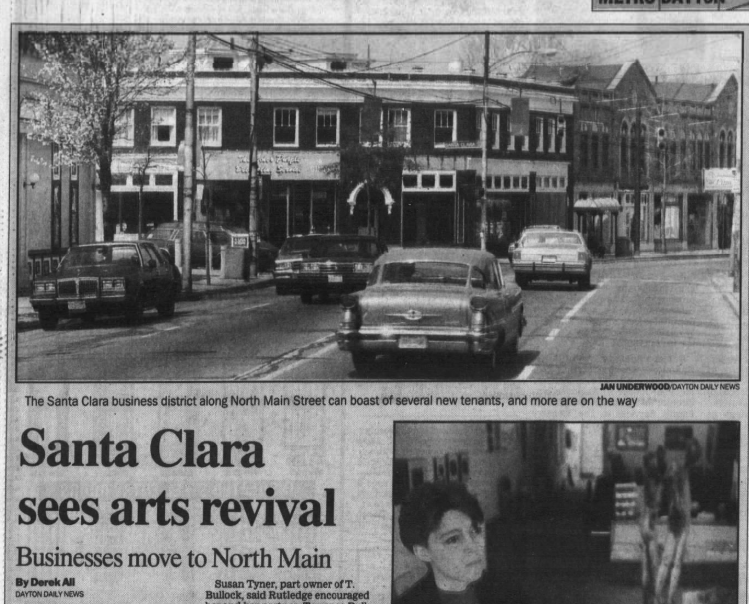
A 1992 Dayton Daily News article about the district at that time. You can also read a 2009 profile of Omega Music when it was still located in Santa Clara
Decline and Vacancy in the Late 20th Century
But despite gaining momentum at times, the “Town Center” plan ultimately didn’t work and most businesses eventually fled.
Some relocated to other parts of the city, like Omega Music. More recently nearly all of the buildings were vacant and deteriorating with the district’s future looking grim.
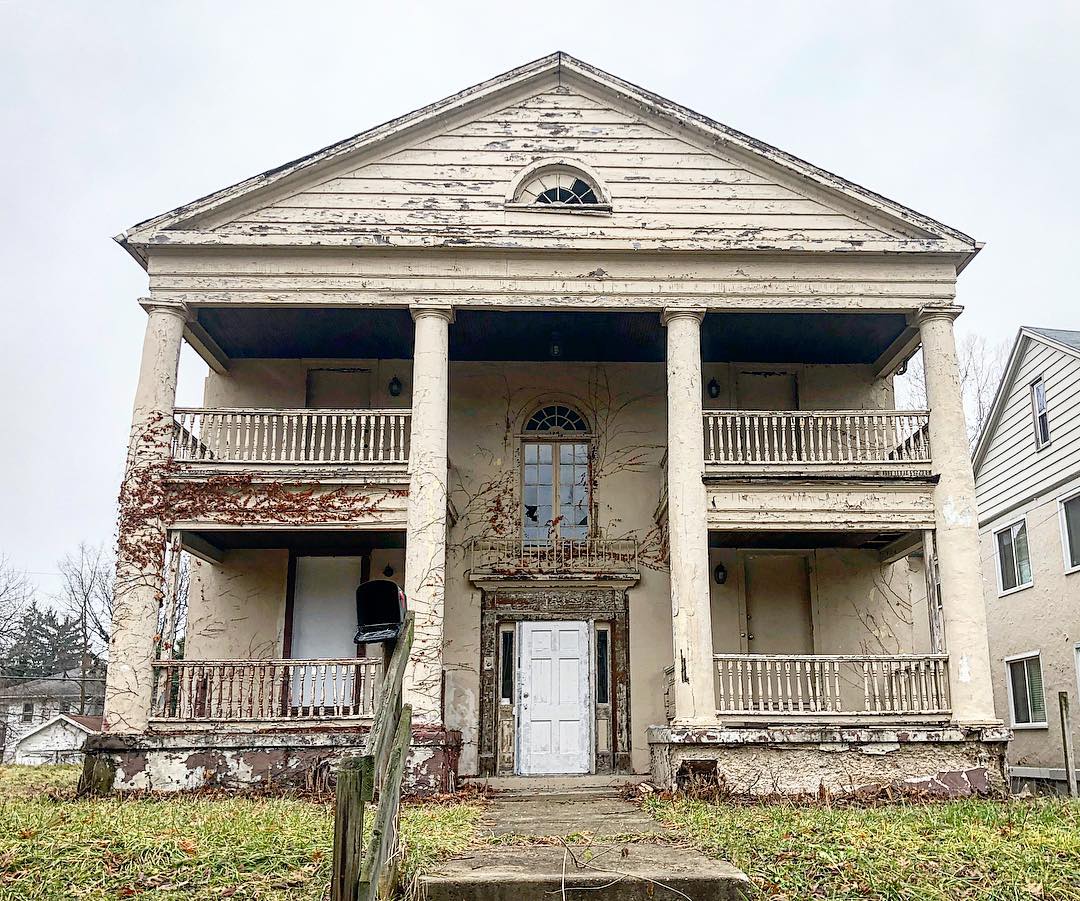
The surrounding residential area also suffers from high levels of vacancy but has many remaining gems including the house at 153 Santa Clara Ave which was reported to be under renovation when we wrote about it last year.
The Santa Clara Juicery opened in 2018 to give new hope to the area, but later closed. Some establishments continue, such as the Sugar’s Lounge bar.
As of 1919 there was a developer interested in restoring the Smith Building, but the article also revealed that the former Riverdale Theater building is scheduled for demolition. The developer said that “he would buy that building, too, with a little help from Dayton government.” Soon after Dayton At Work and Play reported that a stop work order was visible on the building.
There have been other efforts to address the area’s challenges in addition to the work of the neighborhood organization. In 2018, a North Main Street Corridor Plan was adopted by the City Plan Board and City Commission, which focuses on several strategic priorities including Traffic and Pedestrian Safety and Architecture and Preservation. A few years later a major road reconfiguration was completed on North Main with an attempt to increase safety for neighborhood residents.
Santa Clara was called “ground zero of Ohio’s foreclosure crisis” and “one of the 10 most abandoned areas in the country,” so initiatives such as the National Register nomination and placemaking efforts aim to restore a basic level of neighborhood amenities and service to a community that has been neglected for too long.
I hope everything gets saved. What a vital area this was only a short time ago, with no fewer than three popular restaurants (Upper Krust, Joe Bissett’s, and the Brown Derby). Further back in time this was a big shopping district. Naturally it would be folly to let the theater go. When will they ever learn that’s not just about cash?
The Santa Clara District is very heartbreaking. It’s one of my favorite memories when I was working at Omega Music in the mid-90s, getting lunch at Milano’s or the Upper Crust, and enjoying music at the awesome Ethiopian cafe Club Safari. The Color Purple sold unique art and the Dayton Voice newspaper operated upstairs. Many bands such as Brainiac, Salvador Deli, and the Kommandoz OGC practiced and performed weekly. The regulars were very colorful from artists, vagrants, business folk, and hippies all in the same area. It was the arts district as Jeff Rutledge of the Rutledge Gallery had envisioned! Shame the city turned its back on it letting it turn into the destroyed center it is today!
https://www.mostmetro.com/entertainment/street-level-art/santa-clara-orphaned-arts-district-dayton.html
I just spoke with my cousin, Eddie Takacs about his dad’s meat market that was located on the Santa Clara Street side of the wraparound building. My uncle (Donald Takacs) used to have a store located there. It was called The Dale Meat Market. Eddie remembers it as being on the far left side of the wrap around building, and a TV repair place and a peanut shop also being next door. I’m not sure which storefront it was…unfortunately, Eddie doesn’t have any photos of it. I have no idea what year that was…most likely back in the 1950s or maybe early 1960s?
Just thought I would pass that along to everyone. I would love to find a photo of it…I’m working on my family’s geneology.
hi,
My Great Aunts and Uncles owned the store in Dayton Ohio, DALE Fashions, Does anyone remember this or have any pictures? I’m an Artist living in NYC, currently working on my Memoir, I would be so happy to get some info.
best, Shelly
Shelly,
In 1964 I bought a gift for a friend, Jaynie Schiller, at Dale Fashions. I was working as a carry out boy at Shiloh Market on Main at Shiloh Springs, owned by Neil and Sophie Frank. Dale Fashions was a high end women’s clothing store and the gift I bought took most all the money I had. She went to Fairview or the new Meadowdale as I remember.
The Tropics and The Brown Derby restaurants were nearby.
What was the family name of the owners?
Dan
We have repeatedly asked the city to get rid of this delapadated eye sore the roof on the second building has collapsed on itself, we are tired of living in a slummy looking neighborhood , because big time city planners holler historical crap. Nothing has been done and we pay our taxes just like everyone else. The city of dayton has allowed all of North Main street to turn into the biggest slum in the city… TARE IT DOWN !!
U don t remember any of these things. I grew up onthe corner of west hidson and weatley in the 60’s. I remember marrions restaurant at the corner of w. Hudson and b. Main. There was a bar next to marions, it was very dark inside. There was a beauty shop in the corner. I was in love with a girl who lived upstairs. Didn’t know about a theatre there. That would have been very interesting. Across the street was judy’s toy store. There wasa small cassano’s pizza king next to a United dairy farmers store. Of course there was a large liberal market a little south on main was koslers pharmacy. It was pcked with merchandise. It had atube testing machine i used to test a wide variety of tubes. Carrigan’s funeralhome was a beautul house
Next to a sohio station.
The first7-11 i remember wasin this area
Had my first slurpee there. Thecity transit has stops for 7- ewalt and 7-main(shiloh too.