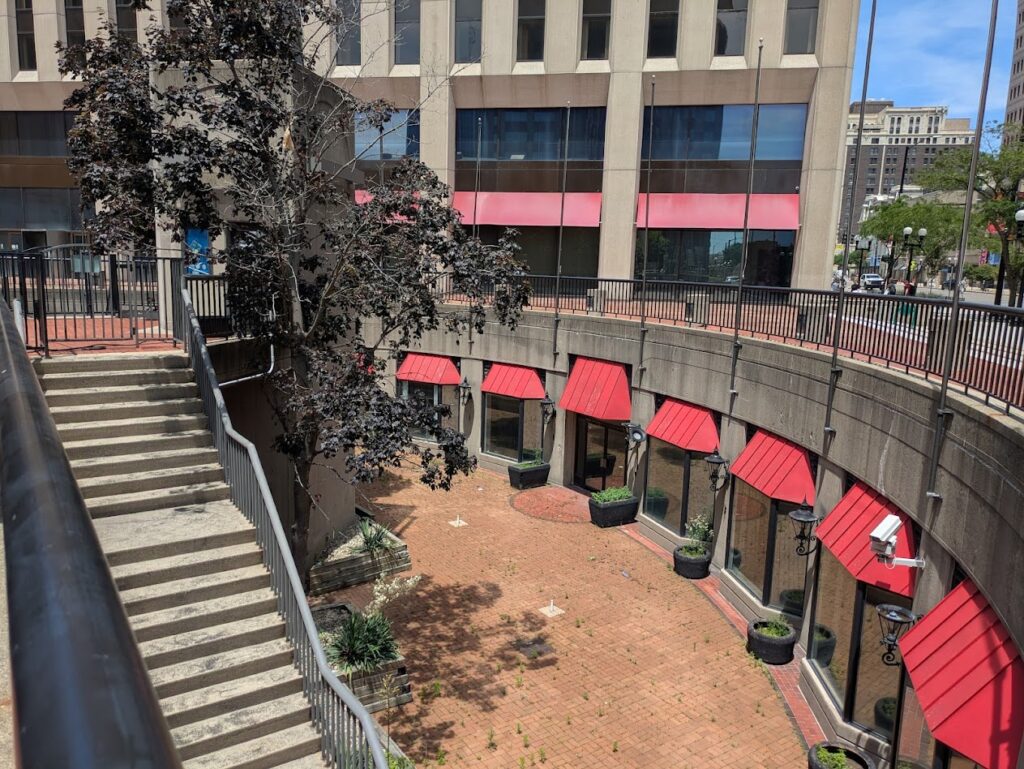
On Courthouse Square in the center of downtown Dayton, there is a very unusual space that is easy to miss.
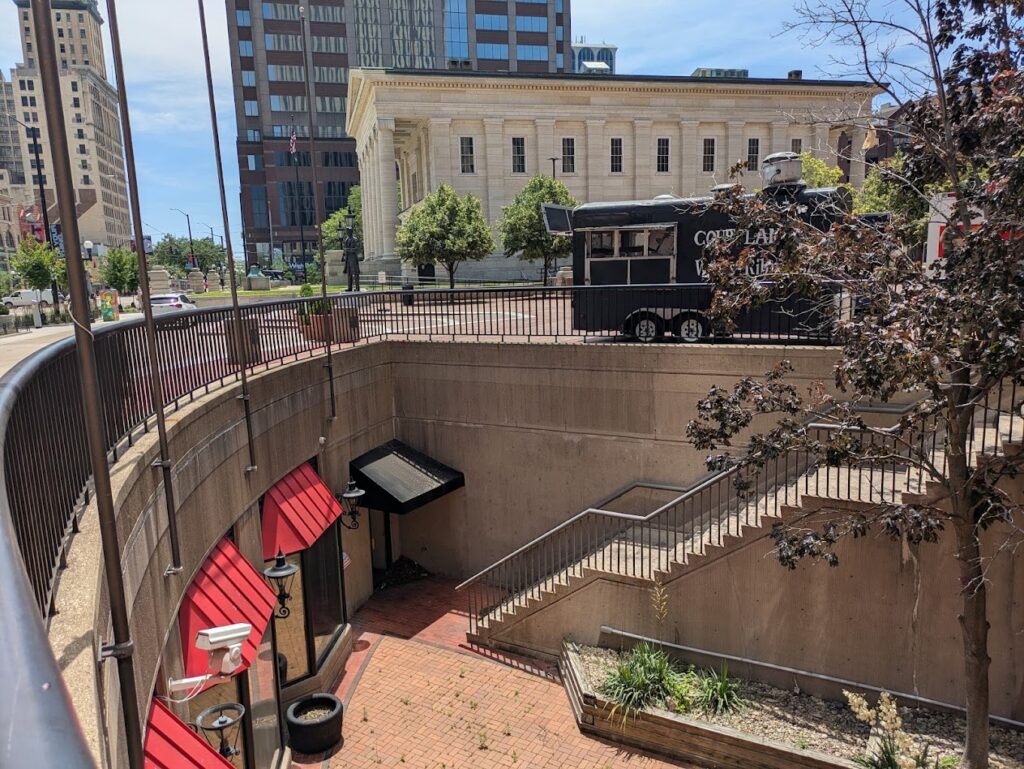
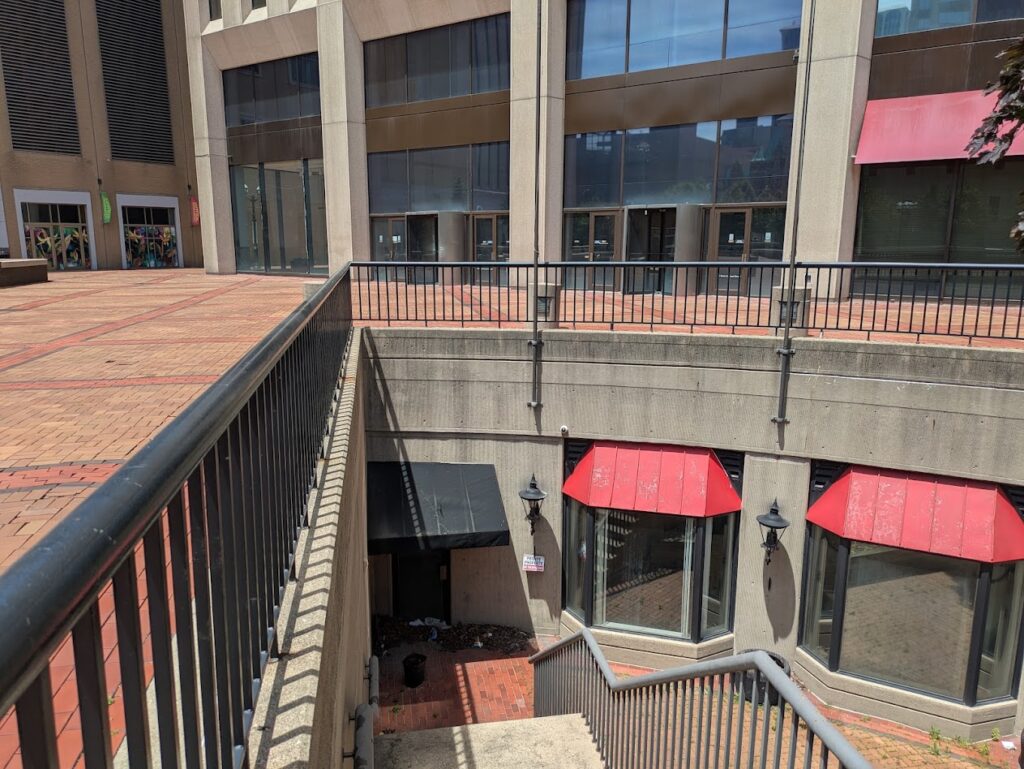
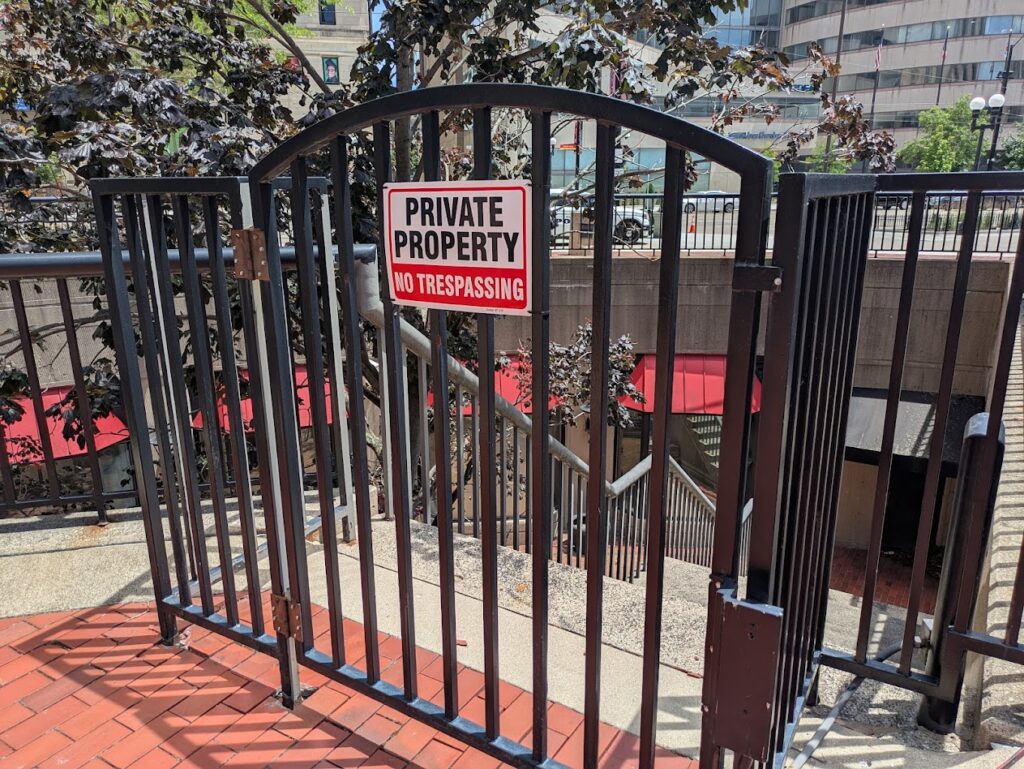
A staircase descends below street level into a sunken courtyard lined with vacant storefronts and red awnings. Unless you already know to look for it, you could walk past without a second glance.
But for years during the 1980s and 90s, that space was home to a series of restaurants that drew a loyal following from the downtown crowd, and left a surprisingly deep impression on the people who worked and dined there.
I shared a photo of the space recently on my Dayton Vistas Facebook page, and the response was much more than I ever would’ve expected.
Dozens of people came forward with memories: former employees, regulars who remembered specific dishes, and people who had marked significant moments in their lives in these rooms.
Taken together, those comments paint a vivid picture of what the space once was, and also why it has proven so difficult to sustain anything there since.
Jacques and Sherlock’s Home
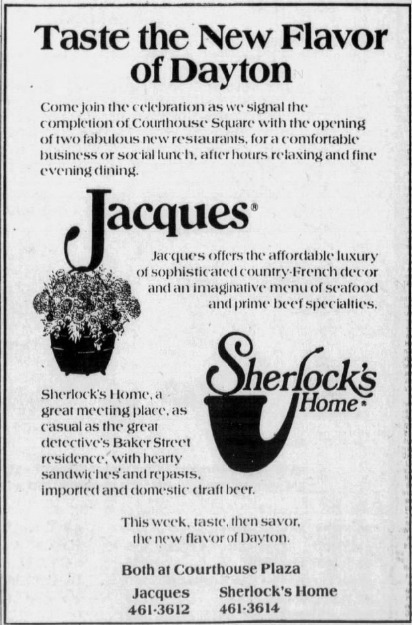
The twin restaurants that opened here in 1979 were Jacques, an upscale French-inspired dining room, and Sherlock’s Home, a British-themed pub.
Both occupied the basement level of Courthouse Square, a development I covered in depth in my earlier articles on the square’s history.
Jacques was operated by Canteen Corp. of Chicago and could accommodate up to 191 patrons for lunch and dinner.
The chef was Alfred Asti, an Austrian-born culinary professional who had trained at the Hotel Grüner Baum in Bad Gastien and served as master of kitchens in resort hotels at Squaw Valley and Aspen.
He brought an ambitious menu featuring dishes like oysters Rockefeller, sole meunière, mushrooms forestière, and a wide selection of entrées prepared in the French tradition.
One review goes into detail on the menu offerings and even their prices at the time:
Veal Viennoise ($9.50) turned out to be a well-executed Wienerschnitzel, lightly crusted and tender. Another veal dish, sauteed veal steak Jacques ($13.85), was even better. Nicely sauced and including, oddly but successfully, scallops. Steak au Poivre ($8.75) was excellent beef with a rich wine sauce. Sauteed Tournedos Henri IV ($13.50) was equally good beef, done with artichoke hearts and Bearnaise … For dessert we indulged ourselves in strawberries Romanoff ($2.25), creme caramel chantilly ($1.50), Souffle glace Grand Marnier (frozen orange souffle at $2.25) and Black Forest cake ($1.85).
For special occasions, Jacques offered “Extraordinary Evenings” — a fixed menu at $32 per person, with wine, tax, and tip easily bringing the tab for two to $100. A strolling violinist and guitarist accompanied the meal, and the food, by nearly every account, was genuinely excellent.
Dayton Vistas Follower David Dreety recalled it as “an excellent fine dining restaurant” in the early 1980s, where he and colleagues would occasionally hold wine industry dinners and where he remembered buying his first bottle of Château Pétrus off an “estimable wine list.” Terry MacPherson remembered lunches at Jacques and Friday happy hours at Sherlock’s, and the “Affair on the Square” outdoor events that packed the plaza on summer afternoons. Diana McFarland Molchan remembered the night her husband proposed to her at Jacques, on February 16, 1988. Crystal Pepsie Johnson went there before prom in 1987. Camille Choate remembered the Beef Wellington specifically, and Sandra Haubach Jacques recalled a pasta dish with artichokes and shrimp.
Sherlock’s Home, meanwhile, drew its own crowd. An English-style pub with a limited menu, it was described at the time as moderately priced and equipped to serve around 100 diners. One article also shared that Sherlock’s Home patrons were “able to have their own clay pipe provided by the restaurant and kept by number on a large pipe rack over the back bar.”
Follower Deb K Carver described it as a beautiful and elegant place for after-work cocktails on Friday nights, and Rick Busch, who worked at both restaurants, remembered summer shifts on the patio for Affair on the Square. The square’s host, Jack Marti, was something of a personality unto himself, a news article noted that diners at Jacques could “poke your head in neighboring Sherlock’s and have a yak with crazy Jack Marti, greeting guests in his deerstalker hat.”
The interior of both restaurants was decorated with “oak tongue and groove paneled wainscotting” and “polished brass chandeliers and lamps imported from England.”
The restaurants also inspired genuine loyalty among their employees. On the Facebook post, Amy Bear recalled giving three years of her life to the restaurant and being among the first hired. Johnny Glaze was part of the original group opening Jacques as a busboy. “It was fancy and well built,” he said.
The First Closure and What Came After
Jacques and Sherlock’s Home closed suddenly on a Friday in March 1982.
Employees were told near the end of the lunch service, given two weeks’ severance, and found the doors locked by that afternoon.
A bartender at Sherlock’s told the paper there had been rumors of a closure for some time: “People were always starting rumors that the restaurant would close, and they would prove not to be true.”
He said the dinner crowd had thinned and reservations had stopped coming in. One employee noted she should have suspected something when the chef quietly moved his family to Florida the week before.
Benham’s Caterers of Dayton took over the lease, with plans to reopen on July 1 under new management, rebranded with an American-style menu in place of the continental approach Jacques had featured.
It eventually became twin restaurants again, The Courtyard (in the Jacques space) and Langtree’s, but they closed on January 17, 1991.
After that, Charley’s Restaurant, which had been the premier dining location across Third Street at the Arcade, moved into the space later in the year after the Arcade shut its doors and evicted its tenants in March 1991.
Charley’s closed its Courthouse Square location permanently after a New Year’s Celebration in 1998.
Why the Restaurants Never Flourished
Although diners raved about the quality of the food, especially at Jacques, a fundamental problem was built into the design before the first table was ever set.
When Jacques was originally being planned, the developers hoped to cover the sunken plaza with a large glass dome, similar to the original Jacques restaurant in Chicago, which was described as a garden restaurant under glass. The dome would have brought natural light into the space and made it a visible and distinctive destination from street level. It was initially deemed too expensive, and though the developer later said “it’s 99 percent we’re going to have the dome,” final arrangements were not made and it was never built.
The underground space that resulted had windows overlooking a bricked courtyard with modest shrubs, accessible by a staircase or a “tiny elevator, both intimidating to some,” as one review described it.
Out of sight meant out of mind.
Erica Knapp Hubler, who took inventory after the last restaurant closed, put it directly: “No street presence and no signage. If all the Mead employees didn’t eat there it wouldn’t survive.”
R-Corp., a wholly-owned Mead subsidiary, was the landlord for the underground spaces, and Mead had agreed to guarantee the financing when Courthouse Square was originally planned. The restaurants were dependent from the start on the downtown office population that Mead itself helped anchor.
The broader downtown story was working against them too.
Longtime Dayton Daily News reporter Tom Beyerlein commented that downtown seemed on the cusp of a real renaissance in those years, but a large exodus of downtown workers followed in the late 1980s and 1990s. The lunch crowds that had sustained the restaurants thinned as major office tenants consolidated or relocated.
When Mead ultimately decided to stop subsidizing the operations, citing “substantial” losses, the venture was finished.
Follower Bob Hanseman framed the core problem plainly: “Whose bright idea was it to create restaurant space below ground-level where it wouldn’t be seen by anybody unless they were already there?”
What Could Come Next Under the Square?
The space hasn’t been forgotten. The comments on my post were full of ideas for how it could be reborn: a speakeasy, a bar with a 1980s arcade theme, an ice cream shop one commenter wanted to call “Hidden Gem.”
Several people drew a direct comparison to the Dayton Arcade: if that building could be revived after decades of vacancy, why not this one?
Visibility, logistics, parking, and the need for a stronger residential and foot-traffic base are the same challenges they have always been. But downtown Dayton is in a different position than it was in the 1990s, with residential conversions adding permanent residents to the core and new activity returning to key corridors.
It is a different frame than the one planners had in 1979, but the space is still there, its red awnings intact, waiting for someone to figure out what comes next.
For more on the broader history of Courthouse Square and its future prospects, see my earlier article on the square’s history and my follow-up piece on its challenges and possibilities.
Sources
“2 Restaurants Open Wednesday.” Dayton Daily News, 2/27/1979.
Bohman, Jim. “Underground Restaurants in Courthouse Square to Close.” Dayton Daily News, 1/16/1991.
Folkerth, Sandy. “Jacques Lacks Both Atmosphere and View, but Fine Menu Makes Faults Seem Trivial.” Dayton Daily News, 26 April 1981, p. 3-D.
“Jacques’ Chef Got in on the Ground Floor.” Journal Herald, 2/7/1979.
“Jacques Restaurant, Sherlock’s Home Shut.” Dayton Daily News, 3/27/1982.
Riesz, Charles. “Jacques to provide competition” Dayton Daily News, 3/29/1979.

Leave a Reply