
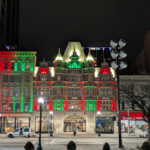
The brand-new Hilton Garden Inn is now open at the Dayton Arcade. It features 93 rooms as well as a 2nd floor bar and restaurant open to the public which overlooks Courthouse Square and the North Arcade retail marketplace.
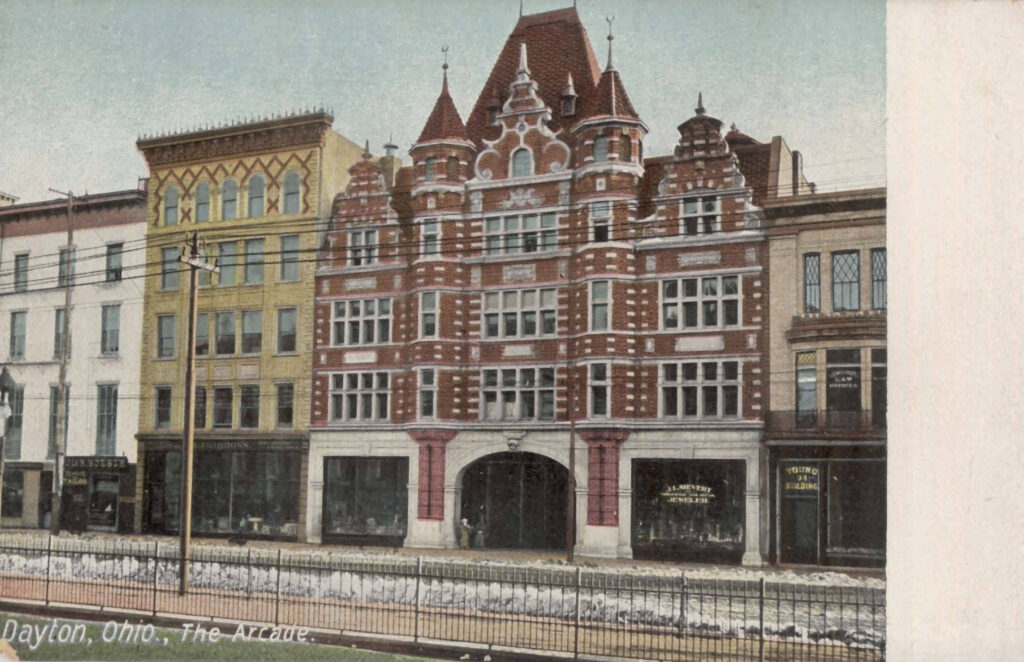
The hotel occupies two buildings, the Third Street Building and Gibbons Annex, both of which date back to the opening of the Arcade complex in 1904 and have some surprising history hidden behind their facades.
The Renaissance Revival-style Gibbons Building (or Gibbons Annex) at 18-22 W Third St appears not to have been built from scratch along with the Arcade from 1902-04, as is commonly believed, but rather was an expansion of an existing two-story building dating back to at least the 1880s.
Uncovering the history of the Gibbons Building/Annex is a difficult proposition due to the fact that multiple buildings have shared the name over the years.
There was a “Gibbons Building” on 2nd Street before the Arcade, and much later the building at the SW corner of 3rd and Main was also called the Gibbons Building (or Gibbons Realty Building). The hotel at 3rd and Ludlow was once the Gibbons Hotel, which even leased the adjacent Schwind Building and called that the “Gibbons Annex.”
Plus, the Third Street Building itself has also historically been referred to as the Gibbons Building or (Gibbons Arcade).
But this part becomes more understandable when you take a closer look at the original ownership structure of the Arcade venture, as well as a glimpse behind the iconic Flemish facade you see out on Third Street.
The Gibbons name is for Michael J. Gibbons, who operated a plumbing and gas and electrical supply business at 20 and 22 West Third Street in the late 1800s. It is circled on the 1897 map below:

A newspaper article from April 1901 announced a major real estate deal that paved the way for the Arcade to move forward. It included the Sullivan property with 33 feet of frontage on the current site of the Third Street Building, which sold for $26,000. To its east, Gibbons owned 66 feet, and he joined the development and became a stockholder of the Arcade Company.
The main visionary of the Arcade was Eugene Barney of the prominent Barney and Smith Car Company which manufactured railroad cars.
The Third Street portion of the Arcade would be a joint venture between Barney and Gibbons, with each owning half of the Third Street Building, while Gibbons continued to own the annex building which was connected via interior doors to the North Arcade walkway.
Sources from this period reveal the fact that the Gibbons Annex was not a demolition and rebuild, but rather an expansion of where Gibbons had previously been operating his business.
The April 1901 article states that “the present Gibbons building will form a part of (the Arcade), and the entrance will be just west of Mr. Gibbons’ store room … Additional stories will be built to his present storeroom … (and) a handsome front will be constructed to a height of five stories.”
Other articles from the time period state that Gibbons “will build an addition” on his existing building, and “will remodel his store.”
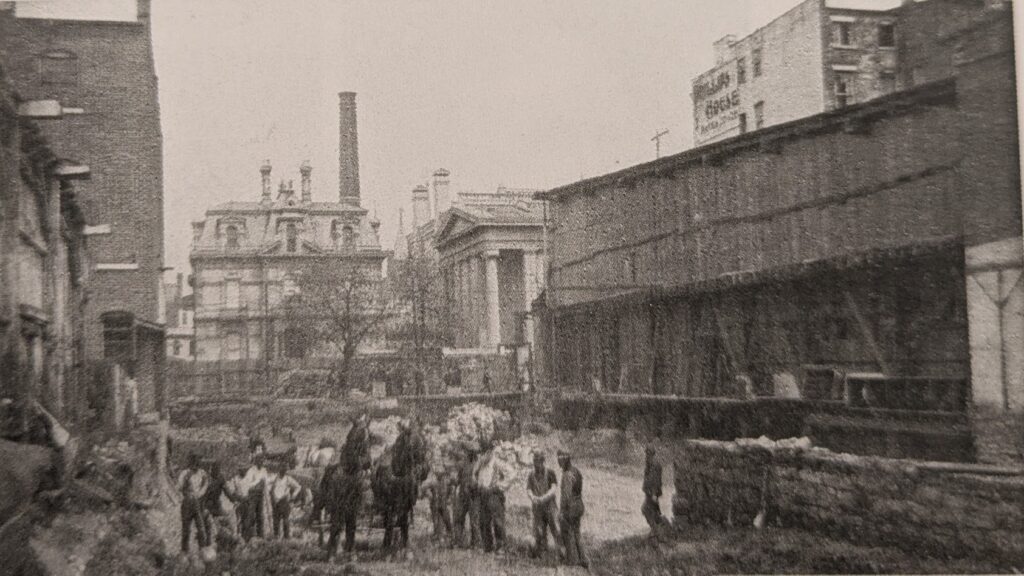
We can even see the building in this rare photograph looking north to 3rd Street from a spot that is today inside the North Arcade. (You can see the back of the Old Courthouse in the background for reference; to its left is the long-demolished old county jail.)
The two story structure on the right side is Gibbons’ Building that was soon expanded for the Arcade.
In this 1887 map (a different orientation from the one above) we can see the two-story Gibbons Building is already constructed at that point, making it at least about as old as the Kuhn’s Building on the 4th Street side of the Arcade, and possibly much older.

In the 1918 map below, you can also see that the Gibbons Annex (labeled 22 and 20 W Third St) is listed as fireproof “above 2nd floor,” meaning that the first two floors still incorporated the original wood-frame Gibbons building from the 1800s.

At this point the Arcade had been open for over a decade, and looking closely we can find some other interesting details.
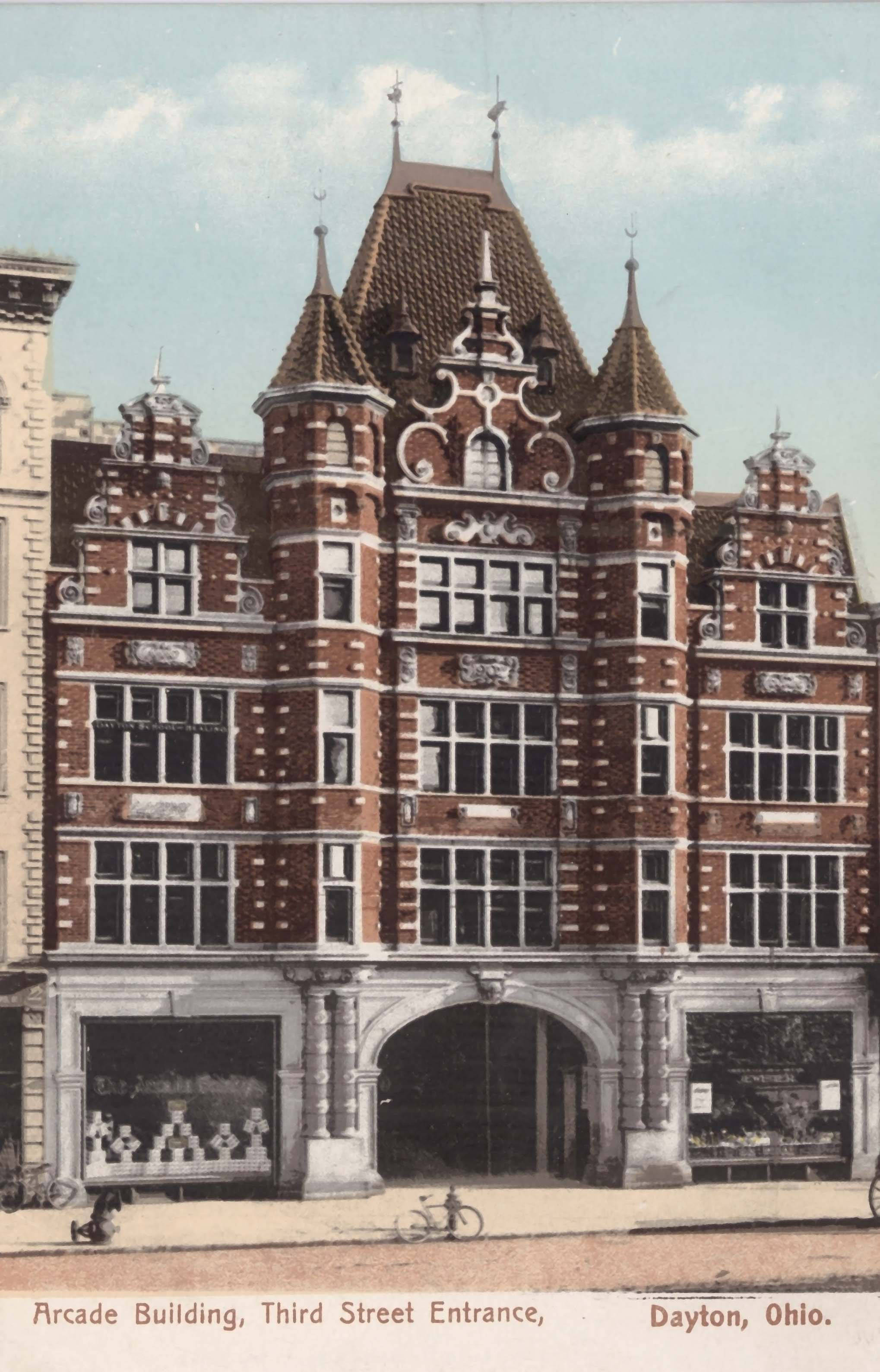
The Third Street Building is also more than meets the eye from the street, although its iconic Flemish Revival facade is one of the most striking in Dayton.
But what looks like a single building from the street is really two buildings, “with two different street addresses and names, two different heights, but joined by a common façade and a shared covered arcade” that is the North Arcade retail marketplace.
In the beginning Barney owned the building on the west side and Gibbons the one on the east and at times these two structures had different names, with the Third Street Arcade referring to Barney’s building on the west (30-32 W Third St) and Gibbons Arcade for the one to the east (24-26).
At other times, including in the 1918 map above, the name Gibbon’s Arcade is used to refer to the whole Third Street Building.
For most of their existence these buildings had apartments on the upper floors, where you’ll find many of the hotel rooms today.
When the Arcade was renovated in the early 1980s, the apartments were originally part of the plan, but they never came to fruition. Several of the complex’s elderly residents had no intention of leaving and remained living on the upper floors while much of the work was being done, before they were finally relocated in 1981.
Historically, the Gibbons Annex building housed restaurants including the Ideal Dairy Lunch and Neal’s Cafeteria. Other tenants included Gene Shaw Jewelers, Kay’s foot health shop, and Red Cross Shoes.
And when the Arcade Centre (today Fifth Third) Tower was being built adjacent to the Arcade, the developers set up an office on the second floor in 1988. The building’s last street-level tenant was Wendell’s Bootery which left in the early 1990s.
And for the hotel today, the Gibbons Annex, previously only five stories on the part fronting Third Street and two stories behind, has been built up to five stories to the same depth as its “Gibbons Arcade” neighbor. Most of the second story of the rear portion had to be removed and the foundation reengineered to support the weight of the additional stories.


It’s fascinating to take a peek behind these facades and see the layers of history present in the Dayton Arcade, and it’s also exciting to see new life and activity inside these buildings that had sat vacant for decades.
Sources:
Aspects of the Dayton Arcade, UrbanOhio
Dayton Daily News and Journal Herald Archives

Hi Andrew – thanks for all you do to bring Dayton’s history to life. I find your articles most informative and helpful! You provide a great service!
Hi Pamela, thanks so much for the kind words!