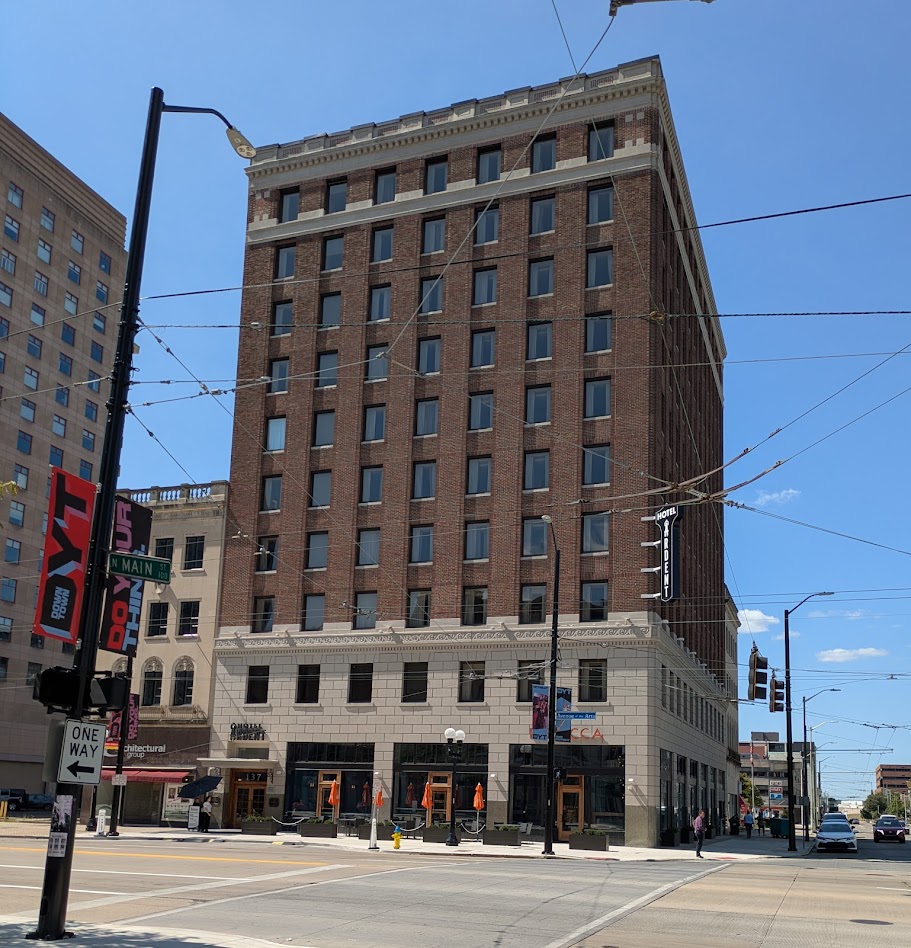
In February 2025, a new boutique hotel became part of the renaissance of Downtown Dayton.
The 118-room Hotel Ardent is located in the historic Barclay Building at Main and First Streets, a site that has a fascinating story involving some big names from Dayton’s past, and a legacy over the decades that largely echoes the trajectory of downtown as a whole.
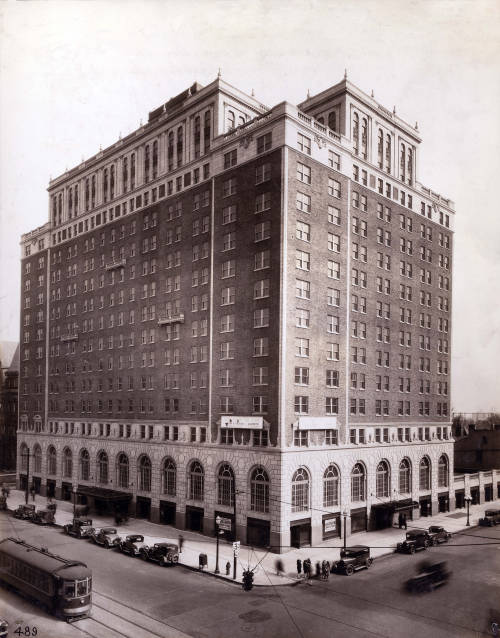
Today it’s called the Barclay Building, but when the 10-story structure was built in 1925-26, it was known as the Harries Building. And the site’s importance in Dayton history begins long before the current building was constructed.
One history states that “the area around First and Main sts. in early days was one of the key centers of the town” and the lot at the SW corner was first platted in 1809 by Daniel Cooper, widely considered the founder of Dayton, and he was its first owner.
The title then passed to David Reed, John Compton, Edward Helfinstine, and Peter Odlin, with the property serving “as the location of homes of pioneers who helped Dayton get its start.”
It was next acquired by Ebenezer Thresher, a Baptist minister and prominent manufacturer who owned the Thresher Paint Co., operated a sawmill business, and co-founded the noted Barney and Smith railroad car company.
He erected a magnificent home at the same corner around 1850, where he lived next door to many of Dayton’s early business and civic leaders who clustered along West First Street.
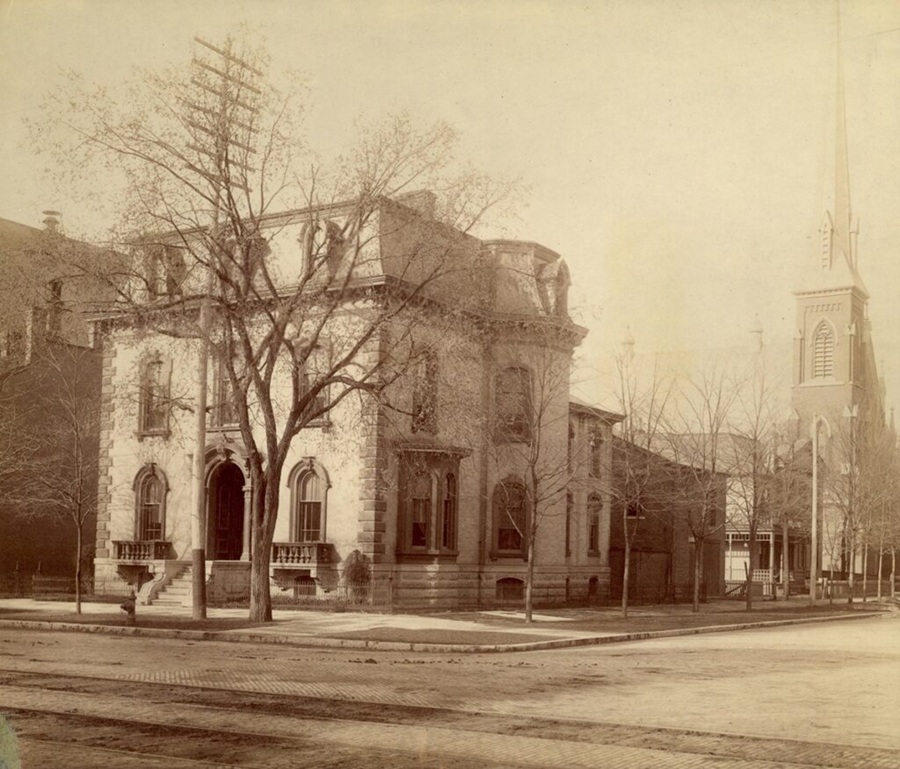
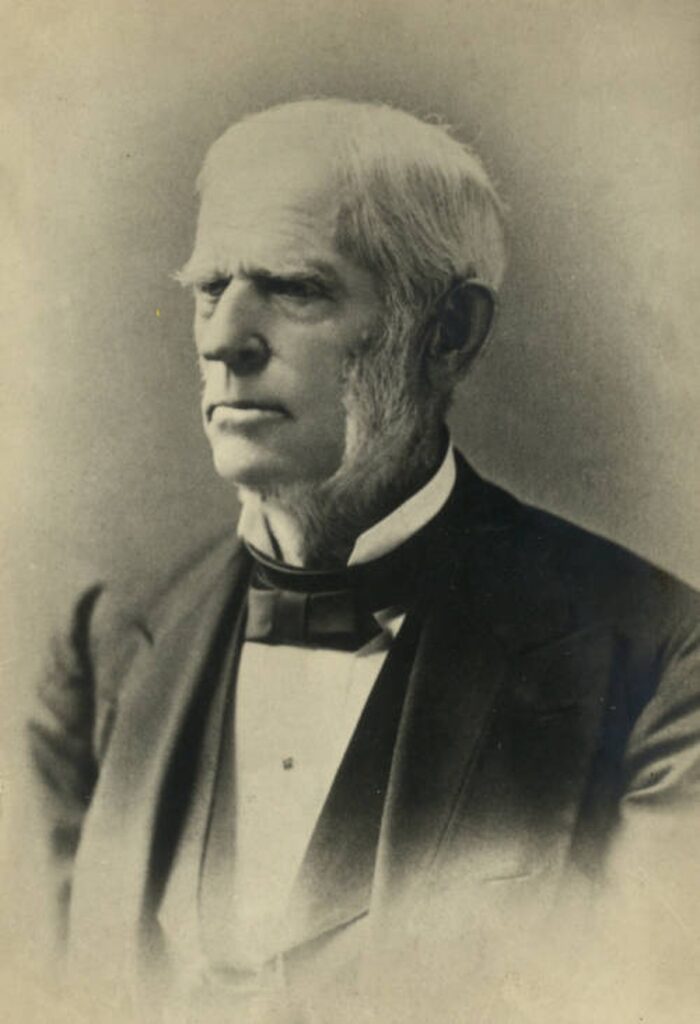
Thresher passed away in 1886 at the age of 87, and in 1893 his estate transferred the property to John Harries, one of the sons of pioneer settler John W. Harries. The elder Harries had operated a brewery on N. Jefferson Street, which was “known far and wide and many of Dayton’s early citizens would gather there daily to collect the news of the town and to imbibe in the beer which Harries had for sale” (Dayton Daily News 1/23/45).
His son John Harries started a sawmill, flour mill, and cotton-yard mill in 1848 east of town on Rt. 4 called Harries Station. Later he built a distillery that was said to be the largest in the county.
In 1894, the Dayton City Club building opened on the site of the old Thresher homestead. One source said that “from then on until 1924 it was the center of social life in the city.”
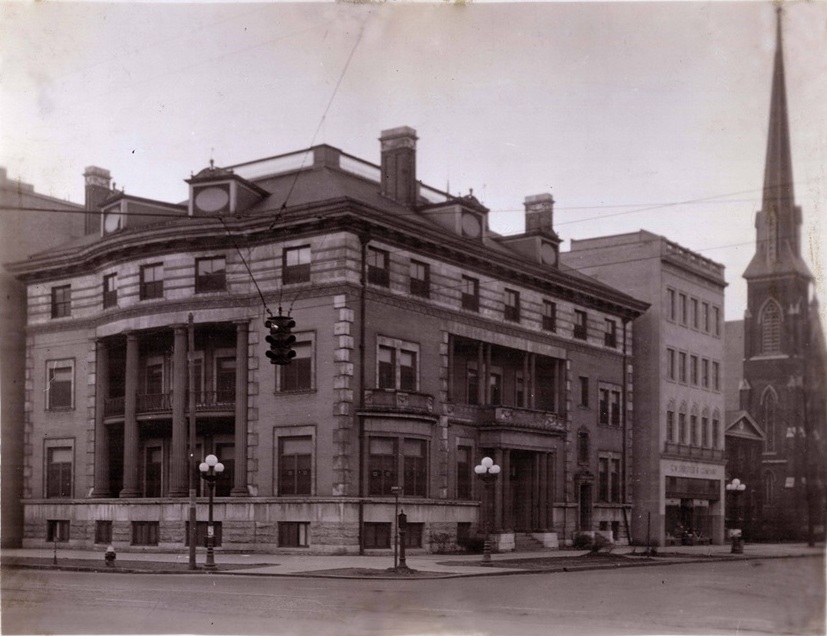
But the club moved to Wilkinson and First (and later inside the Biltmore Hotel) which paved the way for the much larger Harries Building to be built.
One article referred to the modern building as a “monument to the memory of the first Harries pioneer settling in Dayton.”
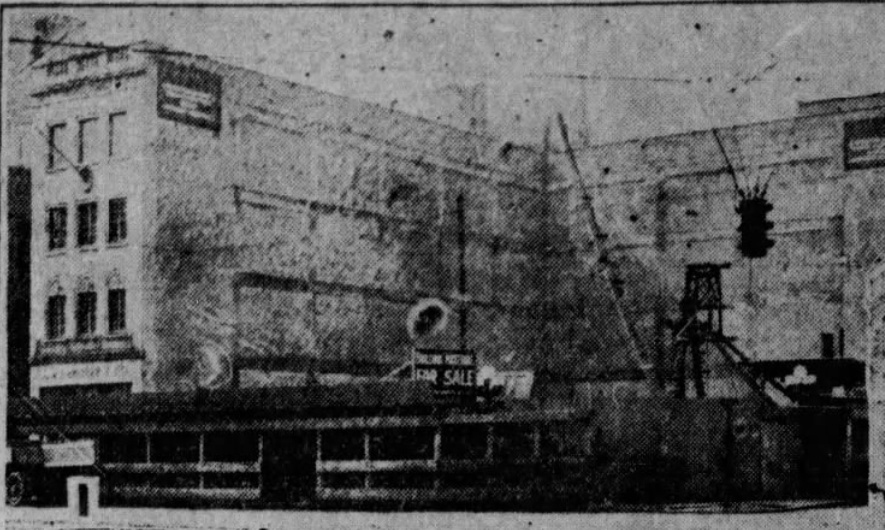
The building’s architect was Frank Hill Smith Inc., but its design was also “based on opinions offered by the Chicago Planning board, a group of building managers from Chicago, Detroit and Cleveland,” who worked with then-owners Howard and E.W. Davies (a daughter of John Harries) on the “floor arrangements and details of finish and equipment” to “produce a building that would be desirable to tenants and also prove a profitable investment” (Dayton Daily News 3/13/25).
The board was described as “getting the fact of building down to an exact science.”
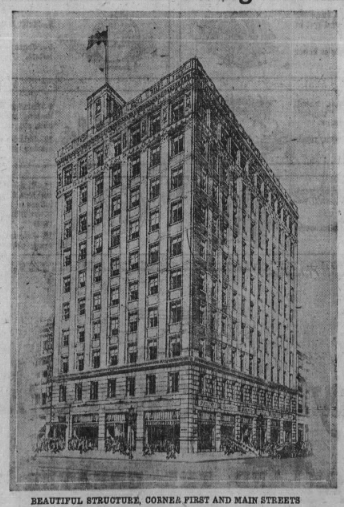
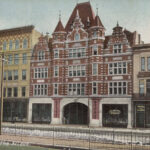
The architecture of the Harries Building has been described as the Second Renaissance Revival style, and the structure is built of reinforced concrete with rusticated stone walls on the first two floors, while the upper floors are faced in brick.
Dentiled cornices (small rectangular blocks that can look like a row of teeth) are found above the first two floors and near the top below a paneled parapet.
There have been multiple exterior alterations over the years, but the “characteristic features of the Renaissance Revival style – the classically composed façade and ornamental elements – remain intact” (Downtown Dayton National Register nomination).
The building also shares both of its side walls with the Walker Building, which forms an L shape around it. Interestingly, that building predates the Harries.
The Harries Building was built right in the middle of the boom years of the 1920s, and it “was among the last of the many high-rise buildings constructed in the style during the early twentieth century, as the Art Deco style of Liberty Tower would soon be more popular, and the depression slowed down building activity.”
Excavation work for the building began in March of 1925 (DDN 3/13/25). By August, construction was progressing swiftly and the building was already 25% leased. Three of the floors were being “particularly designed for doctors and dentists,” and the 9 upper floors were each divided into 11 office suites each (DDN 8/2/25)
Many of those offices were furnished by the C.J. Buntell Co., which was located at 18 Ludlow St. The office furniture was “all in walnut and the filing cabinets are in a harmonizing color.”
Another new improvement at that time was a machine bookkeeping system, which “does away with the old-time worry and trouble of bookkeeping” (DDN 1/31/26).
By January 31, 1926, over 70% of the building was leased. The building had been effectively completed by January 1, but interior work continued for quite a few of the tenants over the next year.
One account around the time of the opening stated that “the metropolitan appearance of Dayton at First and Main sts., has been intensified by the erection of the Harries Building” (ibid).
The new building’s larger tenants included two insurance companies: the Liberty Insurance Company, which took over the whole ninth floor, and the Hamilton Kerr Agency, which moved to the building from its previous office space in the Lindsey Building on Main.
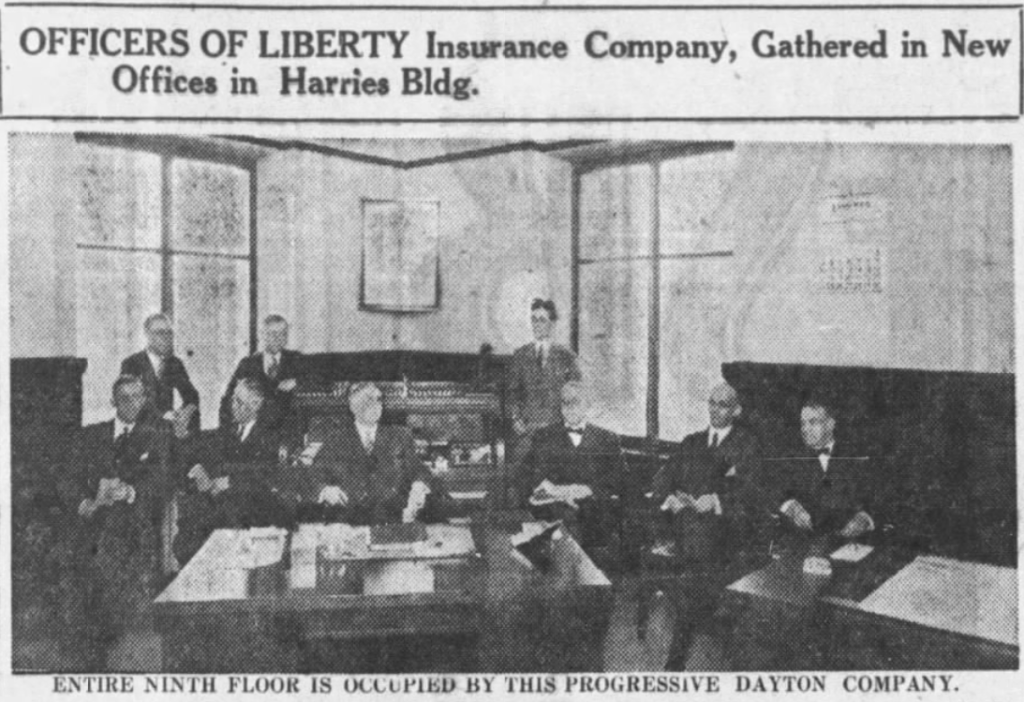
Multiple attorneys in the building included Carroll Sprig in suite 1014 and McConnaughey & Shea in suite 706.
Hubbard, Freeman and Harrison, Public Accountants took space on the 6th floor, along with the dental office of Dr. J.M. Chase and Dr. F.W. Chase.
A 5th floor tenant was My Powder Puff Beauty Shoppe.
Building tenants were also given exclusive use of the First Street Garage across the street, which was built at the same time as the Harries and also by Frank Hill Smith, Inc.
The Downtown Location of National Cash Register (NCR)
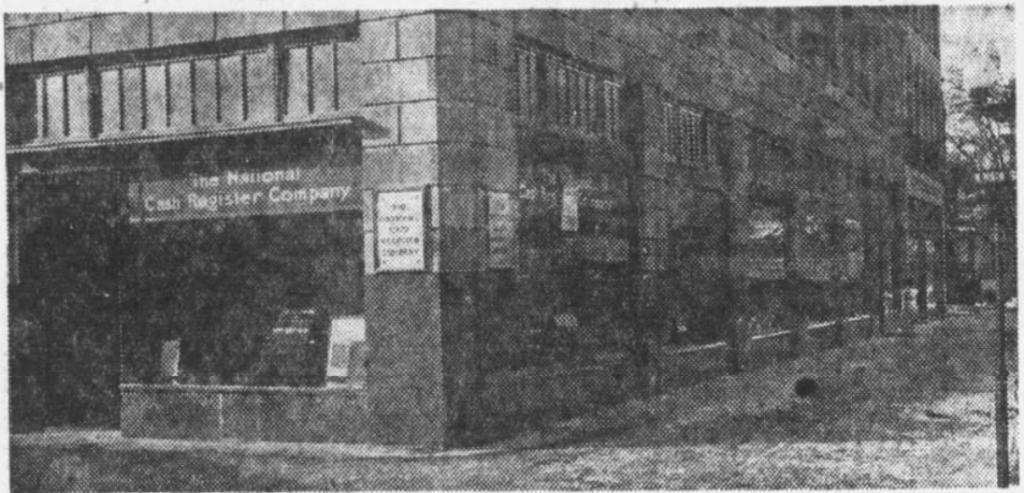
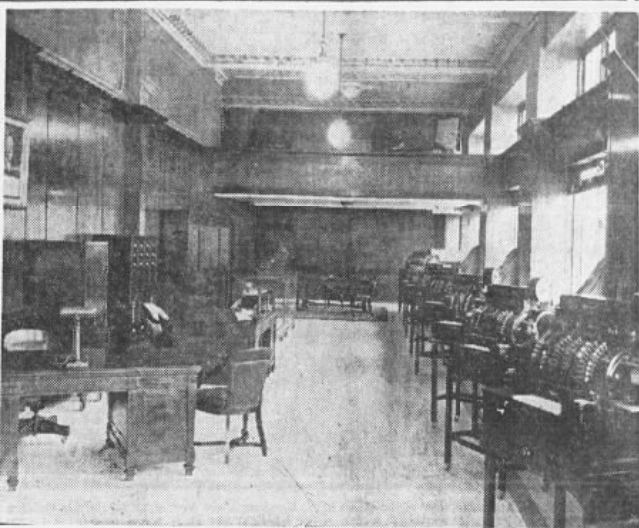
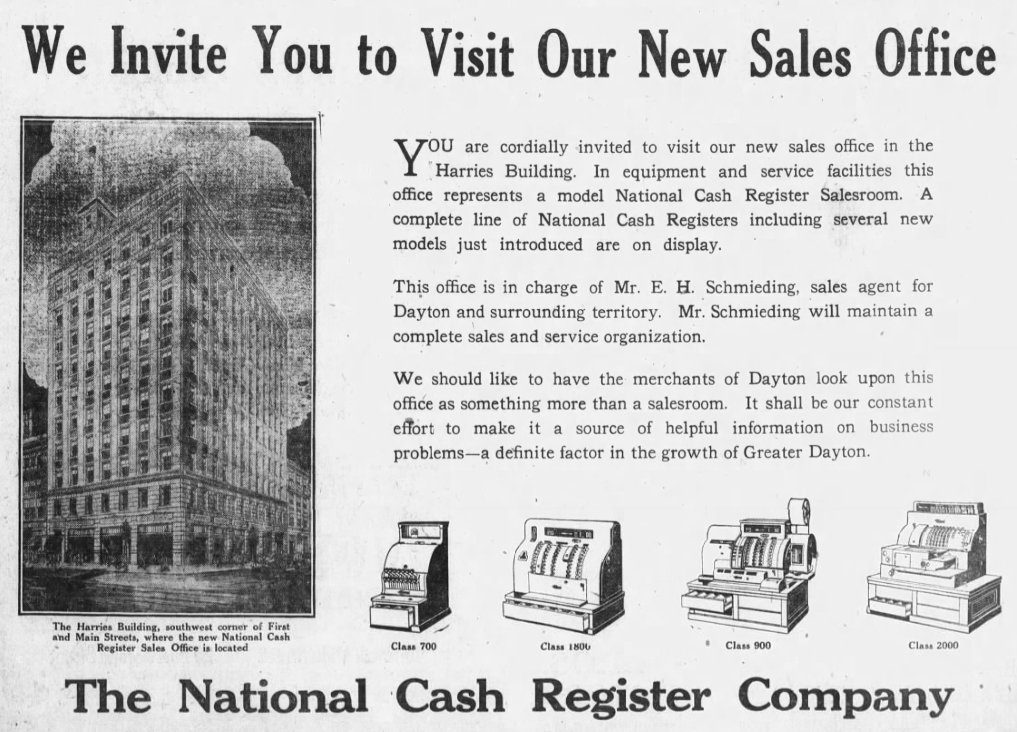
Another of the building’s inaugural tenants was one of Dayton’s industrial giants: National Cash Register. NCR used the first-floor corner space that today houses the Bistecca restaurant for a sales room, which was the first downtown office opened by the company.
The first floor was used for display, and exhibition windows ran down the whole First Street side. The mezzanine level above housed a “convention room” and a service and repair department. NCR also occupied the basement, which was used for storage and supplies. Its woodwork was described as a “marvel of design.” The wood was black walnut all “cut from one large log” supplied by the Dayton Veneer Co.
One businessman visiting the space said that “people will come miles to see this beautiful showroom.”
The office was run by E.H. Schmeiding, NCR’s sales agent for Dayton and the surrounding area. The sales office remained in the Harries Building for a decade until it moved next door to the space in the First Street side of the Walker Building.
Harries Building to Barclay Building: Ups and Downs Over the Decades
One article stated that over the years, “changing occupancy of the building reflects the economic situation of downtown. The occupancy was high during the 1920s, fell during the Great Depression, and upon recovery, remained near full until the early 1970s. The economic challenges Dayton’s downtown and its businesses faced during the 1970s were reflected in the high vacancy rates during the period.”
In 1943, the title to the building was taken by the Fidelity Building association (DDN 5/19/43).
Two years later, in 1945, the building was purchased by another famous Daytonian, James M. Cox, former Ohio governor and owner of the Dayton Daily News, as an investment.
Cox sold it a decade later, in 1955, to Joseph Thal and Gem City Realty. In 1972 the building was sold to Louis and Barbara Goldman. At that time it was said that “a major part of the office space is leased” and the retail spaces were occupied by Baynham’s shoe store and Mill End fabric shop. The Goldmans planned to install automatic elevators and make other improvements (DDN 5/21/72).
The building was renamed the Barclay Building in 1987 after a $3 million renovation by developers Uniprop and Etkin Equities that featured “mahogany, marble and accents of bronze … made with lawyers and other professionals in mind.”
Their goal was described as “to preserve the distinctive character of the building while creating a state-of-the-art office environment.” Originally, the building “was to be renamed the First and Main Building, but the more elegant Barclay won out” (DDN 8/21/87 and 5/12/88).
But according to a 1990 article, “the improvements didn’t sell space” even after rents were significantly reduced, and 67% of the building was unoccupied (DDN 2/25/90).
At that time the El-Bee Shoe Outlet occupied the corner retail space. Through the 1990s the building was still favored by law firms in the upper floors and had the Blue Dog Cafe on the ground floor with a patio space.
For the holiday season in 2002, the Barclay Building served as a new location for the “Tike’s Shop,” a longstanding Downtown Dayton tradition where children could visit Santa, shop for their family members, and have their gifts wrapped by “elves” (DDN 11/29/02).
In 2007 a piano bar named Gregory’s was located in the building, “provid(ing) opportunities to sip drinks and listen to romantic piano music” (DDN 1/24/07).
As of 2010, the building was holding strong with an 85% occupancy rate, including multiple attorneys’ offices, consulting firms, the Gem City Real Estate Group, the Dayton Business Journals, and Gold Star Chili. In November of that year, however, a 20-foot section of the building’s facade fell 10 stories onto the sidewalk. Luckily, no one was injured (DDN 11/3/10).
In 2013, Miller Valentine moved its brokerage and property management group into the Barclay Building. In early 2015 they bought the building, consolidating their workforce there and bringing around 40 additional employees downtown.
Hotel Ardent: From Office Building to New Boutique Hotel
Miller Valentine sold the building in 2018, and the following year plans for a new boutique hotel in the Barclay Building were announced. Miller Valentine would remain downtown, relocating its headquarters to 409 E. Monument Ave.
The major adaptive reuse project would end up facing delays due to the COVID-19 pandemic, and Hotel Ardent opened in February 2025.
The hotel is operated by Chicago-based First Hospitality and is under the Tapestry Collection by Hilton. The Bistecca restaurant serves daily breakfast and dinner as well as weekday lunch and weekend brunch.
The hotel’s look is sleek and stylish while also honoring Dayton’s rich history of innovation. Its website states that “the city’s commitment to innovation and invention inspired us to create a hotel experience that’s truly unique… Every detail has been carefully curated to honor the creativity and genius of the city that brought us countless inventions, including the Wright Brothers first airplane, the cash register, and the portable typewriter.”
And the decision to undertake such a significant redevelopment project in the core of the city was also undoubtedly a product of the resurgence of Downtown Dayton, where in recent years the Dayton Arcade, Fire Blocks, and Water Street districts have seen major new investment as well as preservation of historic buildings, and numerous other projects have added housing, offices, entertainment destinations, and even greenery and safer streets to make downtown a more vibrant destination.
And as for the cash register, some of the same models you will find depicted in the artwork around the hotel were once on display by NCR in the same place you can today enjoy a wood-fired steak and negroni.

Hey Andrew!
A few things I learned during the Ardent’s long restoration included the architect’s frustration with outdated blueprints! Since the building has undergone major modifications over the past 100 years, the construction crew kept discovering hidden rooms not shown on their plans. This contributed significantly to the hotel’s delay in opening!
Interesting! I know it was already a tough time to be doing such a project (given the pandemic, supply chain issues, etc.) so all of that must have added another really challenging wrinkle. So cool to see it now that it’s finished, though!