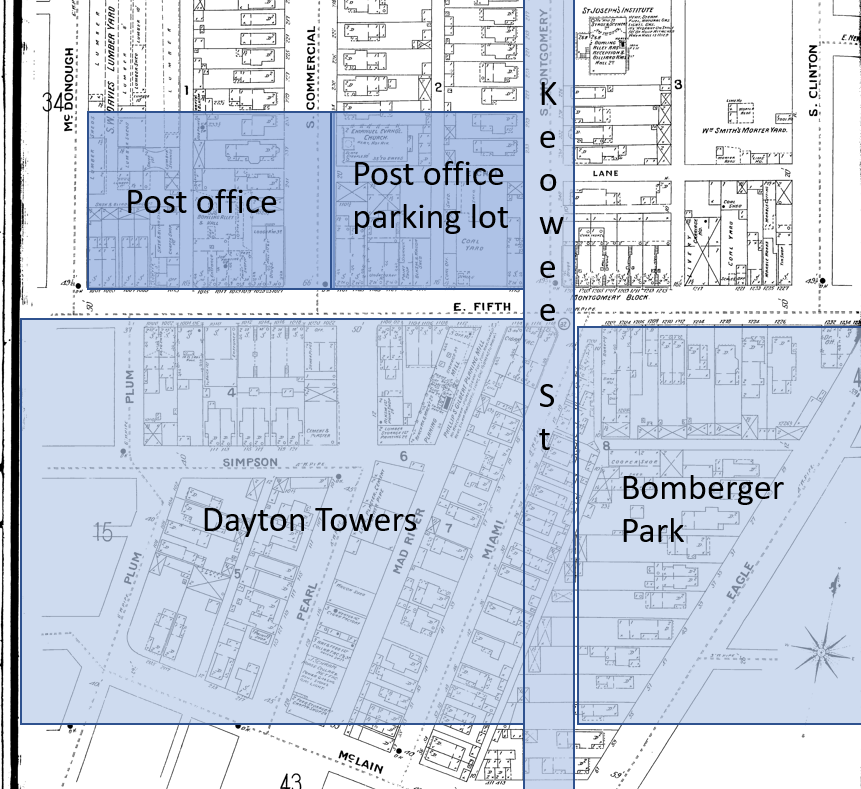
With the benefit of over a half century of hindsight, we now consider the large-scale urban renewal projects of the 1950s and 1960s as huge mistakes which hastened the decline of our cities instead of improving them.
By razing human-scale, walkable neighborhoods for untested experiments in isolated high-rise architecture and streets designed for speeding cars rather than people, our places lost their identities as cohesive communities.
These projects were highly touted before they began, but what about when they recently had been completed?
A Journal Herald article from 1969 gives us such a look for the large urban renewal project in East Dayton.
Overall, the project earned “mixed reviews.” One former city commissioner and community leader in East Dayton, Dr. Roscoe Snyder, said that “even though some mistakes were made, it has been a good thing.”
Snyder also said that “if you separate Route 35 construction from urban renewal, you’d have to say it’s a success,” apparently conceding that ramming a freeway through the heart of dense East Dayton neighborhoods did more harm than good.
Another East Dayton community leader, Mary Lou Clark, said the following about the project, which did include some rehabilitation in addition to the areas that were totally cleared:
“Urban renewal really fixed up the area. But we feel it has started to go down again. There was no follow-up. Urban renewal let us down.”
Earl Sterner, director of the Dayton Community Development Department, had this to say:
“There’s no question the East Dayton project brought a lot of physical improvement. But it didn’t handle the social needs of the community.” He added that although it solved some problems, it “brought old (problems) to the surface,” problems that the program is “not really geared for.”
The article noted that the Haymarket’s “twisting streets and odd-sized lots made the area almost impenetrable to commerce and progress.” (A different logic, then, must have led to demolishing all of the commercial buildings on Fifth Street.)
In addition, the residential “slums” were “filled with small, cramped houses” and had become “dreary and disreputable.”
Despite justifications appealing to the living conditions of residents, the results of urban renewal were presented solely in economic terms. Razing the homes and replacing them with a high-rise apartment, new office buildings and a $6 million U.S. post office led to 50% increase in tax value.
But the relocation of former residents was criticized by many, including Rev. David F. Johnson who “had heard of many persons who moved from the Haymarket to the adjacent Bomberger neighborhood without improving their living conditions.”
Johnson said that the “the people who needed relocation services the most apparently got the least help. They made a ready market for the slum landlords around here.”
The article also explained that although the current project was moving towards a conclusion, the neighboring Burns-Jackson neighborhood was “still-untreated.”
Fortunately, it would eventually be saved from that “treatment” by a grassroots effort that kicked off the historic preservation movement in the area.
Sources
“Urban Renewal Show Ending – Project Lauded, Criticized.” Journal Herald. Oct. 13, 1969.
Sanborn Fire Insurance Maps
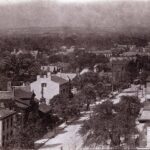
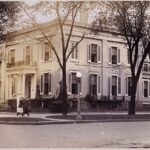
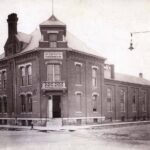

I really appreciate reading the thoughts of residents/community leaders at the time of the “renewal” of the Hay Market area. I am grateful to those with the vision and commitment that saved the Oregon District from a similar fate. I wonder how choices we are making now in the housing going in downtown so very quickly may look to us some years down the road.
Jane Jacob’s of NYC was the lone voice in the wilderness in the early 60s (The Death and Life of Great American Cities, 1961). She stood for maintaining neighborhoods and keeping eyes in the streets. She fought against highrise storage of the poor and the devastating cuts of the highway systems that were routed through our cities. US 35 and I-75 did irreparable damage to Dayton. Could Haymarket been saved probably not. Dayton now has 110,000 residents in 1960 there were 250,000+. Just as the area between Salem and N. Main has become sparsely populated, Haymarket most likely would have suffered the same fate.
Great points, and I love that you referenced Jane Jacobs as I actually quote the very book in some of my presentations about the Haymarket! “There must be eyes upon the street, eyes belonging to those we might call the natural proprietors of the street. The buildings on a street equipped to handle strangers and to insure the safety of both residents and strangers, must be oriented to the street.”