Over the past several years, as I’ve researched Dayton’s industrial history and the neighborhoods that once surrounded its factories, one theme has come up repeatedly: Appalachian migration.
Between the late 1930s and 1960s, tens of thousands of people from eastern Kentucky and surrounding regions came to Dayton in search of work.
Their story is deeply connected to Dayton’s manufacturing boom, and to the neighborhoods that shaped the city during its peak industrial decades, and the urban renewal projects that came as regional patterns shifted and those companies began to struggle.
I recently did some additional research for a talk I gave at the Appalachian Outreach Community Breakfast hosted by Sinclair College. In this article I’ll share a few details about the factories these Appalachian migrants worked in, and highlight a few of the places they settled in the Dayton area. In both cases, much if it is long gone, although some key sites remain.
Dayton’s War-Era Industrial Boom
By 1940, Dayton was a major manufacturing center. The city had a population of 210,000 and 432 factories producing 750 different products.
World War II dramatically accelerated that growth. Dayton’s manufacturing strength and reputation helped it get huge contracts from the government to support the war effort.
By 1943, total city employment was 124% higher than ten years earlier. National Cash Register’s workforce alone reached 20,000 employees. Factories shifted to war production almost overnight.
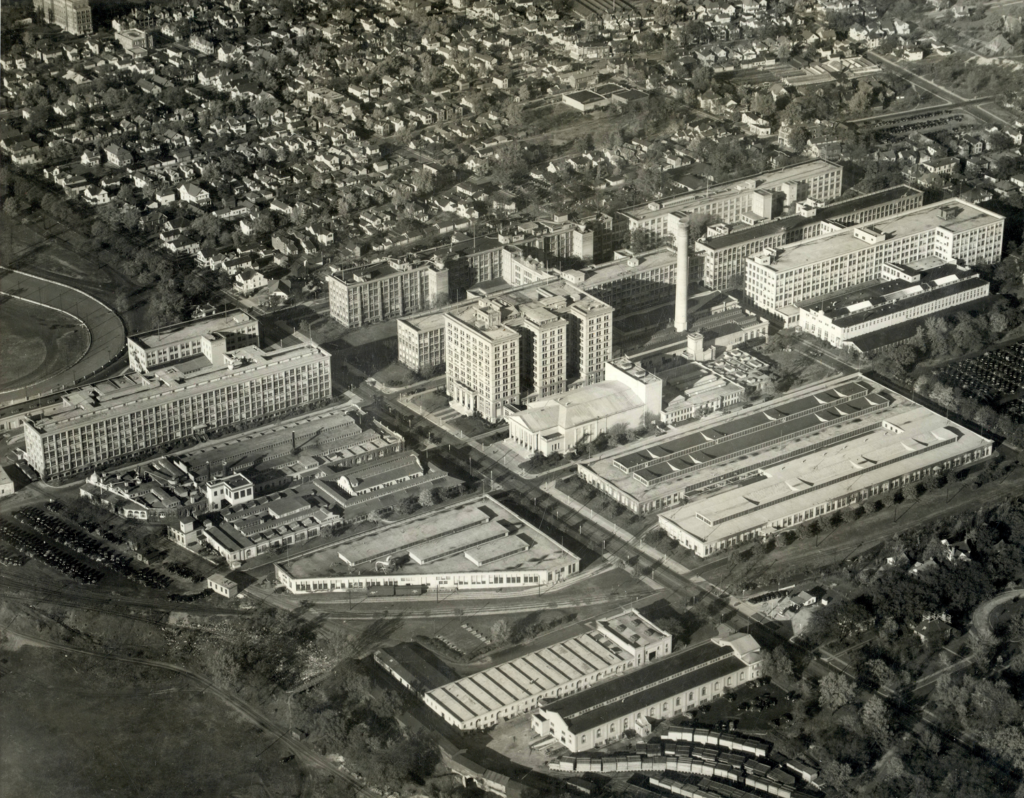
NCR converted to aircraft engines, bomb sights, and was also famous for its work on code-breaking equipment. Delco, which was founded by Edward Deeds and Charles Kettering while working at NCR, expanded massively and employed up to 30,000 workers. Frigidaire produced aircraft propellers and machine guns in staggering quantities.
There are many interconnections among Dayton’s industrial leaders in this time. Delco and Frigidaire were already owned by GM, which had additional plants in Dayton such as the Inland Manufacturing plant surrounding the original Wright Company Factory.
After the war ended, the factories shifted back to consumer goods, but employment remained strong. By the late 1940s and early 1950s, GM alone employed around 40,000 people in the region.
At one point, Frigidaire, NCR, and Delco combined employed over 50,000 people, more than 42% of Dayton’s workforce.
Dayton began the 1950s with 243,000 people, and would grow by another 18,460 during the decade. The region’s industrial base had nicely rebounded and there was ample opportunity for work.
In 1958, Dayton was one of Ohio’s eight largest cities and a study found it to be the wealthiest among them in terms of average weekly pay.
This prosperity is illustrated by the number of new shopping centers developed during this time in the metro area.
The Appalachian Migration to Dayton and the Industrial Midwest
One estimate suggests that 45,000 people migrated to Dayton during this period seeking work, many from central and eastern Kentucky, particularly Harlan and Perry counties.
Other midwest industrial powers like Detroit, Cincinnati, Cleveland, Akron, and more experienced similar migration from Appalachia during the mid-20th century, as workers followed industrial jobs north along what later became known as the “Hillbilly Highway.” Some sources estimate that 7 million people traveled north from Appalachia during this time period.
When Appalachian migrants arrived in Dayton, they found a dense streetcar city including neighborhoods built specifically for industrial workers. But according to one source, “the Dayton area was grossly unprepared for the influx of workers in its factories” which “created a housing crisis in the city.”
In 1942, the Dayton Public Welfare office reported that 4,000 people were searching for homes, and fewer than half would find one. Reports described 3-4 families sharing a single house, families living in garages and hotel rooms, and people sleeping in shifts.
East End, the “Port of Entry” Neighborhoods, and Suburbs
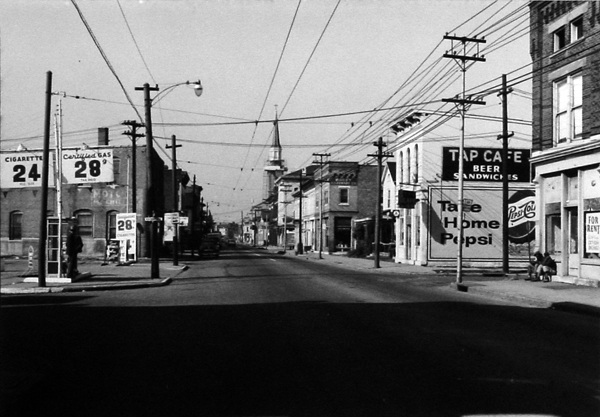
Appalachian migrants occupied multiple locations in the Dayton region, but the strongest concentration was on the near east side.
One study took common eastern Kentucky surnames and checked them in the 1947 city directory. It found the largest concentration in the Burns-Jackson neighborhood, today’s Oregon District, and called it a major “port of entry” for Appalachians early in the migration.
Other concentrations formed in the Haymarket and St. Anne’s Hill neighborhoods directly to its east (making up the “east end” area that is commonly mentioned) as well as downtown residential districts on the west and south sides of downtown. There was also a smaller pocket in West Dayton.
Inner-city neighborhoods have historically gotten the most attention in conjunction with Appalachian migrants, but at the same time, other Appalachian families had dispersed into suburbs such as Moraine, Riverside, Drexel, Harrison Township, and parts of Kettering and Mad River Township.
Poverty was a theme among many new arrivals, but others enjoyed stories of success. One book shares the experience of one Dayton family who moved to Huber Heights:
“Wesley Reagan would speak with enduring pride of the moment when he and Lula were able to purchase their first home, in a working-class subdivision just outside of Dayton built by a local developer who put up thousands of such homes across central and southwestern Ohio during the 1950s and 1960s. “A Huber Home is what I bought. Huber was the biggest builder of single-dwelling brick homes in the United States, and that goes back many, many years ago.” And after three decades of paying membership dues to the plant’s International Union of Electrical Workers local, Wesley, who had left Tennessee with barely a penny to his name, would even be able to retire at the relatively young age of 52, with a union pension and company-provided health insurance for the remainder of his and Lula’s lives” (Fraser).
Appalachian Community, Urban Renewal, and Adaptation
As the 1960s progressed and Dayton began to lose population for the first time, Appalachian migrants began forming community networks to help migrants navigate urban life and deal with prevailing attitudes about them.
One source wrote about “a pervasive ‘transient psychology’ that made poor southern whites the bane of employers and landlords alike… noting that in Dayton’s East End, landlords would only rent to southerners by the week, so that if they ‘slip off quietly for Eastern Kentucky, at least the landlord will only lose a week’s rent, not a month’s rent'” (Fraser).
Their neighborhoods themselves also began to undergo drastic change as Dayton grappled with its decentralization and suburban growth.
Appalachians were frequently mentioned in large-scale urban renewal plans intended to clear and rebuild neighborhoods and raise living conditions for everyone, although they rarely achieved these goals.
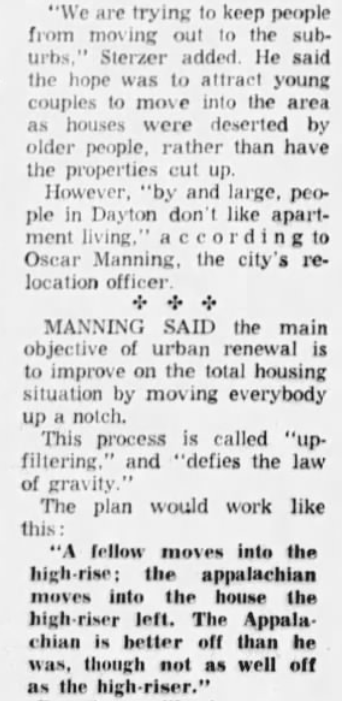
The Haymarket neighborhood was demolished in the mid-1960s, a classic example of urban renewal.
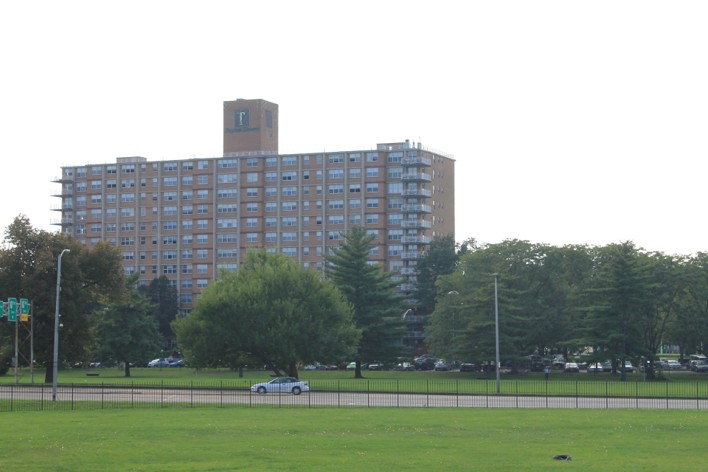
The Oregon District to its west was targeted for clearance as well, but preservation efforts ultimately saved it, although highway construction and a housing project shrank it to about half of its size when the Appalachian migration had begun.
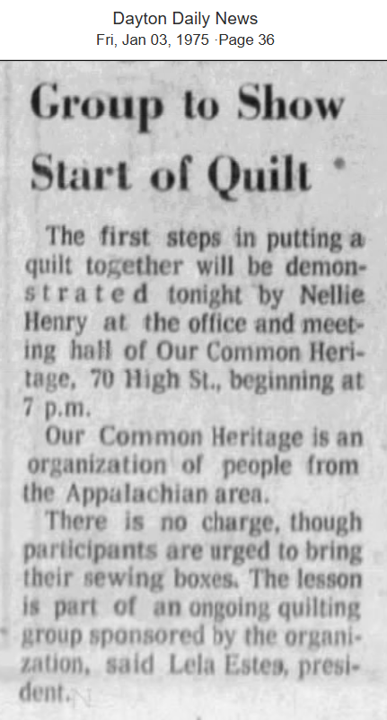
In 1973, several volunteer groups combined to form the Our Common Heritage organization, which became known for helping Appalachian migrants with housing issues, employment challenges, and cultural adjustment, while also preserving Appalachian traditions.
It focused many of its efforts on the east end area, and at one point met at 70 High Street in the former First United Presbyterian Church which still stands in St. Anne’s Hill.
Industrial Decline in Dayton and the Industrial Midwest
Beginning in the 1970s, Dayton’s industrial base began to erode, and the factories that had drawn tens of thousands of Appalachian migrants to Dayton began disappearing, as they did in Cincinnati, Detroit, and the rest of the region that began to adopt the name of the “rust belt.”
NCR shifted away from mechanical manufacturing as electronics advanced. By 1977, production had largely moved from Dayton, and local employment dropped on a massive scale. The entire factory complex centered on Main and Stewart streets would be demolished beginning in the late 1970s, and only a few later NCR buildings survive to the present day.
Frigidaire was sold by GM in 1979. The original downtown Frigidaire plant also closed and was later demolished.
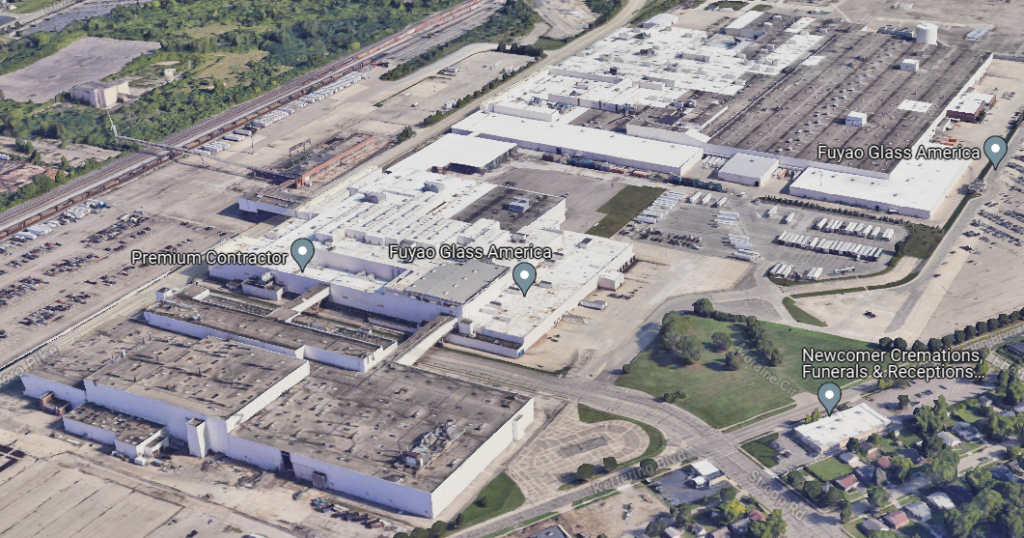
The Moraine assembly plant continued auto production for a time but closed permanently in 2008 and made national news, although recently it has been reborn as Fuyao Glass America.
Delco’s factory closed down too, but its key manufacturing buildings survive, now redeveloped into mixed-use housing developments adjacent to the Dayton Dragons ballpark.
The Appalachian migration unfolded alongside Dayton’s industrial expansion and contraction, and although so much has changed, there are still many visible traces in both the neighborhoods that survived, and the factories that once powered the city.
Sources
Hillbilly Highway by Max Fraser
https://www.appalachianplaces.org/post/appalachians-in-places-where-there-are-no-mountains
Ohio Modern Dayton survey https://www.ohiohistory.org/wp-content/uploads/2022/01/rp-23.pdf
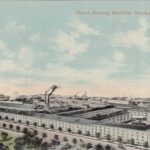
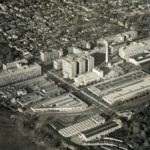
I just read this article and question something you point out. I grew up GM. My father was Cost Supervisor for Delco Moraine in the 60’s and 70’s. I was employed by Delco Products from 1973 to 1983 working in Accounts Payable department for ALL divisions, we were consolidated. . I was responsibe for paying for construction and certain products used by Frigidaire. When GM sold Frigidaire to White Westinghouse both Frigiir daire plants became Delco Air Conditioning. Acounts Payables went back to each division and I transferred downtown to the Taylor Street plant until I left in 1983 to start my family. Your article mentions the downtown plant was closed after Frigidaire was sold and torn down.No, it became Delco Air Conditioning as well as the Moraine plant. I left Dayton in 1985.