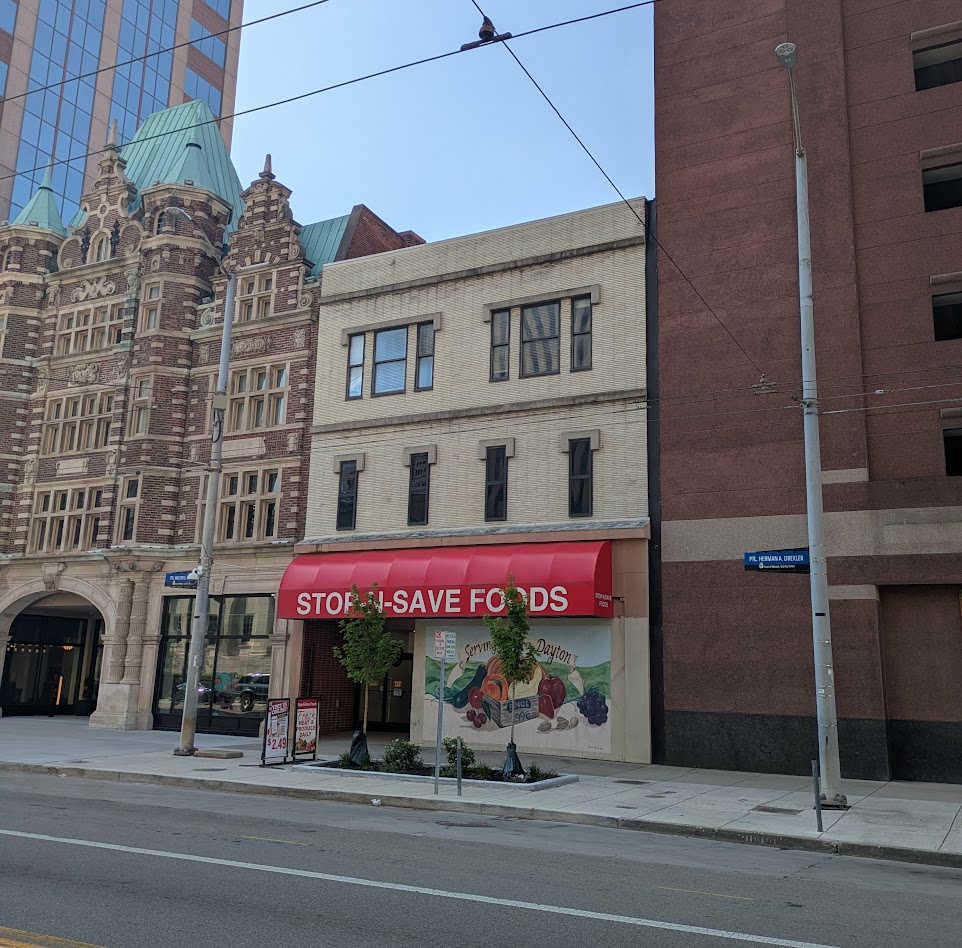
Today it’s not one of the 9 interconnected buildings in the Dayton Arcade redevelopment, but the 3-story structure immediately to the west of the Third Street Building has an interesting history of its own as well as a long association with the complex.
And today it also provides an often-overlooked grocery store right in the heart of downtown.
The building, in fact, has housed a grocery store for 75 years, and long ago was also the home of an Arcade bowling alley.
It is known as the Young Building and it actually predates the Arcade as it was built in 1900 and opened in 1901.
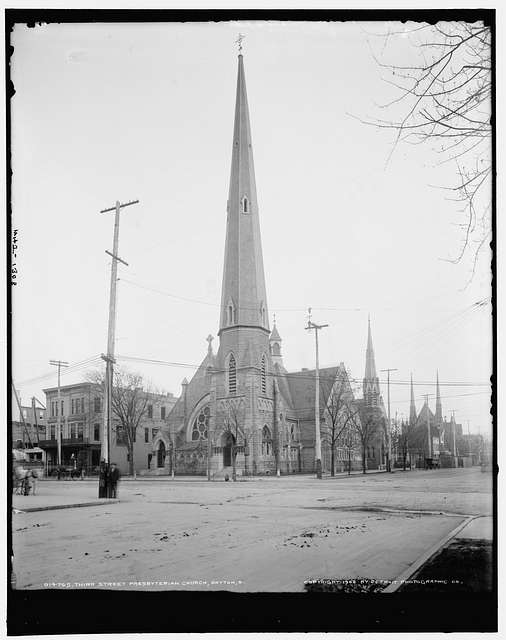
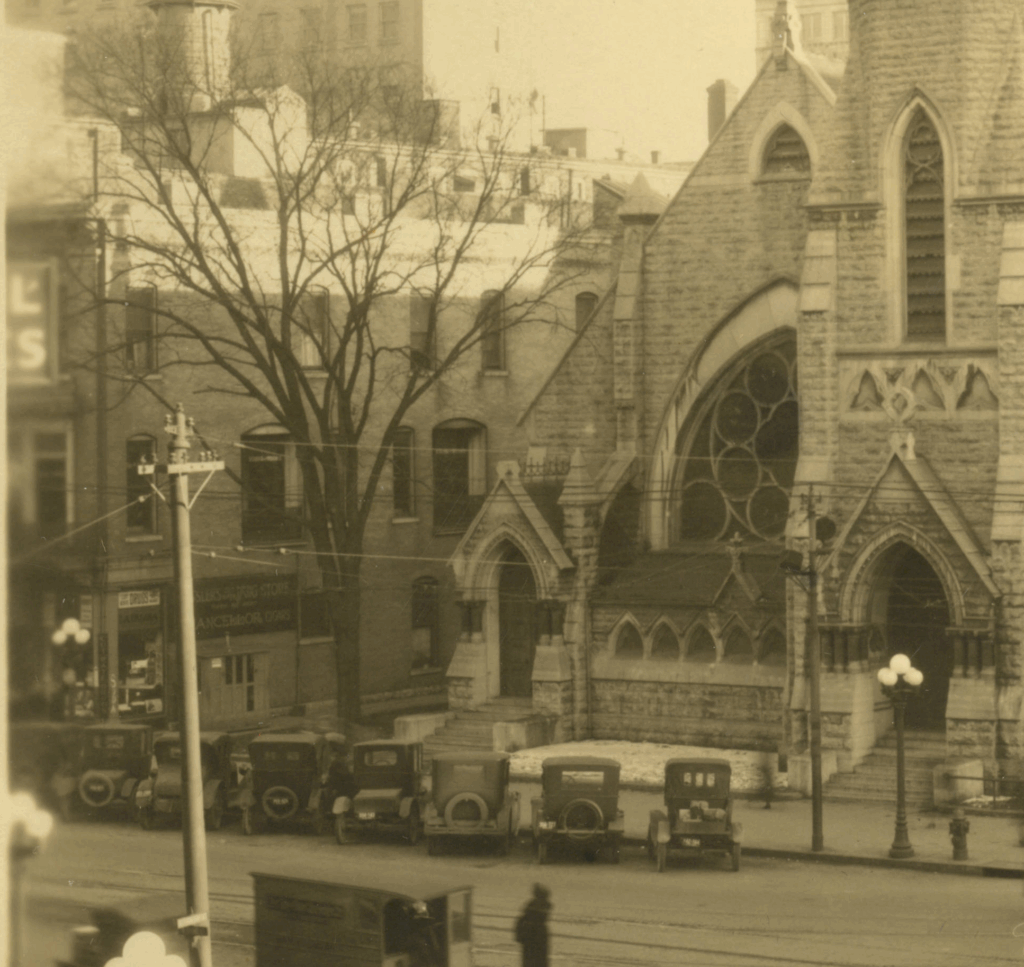
The facade has been significantly altered over the years, however, and originally much more of the building was visible from its west when the corner was occupied by the Third Street Presbyterian Church.
The Young Building was named for brothers William H. and George R. Young, lawyers who established a partnership in 1888. Their Young and Young firm had an office in the building for many years at 34 W Third St.
The Youngs were a prominent legal family in Dayton, as the brothers “followed in the footsteps of their illustrious father,” Edmond Stafford Young. They also had other prominent real estate holdings including owning the Victoria Theater at one time (Dayton Herald 5/17/32).
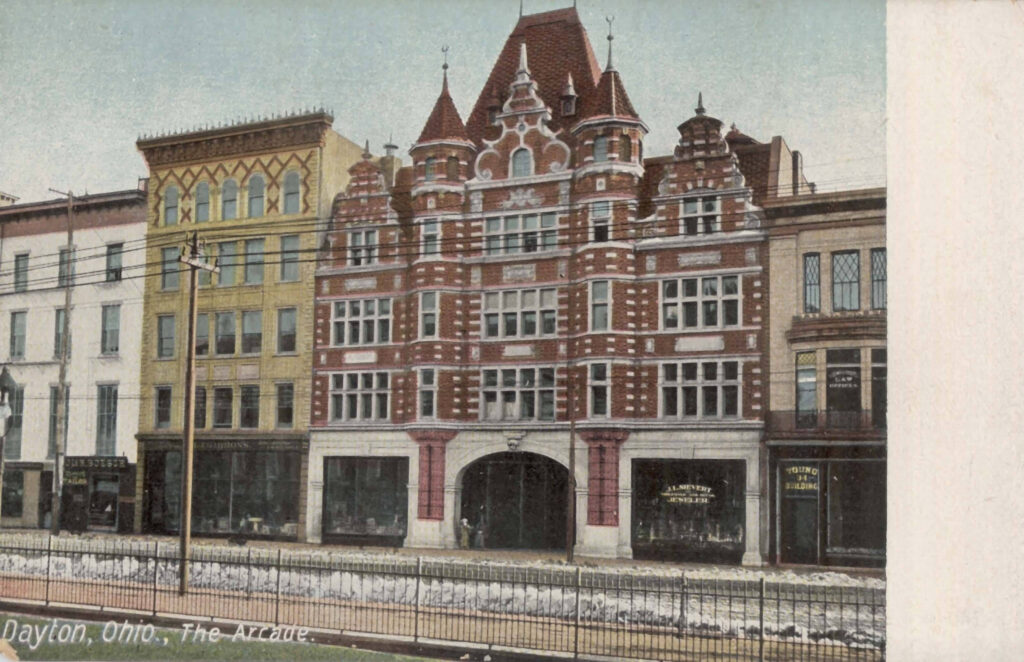
The Young Building is visible to the right of the Arcade’s Third Street Building. The side visible here is where the Young and Young Law Office was located.
But the most interesting use of the building in its early years was not an office tenant, but rather a bowling alley.
When it was under construction in 1907, a newspaper article described it as a “fine bowling academy … the like of which can only be seen in such cosmopolitan cities as Greater New York and Chicago.”
The location “in the Young Building Annex adjoining the Third street entrance of the Arcade … will comprise ten fine alleys, with provision for ladies and gentlemen, constructed by the Crawford, McGregor & Canby Co,” the Dayton firm which had also just furnished the alleys that were used in the National Tournament of the American Bowling Congress in St. Louis the previous year (Dayton Herald 10/21/07). That company would become McGregor Golf, the leading manufacturer of golf clubs for decades.
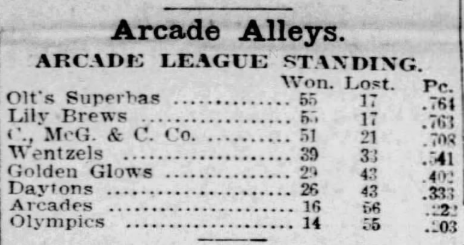
Originally there were 5 lanes on the first floor and 5 on the second. Newspaper articles from those years cover “the Arcade Bowling League” at the “Arcade Alleys,” whose teams in those years included the Arcades, Walnut Hills, Olt’s Superbas, Lily Brews, and more (DDN 12/16/07, Dayton Herald 3/30/10).
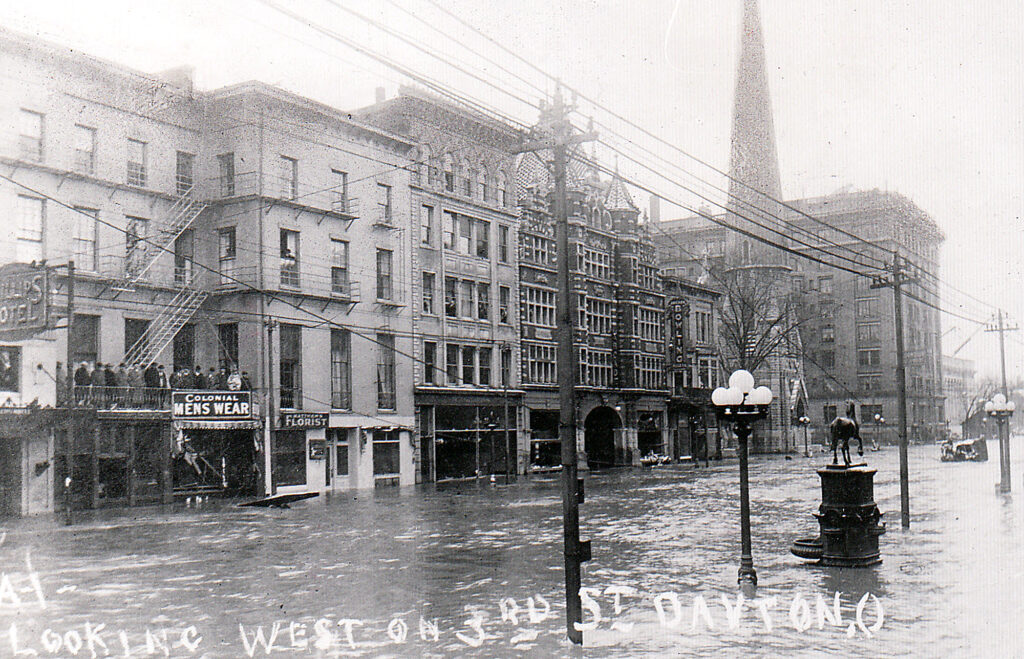
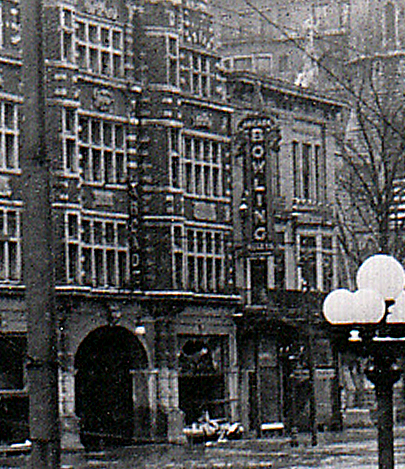
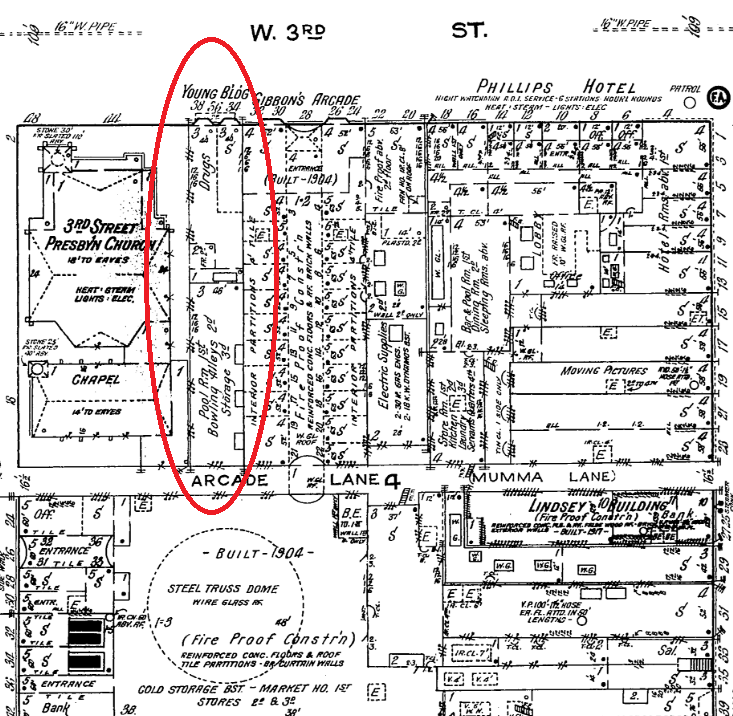
By 1918, we can see in the map below that there was a drug store out by the Third Street entrance, with a pool room behind that on the first floor, bowling alleys on the second, and storage on the third.
The space next to the drug store out by Third Street is where the Young and Young law office was located, although it’s not labeled on the map.
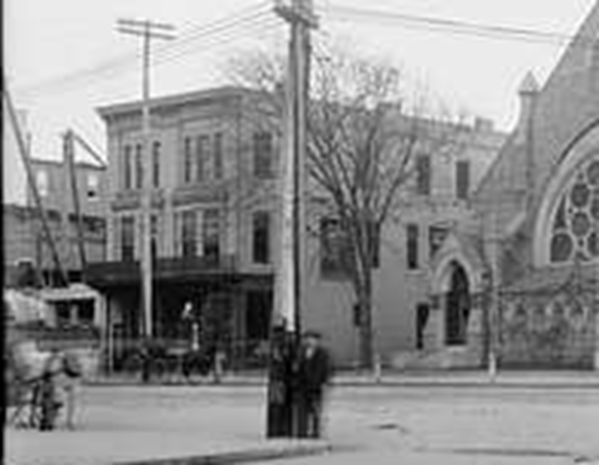
Signage for that drug store and the west side of the Young Building is visible in another image of the old corner church:
In 1925, John McShane opened a restaurant in the Young Building named McShane’s Grill. It originally operated in the rear half of the building, but about 10 years later McShane took over the whole first floor and added a bar. For years it was a “center for sports events.”
Then in 1950, it was announced that a new Liberal market grocery store would be taking over the space.
Downtown Dayton’s Liberal Market Grocery Store
Liberal Markets Inc had been founded in Dayton in 1921 by Abe Schear and grew into a major player in the local grocery industry (DDN 6/7/50).
Schear had been looking to open a downtown store for several years, and highlights of the new 7,000 square foot space included a “food-o-mat,” a “self-serve meat department,” and air conditioning.
The Schear family originally leased the space from George Young’s widow Hannah who still owned the building in 1950. It later was owned by the Schear family for many decades into the 2000s.
In 1954 the downtown store announced an unusual event: the cutting of a huge piece of Sheboygan cheese, “the largest cheese ever produced in one piece” which had been on display for 10 days and would be offered for sale while its was being cut.
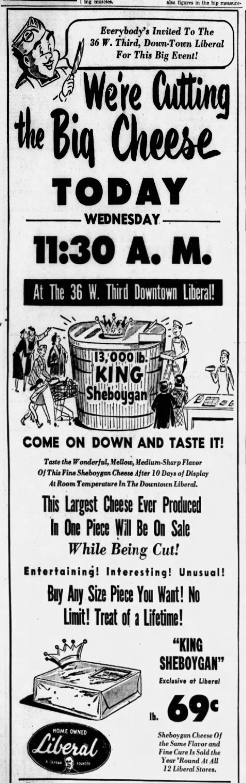
(Source Journal Herald 3/3/54)
In 1970, Liberal signed a new long-term lease and completely remodeled the store.
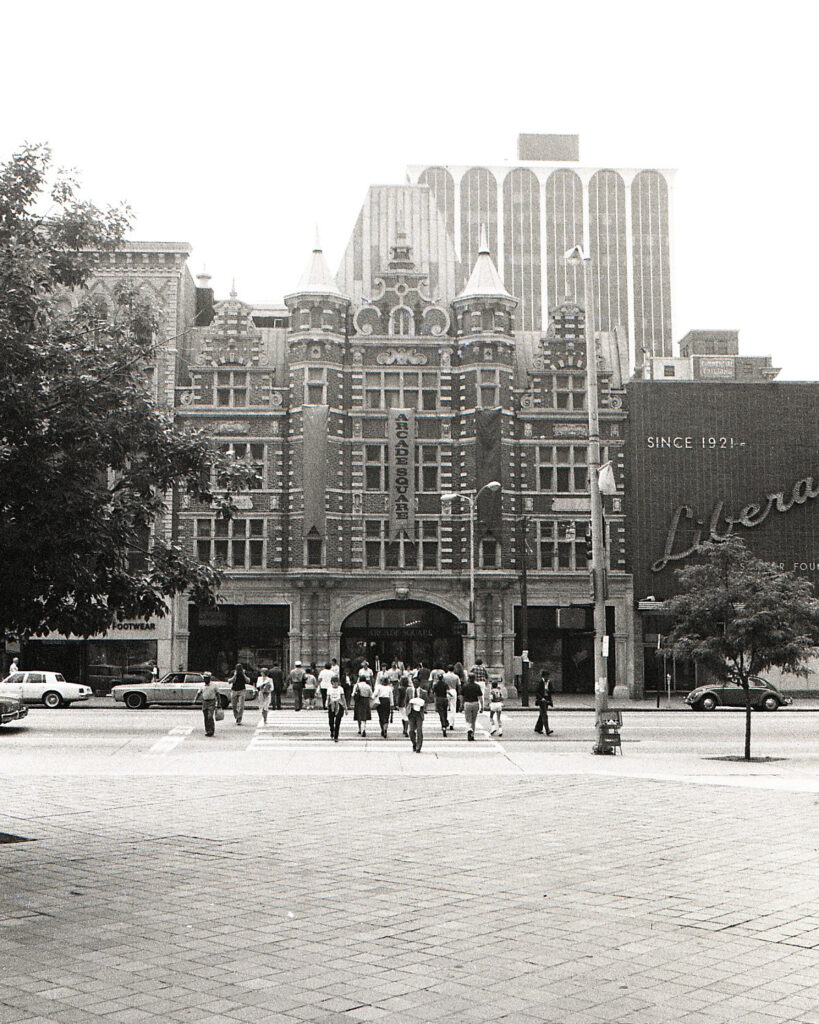
In 1981, workers at Liberal went on strike to protest unfair labor practices. The multiple-week strike especially affected the over 1,200 senior citizens who lived downtown and relied heavily on the store.
Liberal ended up filing for bankruptcy and soon closed its 14 Dayton-area stores.
The downtown location, as well as other former Liberal stores, was bought by Metro Markets Inc.
The labor issue continued, as the two unions, Local 1552 of the United Food and Commercial Workers Union and Local 430 of the Amalgamated Food and Allied Workers Union, attempted to get its now jobless members into positions at the new stores, specifically contending that Metro Markets was an “alter ego” or “joint enterprise” of the Schear Family and Liberal (Journal Herald 7/29/81).
Lee Schear, a grandson of Liberal’s founder Abe Schear, was at the time Metro Markets’ director of operations.

By 1989 Lee Schear did own the company, which at that time operated Metro Markets as “smaller stores designed for individual neighborhoods” (DDN 5/31/89), a larger “Schear’s Food Center at Woodman and Burkhardt, and the downtown store was rebranded as “Schear’s Marketplace.”
In the early 90s, Schear’s Marketplace not only sold groceries but also had a dry cleaner (Clean Scene), a premium florist (Colonial Flowers), and downtown’s last independent pharmacy (Carl Schmidt Drug Store, founded in 191, formerly at 114 W. 5th and then 5th and Ludlow before taking a 540-square foot corner of 36 W Third in 1990). The drug store would close in 1995 when the pharmacist, Howard Faust, moved to the Revco Drug Store at Fourth and Main) (DDN 6/25/90, 2/10/95).
In those days the grocery store was also connected to a food court on the west side of the Young Building, and it also had a separate entrance and exit at the rear of the store off of Arcade Lane.
Schear’s Marketplace closed at the end of 1996, about 5 years after the Arcade shut its doors for good.
Stop N Save—Downtown’s Often-Overlooked Grocery Store
But in February of 1997 it was announced that a new Stop-N-Save food market owned by Tony Abboud would be opening in the space. He invested about $350,000 in remodeling and inventory and the store was rearranged into a similar layout as the former Liberal store from years earlier, with its only entrance and exit on the Third Street side (DDN 2/27/97).
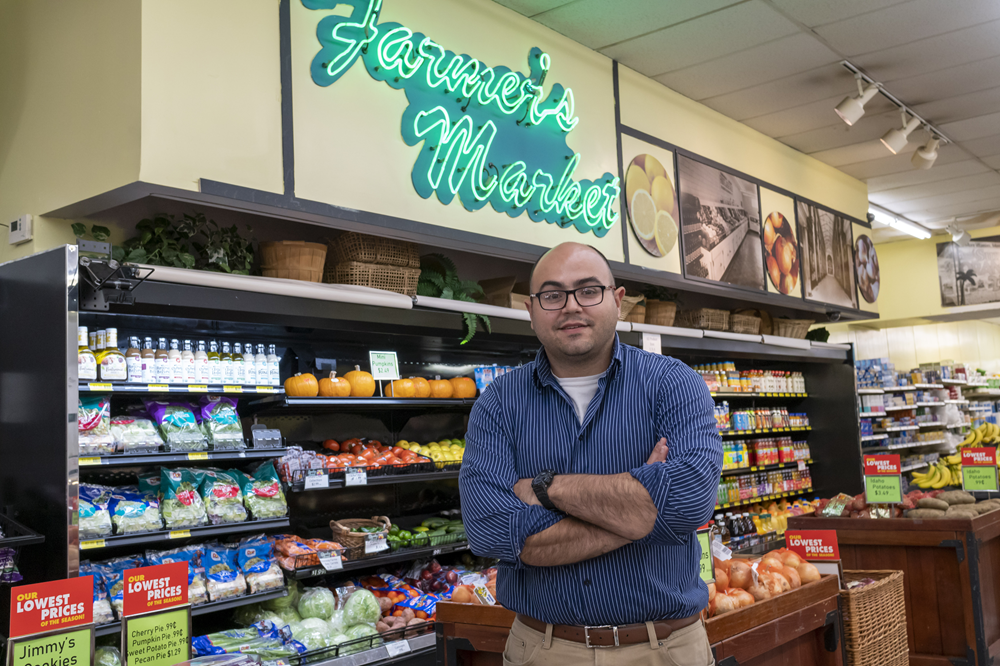
Stop N Save is still in operation today, now co-owned by Tony’s son Joe Abboud (pictured below), and it offers much more in terms of a downtown grocery option than many passersby assume, including fresh produce and a deli counter.


This is a WONDERFUL sharing of history, as I only knew it from Liberal’s during the 1970s to what is now, Stop-N-Save.
I will stop in there to check it out, especially since you declared that “it offers much more in terms of a downtown grocery option than many passersby assume, including fresh produce and a deli counter.”
Thank you, Andrew, for ALL the AWESOME work you create in preserving, sharing and honoring Dayton!!
Hi Karen,
Thanks so much! Yes, I learned a lot about it too over the course of this research. The only sources I could find didn’t mention the building’s name and also said it was built in 1930! And it is pretty cool that it’s been a downtown grocery store for 75 years. Definitely worth checking out. I assume they’ll likely get some new business with the downtown CVS closing.