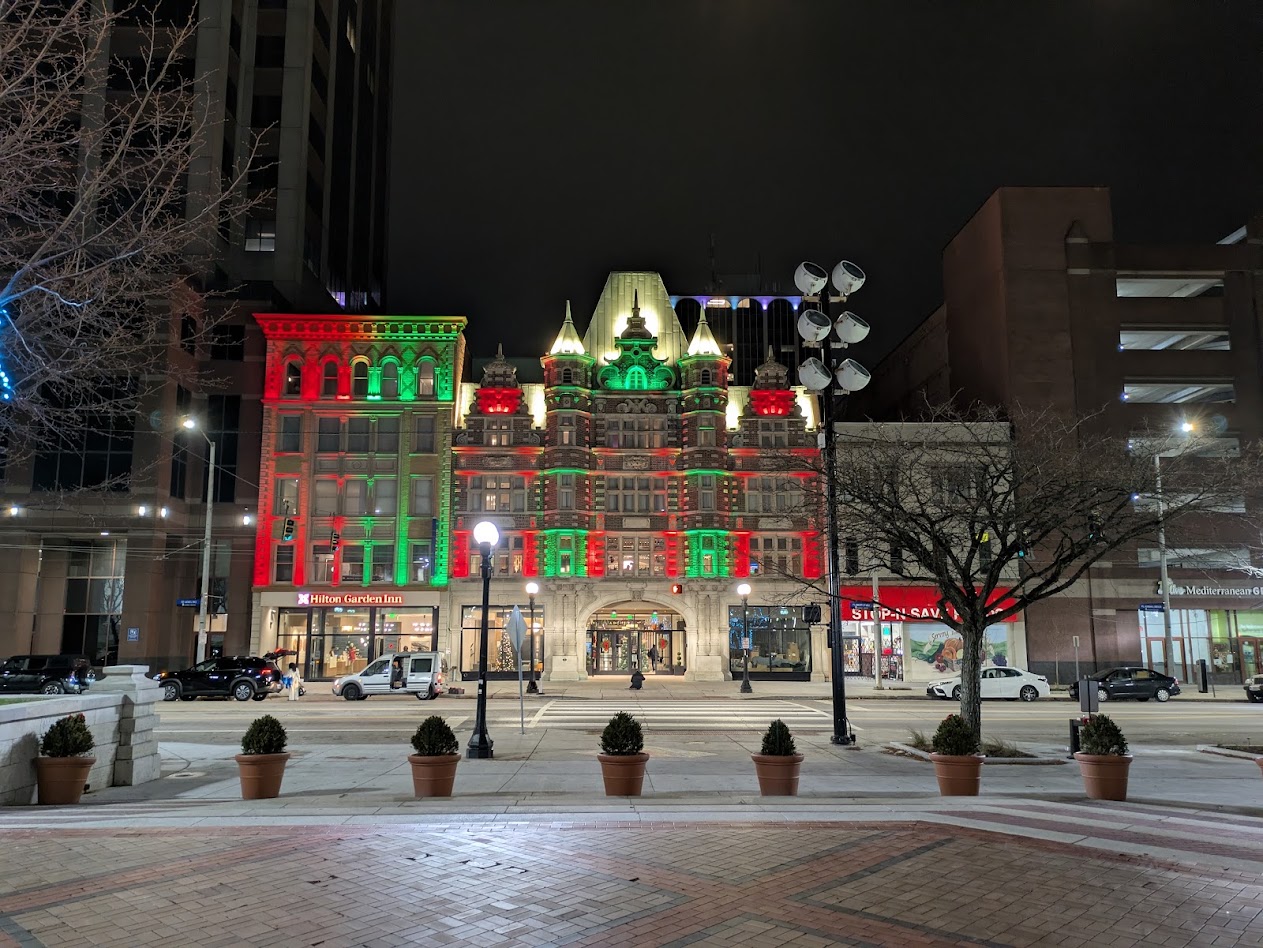
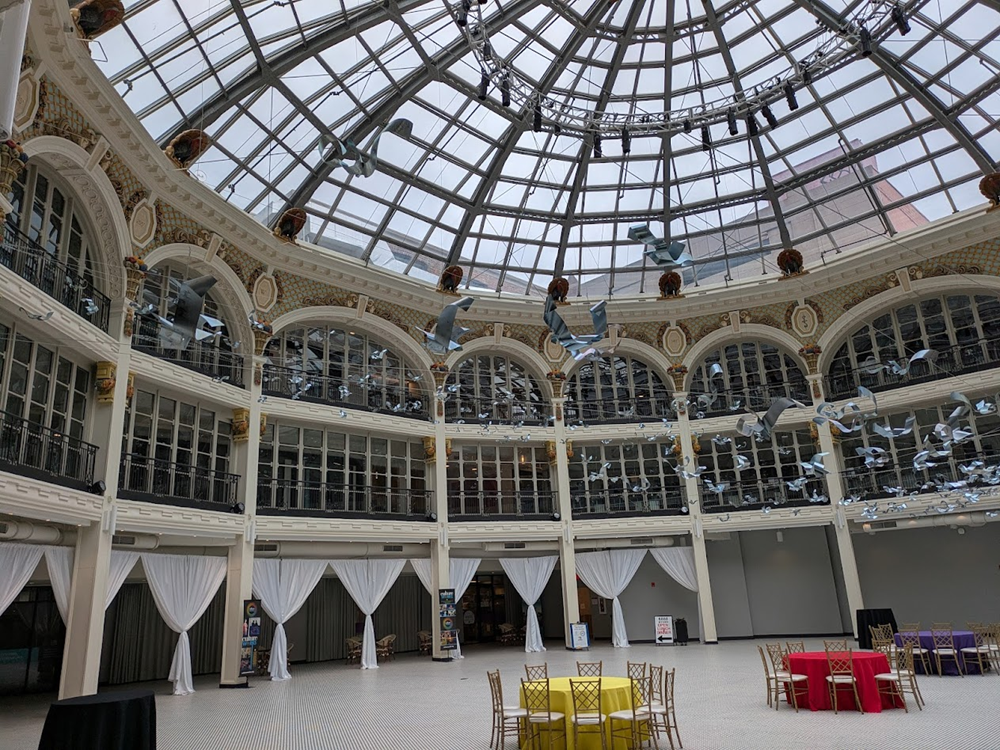
The Dayton Arcade is a historic 9-building commercial and residential complex surrounding a glass-domed rotunda in the heart of Downtown Dayton. Dating back to 1904, it is one of the Gem City’s most beautiful, as well as historically important, landmarks.
Its soaring rotunda, intricate architectural details, and mix of retail, office, and residential spaces have made it a hub for downtown living, commerce, and social life for well over a century. Over the years, the Arcade has reflected Dayton’s broader story: major growth, urban decline, and a slow but steady push toward revitalization.
This guide will take you through the Dayton Arcade’s full history, including its rise and fall, as well as detailed information about its recent redevelopment. It also will link to additional stories and media for a deeper dive into particular aspects of its story.
For an even more detailed, year-by-year breakdown, you can also explore my Dayton Arcade Historical Timeline.
What Buildings Make Up the Dayton Arcade Complex?
A common question among Daytonians is what exactly makes up the Dayton Arcade. And there is certainly reason for a little confusion as it is much more than a single building!
The Dayton Arcade is a 9-building complex of interconnected structures spanning a whole city block bounded by Third Street to the North, Ludlow Street to the West, Fourth Street to the South, and Main Street to the East.
The current definition of the Arcade does not correspond exactly to the historical Arcade, however, as the recent redevelopment project has incorporated additional adjacent structures. (And there are also a few buildings in the same block that are not considered part of the Arcade.)
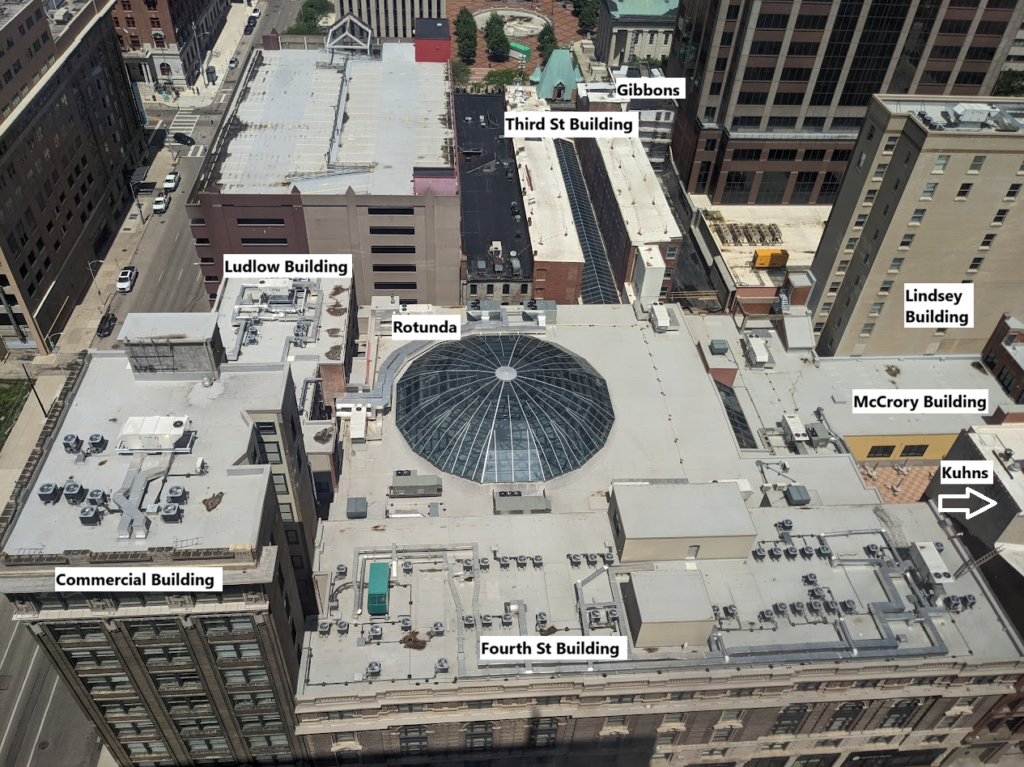
Below is a list of the 9 Arcade buildings, with more information and pictures about them following that (including an aerial view so you can visualize how they are arranged across the block):
(North Arcade)
Third Street Building
Gibbons Annex Building
(South Arcade)
Ludlow Building
Fourth Street Building
Commercial Building
Kuhns Building
Lindsey Building
McCrory Building
Central Rotunda Building
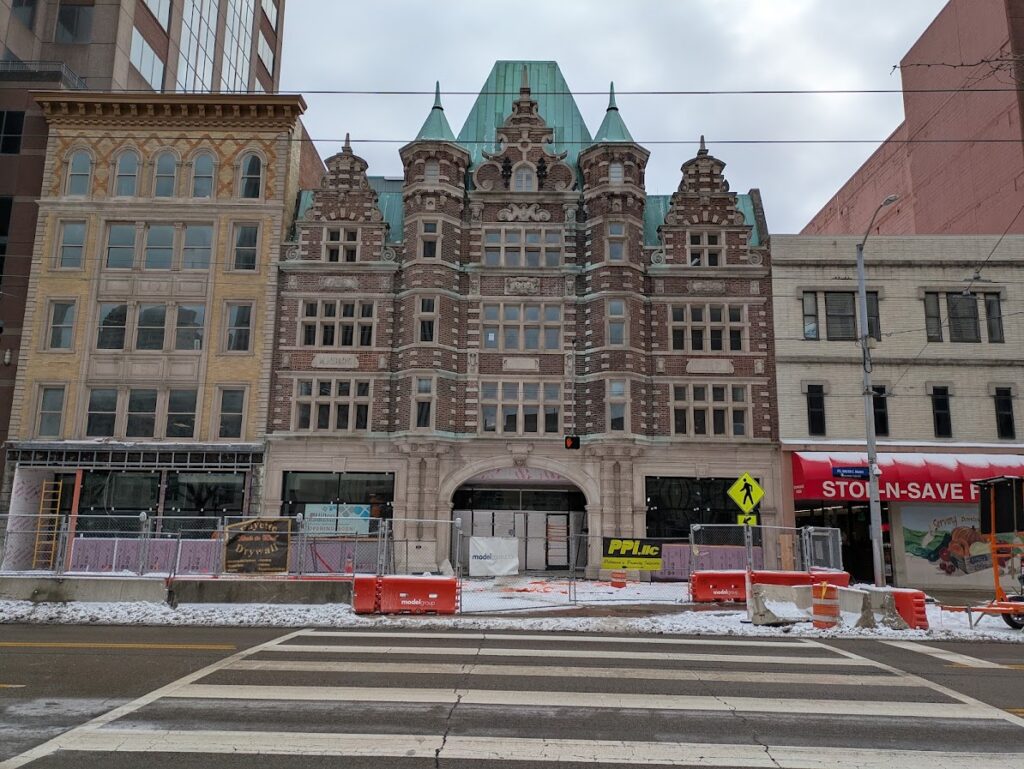
The first section of the Arcade which opened in 1904 consists of the Third Street, Fourth Street, and Ludlow Street Buildings, as well as the grand Central Rotunda in the center that originally housed a market house.
The Third Street Building is of a striking Flemish design that makes it one of the most beautiful facades in the City of Dayton. Next to it is the Gibbons Annex Building which was originally owned by Michael J. Gibbons and was not originally part of the main Arcade.
Learn More About the Surprising History of the Third Street and Gibbons Buildings
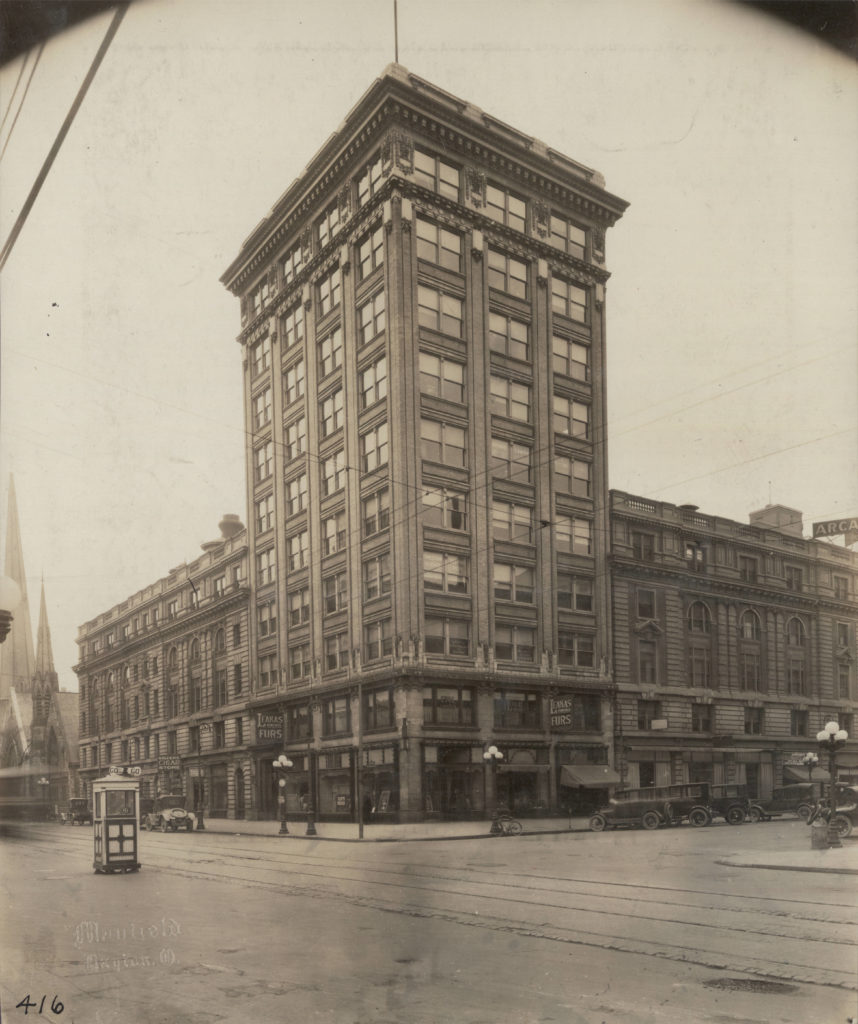
In 1908, the 10-story Commercial Building was completed at the NE corner of Fourth and Ludlow, which was one of the taller buildings in Dayton at the time and the first such structure to be built west of Main Street.
The remaining structures in today’s complex were not originally built as part of the Arcade: the Kuhns Building (built in 1882 so actually predates the Arcade by a couple of decades) at the NW corner of Fourth and Main, and the McCrory Building and the Lindsey Building to its north on Main.
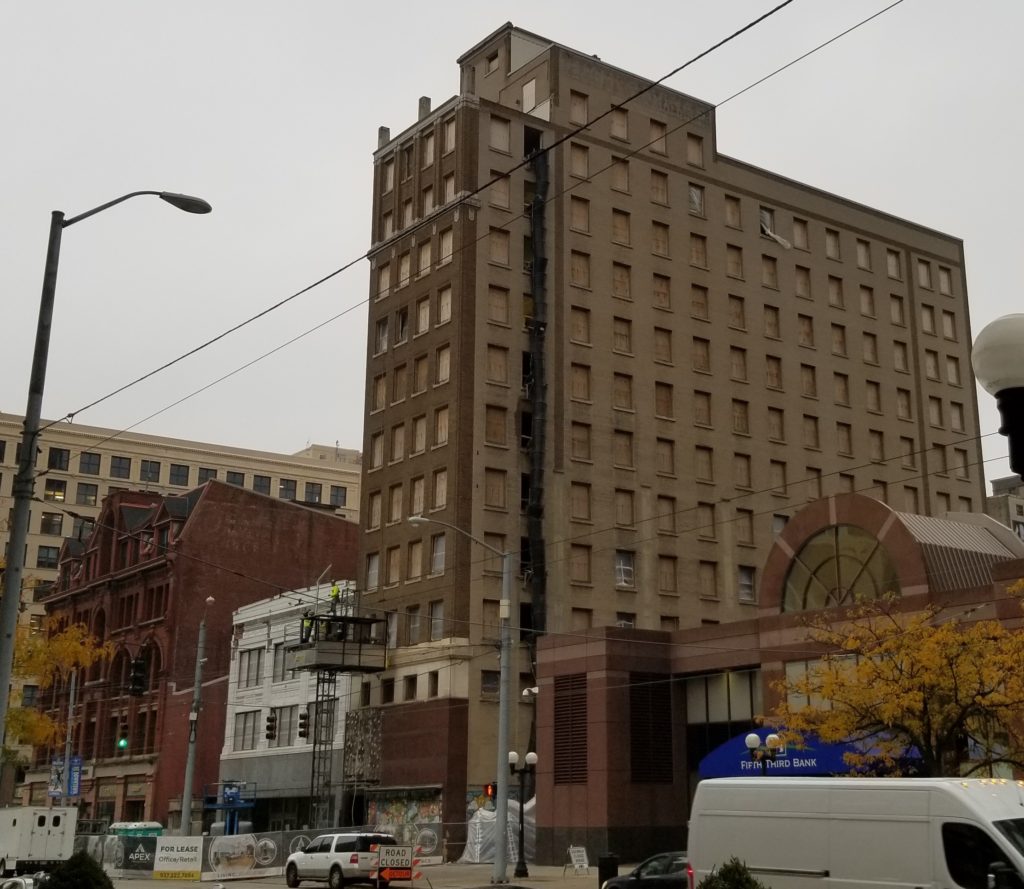
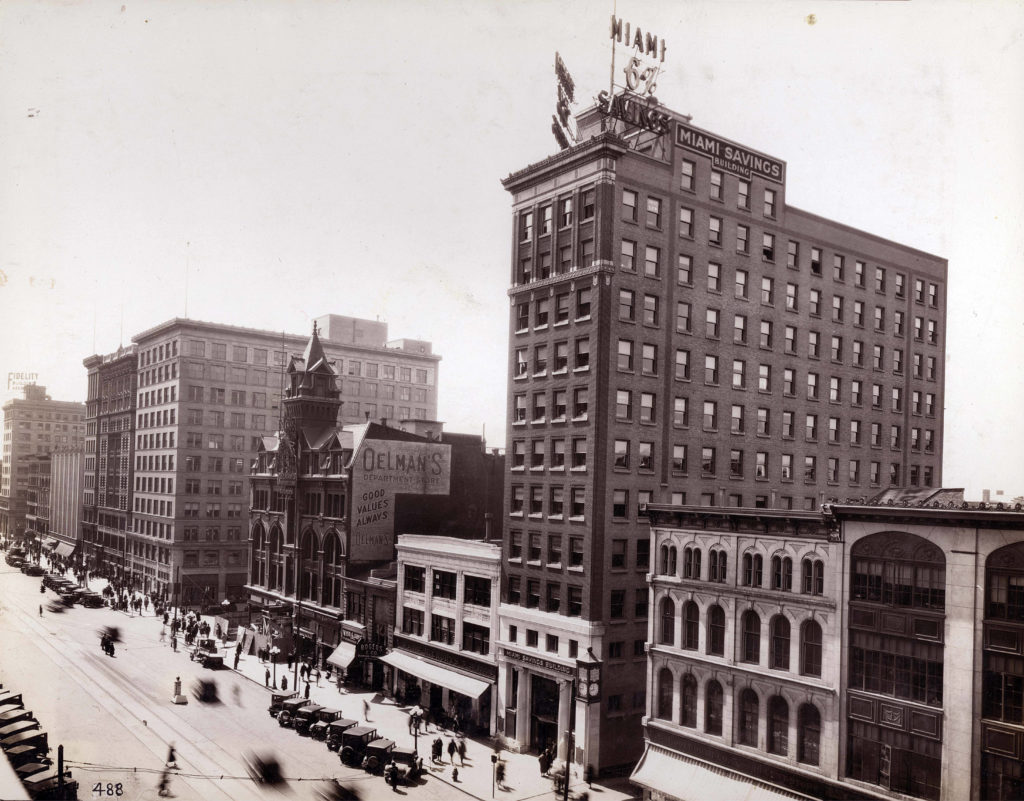
Learn More History of the McCrory Building as well as a Previous Redevelopment
The Fifth Third Tower at Third and Main, the parking garage at Third and Ludlow, and the Young Building housing Stop N Save Foods are on the block but are not part of the Arcade redevelopment (although there are interior connections among them).
Aerial View of the Dayton Arcade’s 9 Buildings
Early History of the Dayton Arcade
Construction of the Dayton Arcade began in 1902 and was completed in 1904. The idea was conceived by Eugene J. Barney of the Barney and Smith Car Company along with Michael J. Gibbons.
The original buildings were designed by prominent architect Frank Mills Andrews, combining neoclassical grandeur with modern commercial functionality of the time.
Read about the Arcade’s Grand Opening Festival in 1904
The Arcade’s unique layout—with the glass rotunda as the centerpiece flanked by multi-story buildings as well as the walkway across the block from Third that gives the Arcade its name—created a lively interior “street” that was closely interconnected.
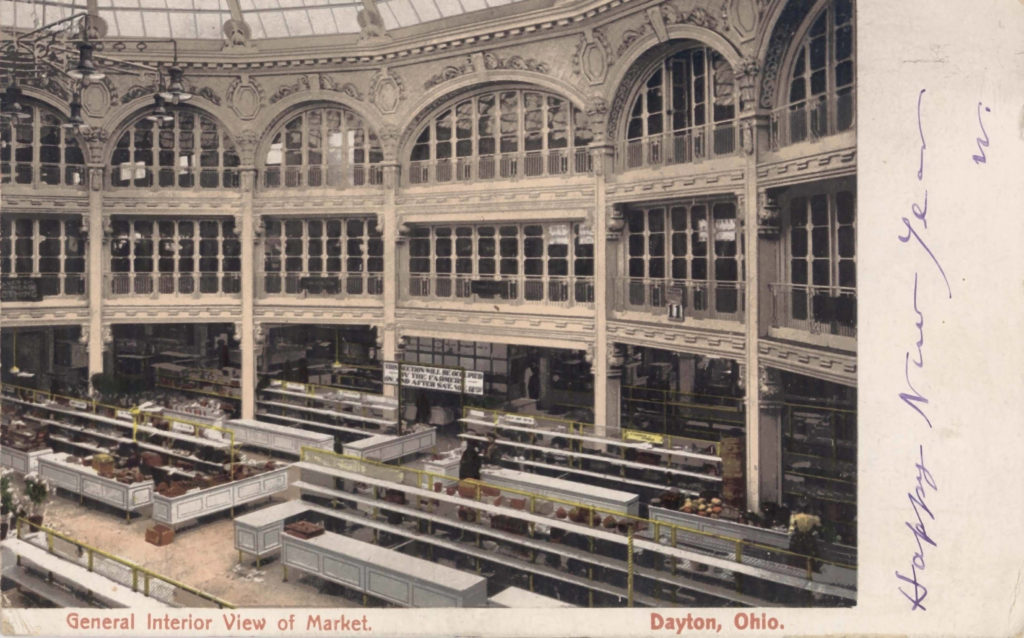
The Arcade quickly became a major downtown destination, drawing Daytonians for all types of shopping and business, while apartment spaces took up the upper floors of the Fourth Street, Ludlow, and Third Street Buildings.
Local newspapers of the time praised the Arcade’s elegance, as well as the sense of urban sophistication it brought to a city that was growing on the weight of its industrial power.
Peak Years: Commerce and Community But Also Struggles
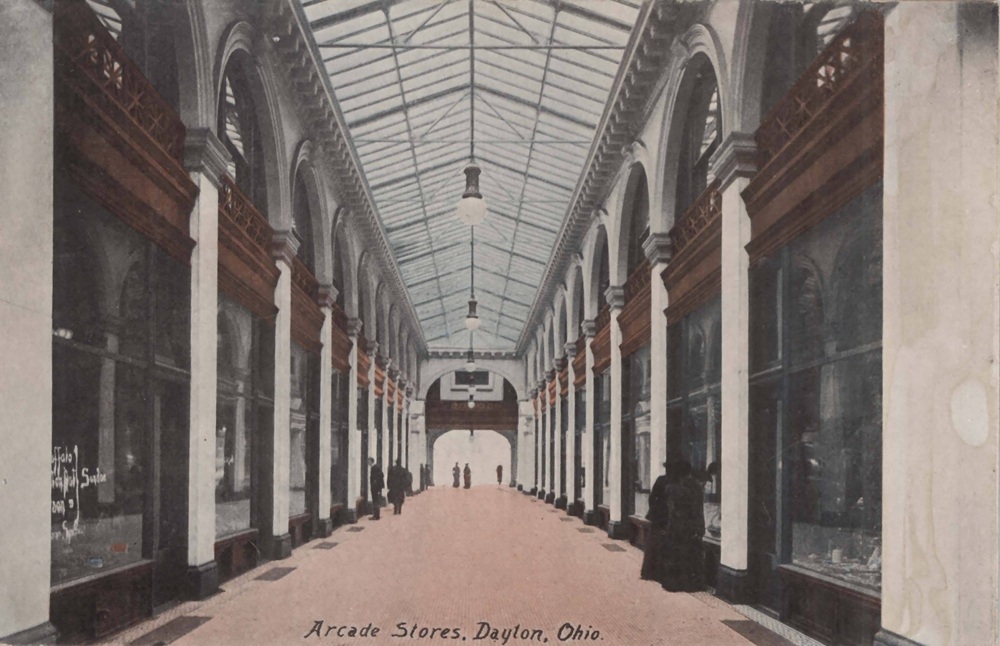
The Arcade was known as the Crown Jewel of the Gem City, but it actually suffered some adversity even in its early years, such as the Great Flood of 1913 just 9 years after its grand opening, and then the Great Depression which affected downtown shopping patterns.
But overall, through the first half of the 20th century, the Arcade thrived as a hub for buying everything from everyday necessities to specialty and luxury goods, and its full ecosystem that also included a variety of professional offices and living spaces led it to be called a “City Within a City.”
The Arcade’s location near key transit hubs and the bustling downtown office district ensured high foot traffic. For decades, it stood not only as an architectural marvel but also as a central node in Dayton’s commercial life.
The Dayton Arcade’s Decline, Closure, and Uncertain Future
Despite these occasional struggles in its early decades, a large contingent of Daytonians remained committed to supporting the Arcade throughout and it had always bounced back strongly.
But by the 1950s and 60s, the construction of interstate highways and the opening of suburban shopping malls caused the Arcade to decline even further. This eventually forced it to radically redefine its role within Downtown Dayton, a project that ultimately failed.
The Arcade’s struggles in the second half of the 20th century certainly weren’t due to a lack of effort. After the complex was added to the National Register of Historic Places in the 1970s, a large redevelopment project called Arcade Square was launched that eventually opened in 1980.
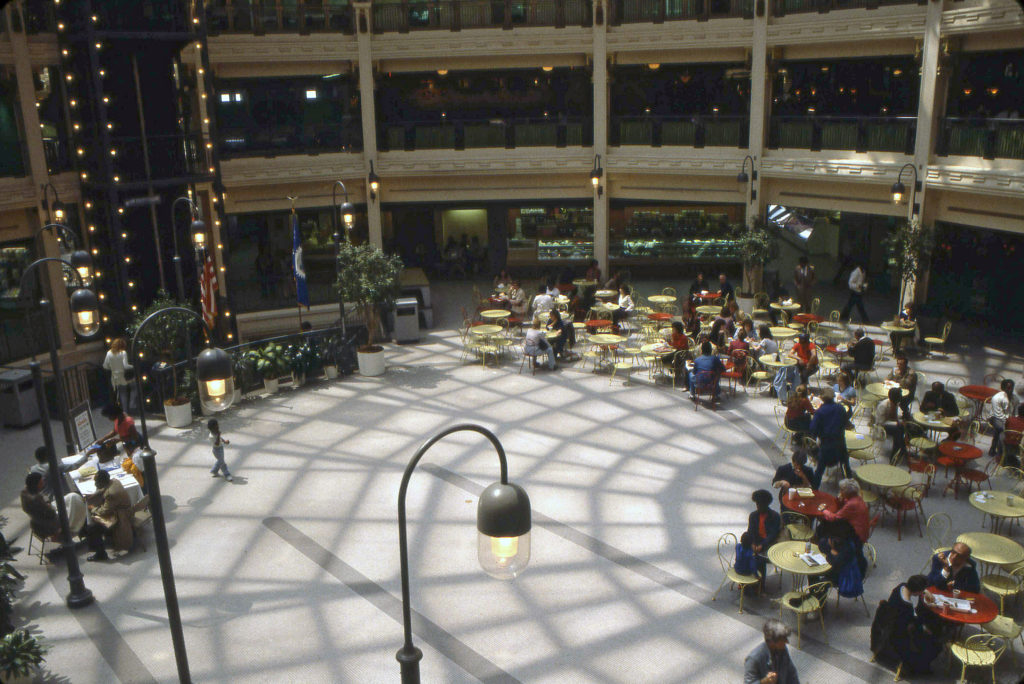
The Arcade was re-envisioned as a new type of retail and food center, deviating from some of its core identity in an attempt to emulate features of suburban shopping malls. Although its food court was popular (which became located in the basement of the rotunda after the ground floor was cut out) the rest of the complex never bounced back.
The upper-floor apartments never reopened as had originally been planned. By the late 1980s, commercial spaces were largely vacant as the retail base continued to shrink. The Arcade officially closed in 1991.
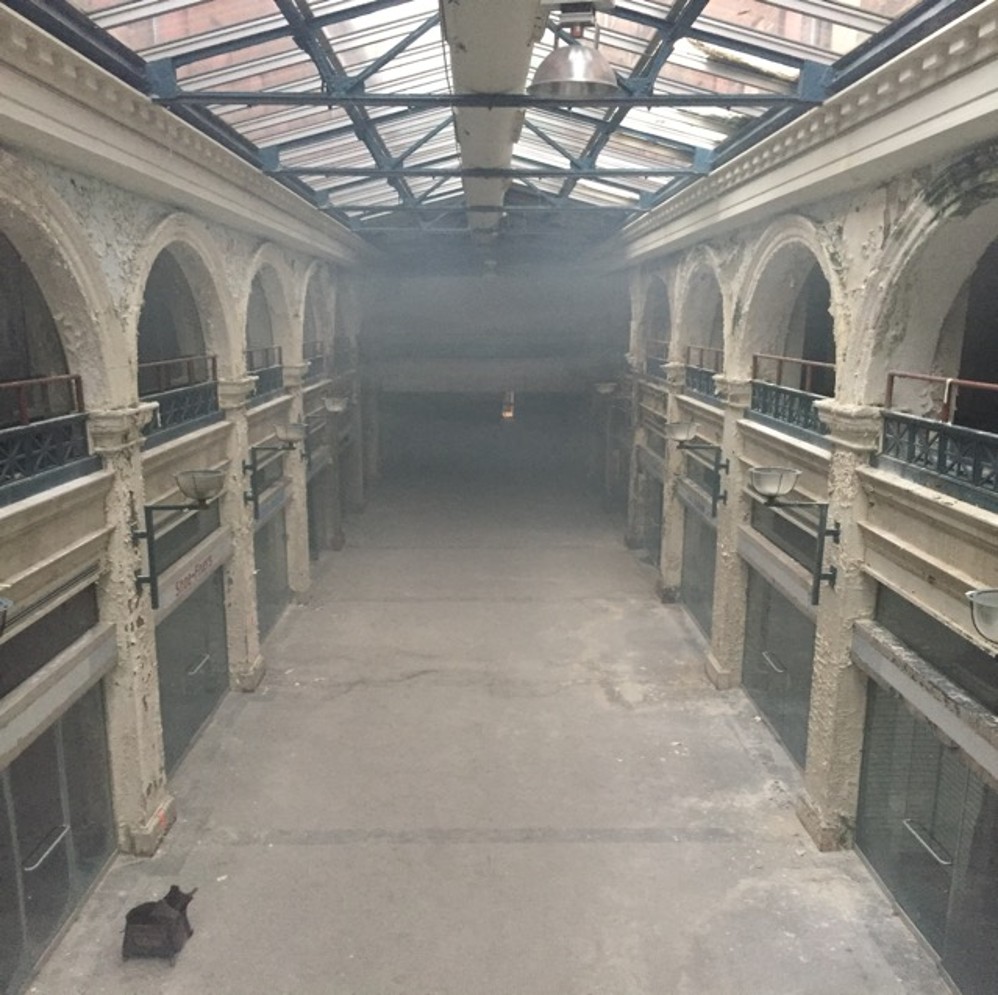
For many years it remained vacant, its iconic rotunda dark and quiet, a ghostly echo of its former vibrancy. Urban renewal efforts and redevelopment plans stalled, leaving the building’s future uncertain.
Read more about the various attempts to resurrect the Arcade post-closure
Dayton Arcade Restoration Efforts: A New Chapter
The Dayton Arcade was vacant for roughly three decades, during which several proposed redevelopment proposals (including the Arcade being listed on eBay at one point!) failed to move forward.
But in 2016, a major new project spearheaded by Cross Street Partners began to take shape. Although there were several ups and downs along the way as the development team assembled the financing needed, they would eventually rehab several buildings back to productive use including apartments, a new business and education hub, and multiple retail and other tenants.
First Redevelopment Phase: The South Arcade (Opened 2021)
The Arcade’s $95 million first phase focused on the south half of the block and centered on residential and office spaces. It utilized diverse funding sources including federal and state historic tax credits, Low Income Housing Tax Credits, city/county contributions, PACE financing, and much more. It was completed in 2021.
The Hub, a collaboration between the University of Dayton and the Entrepreneurs Center, brought classrooms, private offices, co-working, and a variety of collaborative spaces to help grow the Dayton region’s entrepreneurial ecosystem and bring together students and companies of all types.
It occupies the McCrory Building as well as parts of the adjacent structures on the South Arcade surrounding the Rotunda.
The Arcade’s first phase also brought 110 new apartments, most of them affordable, spread across the Fourth Street, Commercial, Ludlow, and Lindsey Buildings.
The central rotunda space itself has become a venue for special events and quickly became a highly sought-after wedding venue. It also has hosted quarterly public market days with a variety of local vendors, including the popular Holly Days festival.
Ground-floor retail spaces across the buildings in the South Arcade took a bit longer, but by 2023 had added restaurants, a coffee shop, The Co art gallery, and the 6888 Kitchen Incubator along Fourth and Ludlow Streets.
Today one can dine inside the Dayton Arcade at Table 33 or Lucho on Fourth Street, grab food from multiple restaurants out of the 6888 Kitchen Incubator on Ludlow Street, plus get food or drinks and look over the retail walkway from the Garden Grille and Bar on Third Street (as part of phase two below).
Second Redevelopment Phase: the North Arcade (2025)
The second phase of the massive Dayton Arcade redevelopment centered on the Third Street side of the Arcade. It had been reported to be a $41 million project. When it wrapped up construction in July 2025, a newspaper article reported that in total, $162 million had been invested in the Arcade’s rebirth.
The second phase involves the 93-room Hilton Garden Inn hotel (with a bar and restaurant open to the public) which opened in 2025.
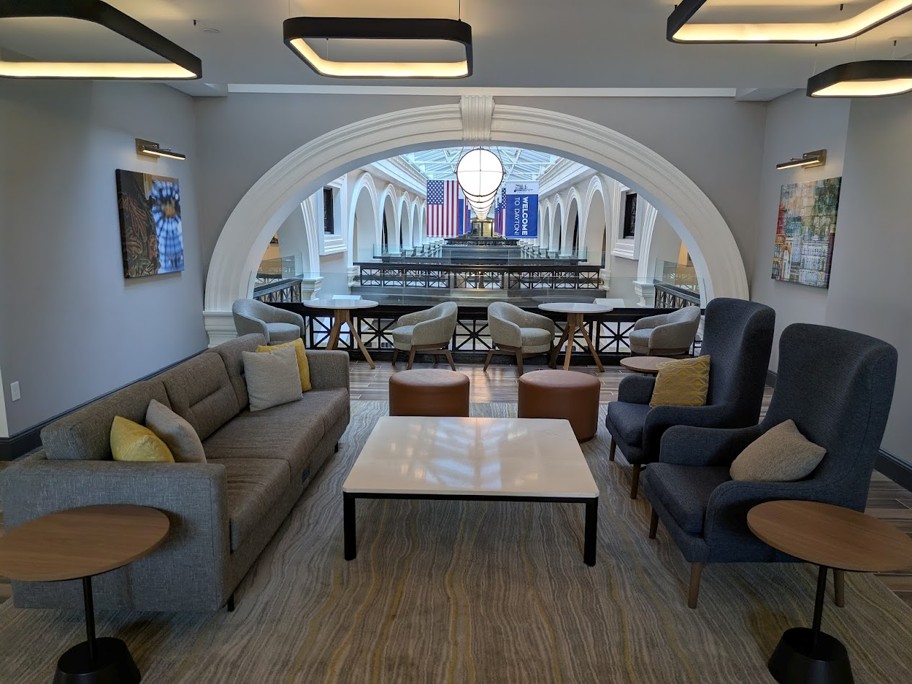
The hotel occupies the upper floors of the Third Street Building as well as the Gibbons Annex Building next to it.
The walkway on the ground floor of the Third Street Building has been turned back into small retail storefronts, and tenants that include Smales Pretzels, Luke’s Custom Cakes, Tiffany’s On Third, and more, are gearing to open up in early 2026.
Where To Park When Visiting the Dayton Arcade
Another very common question for those interested in checking out the in the Arcade is where to park. The perception is sometimes that there is no parking nearby, but there are actually a multitude of options if you know where to look.
The many parking meters surrounding the complex, especially to the west and southwest, are good options, especially for being free after 6pm and on weekends.
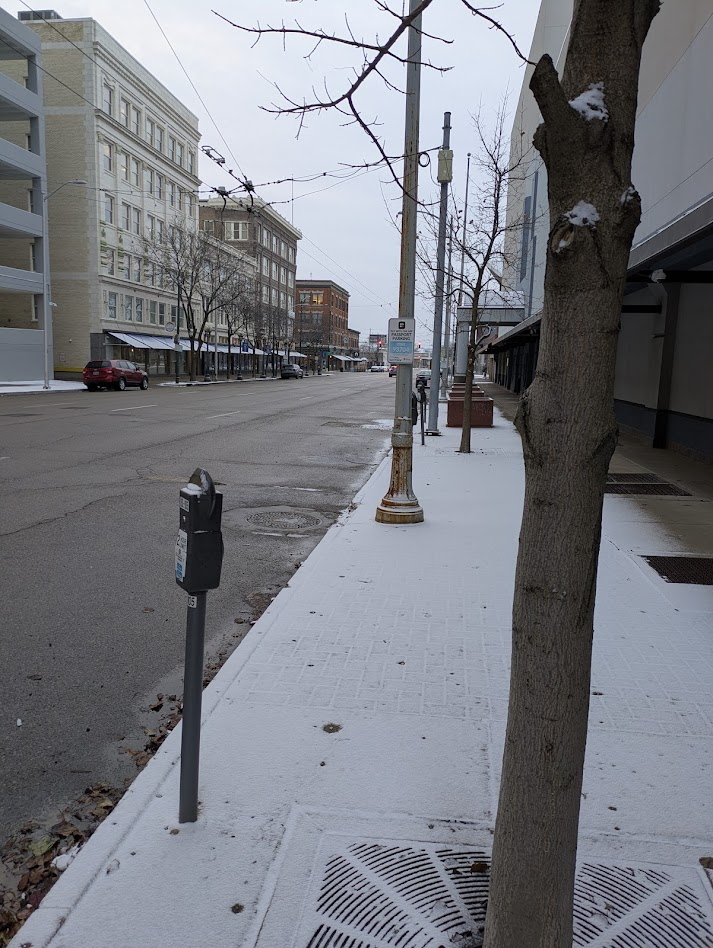
If you don’t want to have to hunt around for an open meter, there are also multiple garages in easy walking distance.
The Reibold Garage is one of the best options, located right across Fourth Street from the South Arcade.
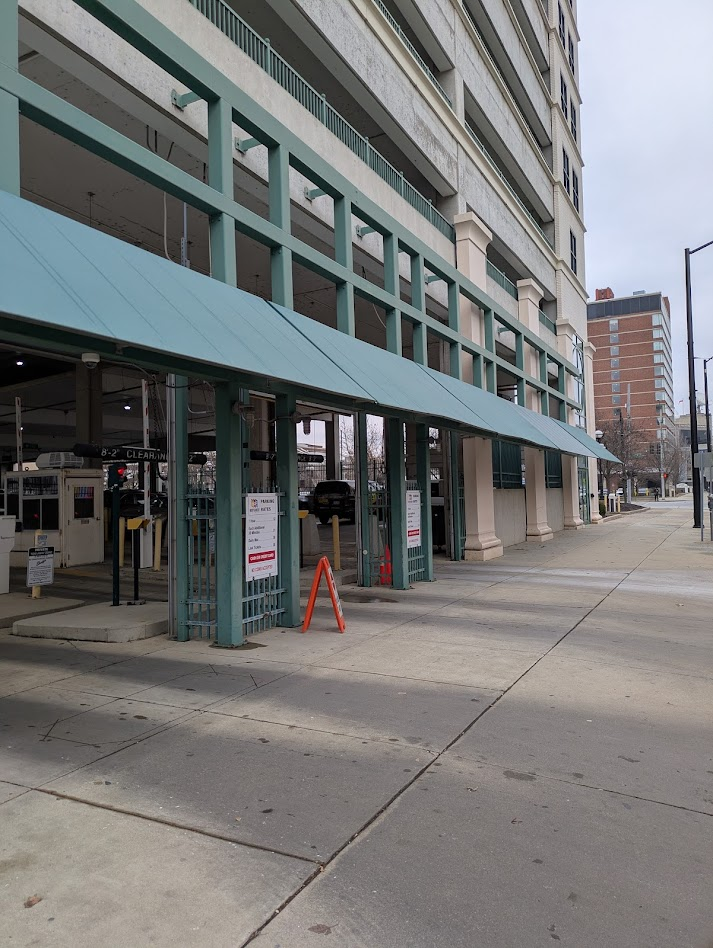
The Fifth Third Garage is also on Ludlow Street directly next to the Ludlow Building of the Arcade, and there are several others in the surrounding blocks too.
And another garage option that is even cheaper is the Oregon District Garage (formerly the Transportation Center Garage) at Fifth and Jefferson which is just a couple blocks away and a short walk across the lawn of the beautiful Levitt Pavilion.
More Dayton Arcade History Articles
On Dayton Vistas I have also created additional content that captures specific aspects of the Arcade’s story in text, image and video formats:
- Dayton Arcade History Timeline: A deeper dive into the complex’s history up until it closed in the 1990s, including several rare photos.
- Dayton Arcade Post-Closure Timeline: A look at the various failed attempts to bring the Arcade back after it closed, and a timeline of the circuitous route of the current redevelopment from its conception to real construction.
- Hidden History of Third Street and Gibbons Buildings: These two buildings have beautiful and ornate facades, but both have some hidden surprises hidden behind them.
- The Commercial Building: Before and During Construction: Some rare photos of the homes that previously stood on the site of the Commercial Building and the building during its construction.
- Will the Dayton Arcade Redevelopment Happen? (2018): An article I wrote that analyzed the proposed redevelopment and its progress two years after it was announced, when the Arcade project was still very much up in the air. (Fortunately the story had a happy ending!)
- Thoughts on Arcade Second Phase: Some Arcade reflections I wrote when the second phase of the Arcade was gearing up, expanding on what the redevelopment project means for Dayton and for bringing the Arcade back to its original functions.
Dayton Arcade Videos
A tour of the hotel soon after it opened in 2025:
A peek in the Rotunda and a preview of the North Arcade construction, as of late 2024:
@daytonvistas A look inside the Dayton Arcade rotunda, as well as a sneak peek at the progress of the North Arcade, where redevelopment including small retail shops and a hotel are slated to open soon. #daytonarcade #daytonohio #historicarchitecture #historicbuildings #adaptivereuse #historicpreservation ♬ original sound – Dayton Vistas
Leave a Reply