The Reibold Building has been a major landmark in downtown Dayton for more than a century, evolving through three distinct construction phases between 1896 and 1914.
Considered one of Dayton’s earliest skyscrapers, it reflects the city’s rapid commercial growth, ornate turn-of-the-century architecture, and later civic redevelopment. This article will trace how the building was created, expanded, adapted, and preserved through changing eras of downtown life.
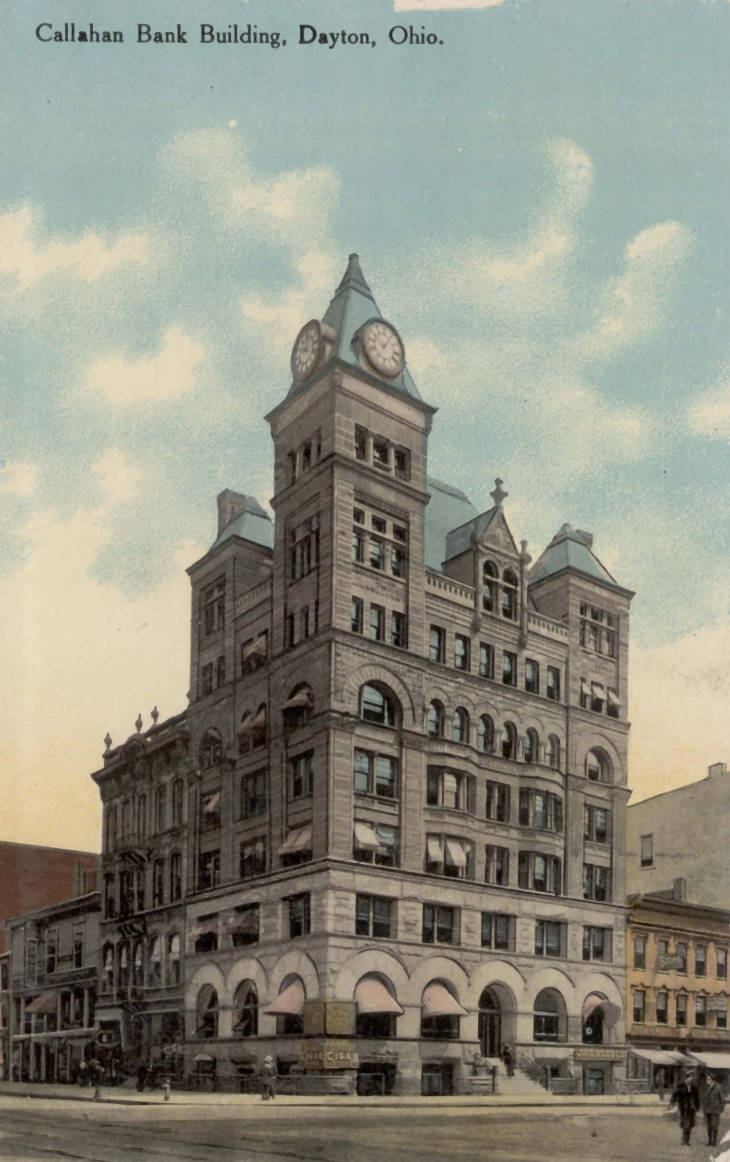
The title of Dayton’s first skyscraper is not universally agreed upon (many give the nod to the 1892 7-story Callahan Building, since demolished) but the Reibold Building is definitely in the conversation.
This structure was built in 3 sections, with the first opening in 1896. The 10-story Second Renaissance Revival building has the most ornate details of the trio.
This would be the tallest building in Dayton for almost a decade until the first phase of the Centre City Building was completed.
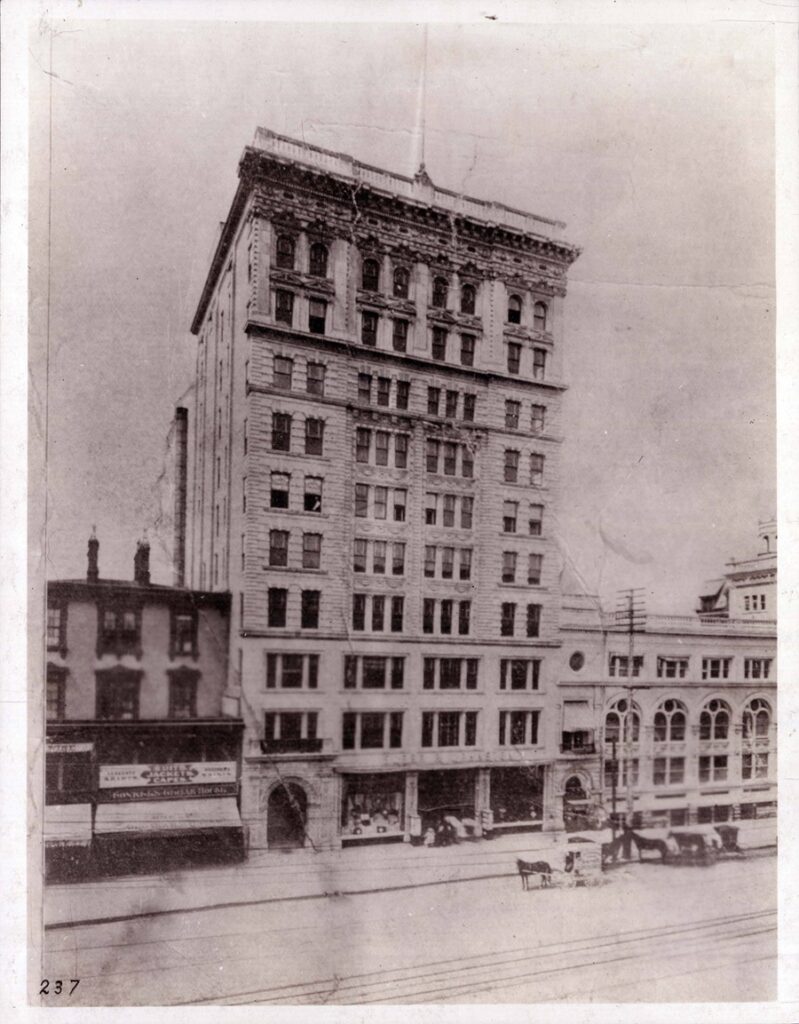
The elaborate architectural features are described in a National Register nomination form:
“The four bay front façade of the original is limestone clad, elaborated throughout with rusticated stonework. The central bay is set back slightly from the side bays. Decorative stone cornices project over the seventh and eighth floors. Side bays have two rectangular double hung windows each, and these are unified with an extended stone sill. The central bay comprises of sets of three ribbon double hung windows. Floors four to seven are elaborated with stone spandrels with wreath ornamentation. The eighth floor, which is separated by cornices above and below, forms a base from which the elaborately ornamented upper two floors rise. Windows at the ninth floor level are topped with stone pediments; the tenth floor forms an arcade of round arched windows, and an elaborately ornamental cornice with moldings and decorative brackets marks the roof line.”
The Reibold building was named for its developer, Louis Napoleon Reibold.
The first tenant was the Elder and Johnson department store, which later became Elder-Beerman. Originally the store took up 2 floors and the building’s basement, but they grew to occupy 3 more floors.
Interestingly, the corner lot has a retail connection that predates the Reibold and Elder and Johnson. It was the location of Rike’s before it moved to its more familiar location at Main and 2nd. This corner building was built in 1893 and only lasted until 1912.
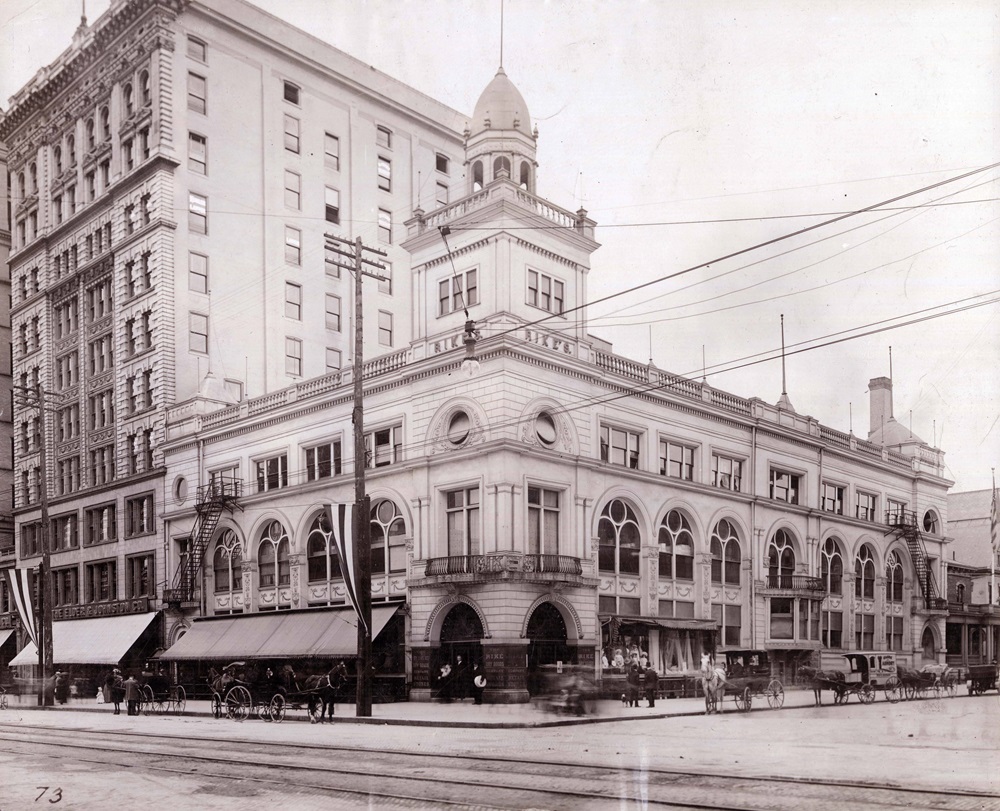
As Dayton’s commercial district grew, so did the Reibold.
The second section of the building on the south side was completed in 1905, designed by Peters, Burns, and Pretzinger.
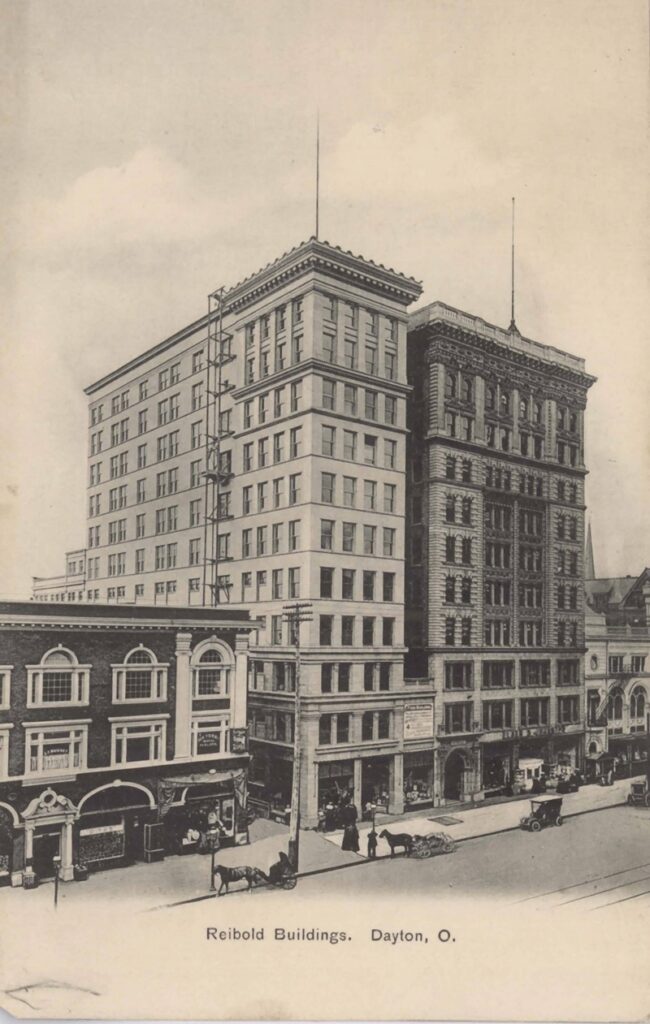
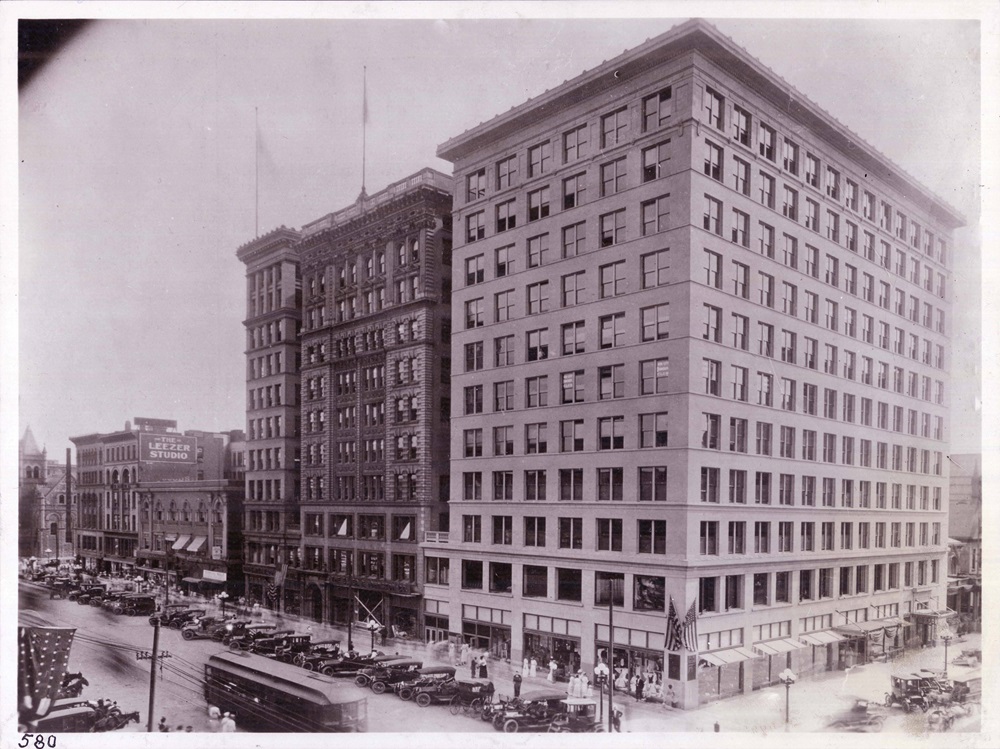
The third and final phase would arrive after one of the darkest moments in Dayton history.
The final section, the “Reibold Annex,” was delayed by the Great Flood of 1913 but eventually opened in 1914.
By the 1930s, the Reibold was adapting to modern retail expectations.
Dayton’s first escalators were installed at the Reibold Building in 1934 by the Otis Elevator Company. During its heyday the Reibold housed a variety of additional tenants including lawyers, doctors, insurance companies and financial services firms.
Urban renewal pressures and the decline of downtown retail reshaped the Reibold’s role.
Decades later as downtown was declining as a retail hub and vacancies increased, the Reibold was bought by Montgomery County for use as government offices in 1972.
Originally, there was a plan to cut off the building’s top 6 floors, which fortunately wasn’t implemented.
The building underwent a $9 million renovation in 2002, which included restoring the terra cotta and brickwork. This project also built the 11-story parking garage adjacent to it on the south side.
The garage sits behind a surface parking lot that faces Main Street, providing a tantalizing development opportunity to bring more vitality to Dayton’s central corridor and help restore the street wall of the block.
Reibold Building: Frequently Asked Questions
1. When was the Reibold Building constructed?
The building was completed in three phases: the original ten-story section opened in 1896, a south-side expansion followed in 1905, and the Reibold Annex was finished in 1914 after delays caused by the Great Flood.
2. Who was Louis Napoleon Reibold?
Louis Napoleon Reibold was a Dayton developer whose name the building carries. His original structure helped anchor the growing commercial center of the city during the late 19th century.
3. What architectural style is the Reibold Building?
The 1896 section is a strong example of the Second Renaissance Revival style, with limestone cladding, rusticated stonework, arched windows, and an elaborately detailed cornice. Later additions were designed to harmonize with the original façade.
4. What businesses originally occupied the Reibold Building?
Its first major tenant was the Elder & Johnson department store, which occupies multiple floors. The building later attracted offices for doctors, lawyers, insurance companies, and financial firms.
5. How has the Reibold Building been used in recent decades?
Montgomery County purchased the building in 1972 for government offices, a role it continues to serve. A major renovation in 2002 restored its façade and added a new parking garage.
6. Why is the Reibold Building historically significant?
It represents one of Dayton’s earliest skyscraper-era structures, reflects changing phases of downtown growth, and tells a broader story of architecture, retail development, urban renewal, and civic preservation.

My paternal grandmother was a model e at elder johnson before she married my paternal grandfather who was a machinist at ncr. They. Setup housekeeping on apple street. Thanks again for another fantastic set of articles.