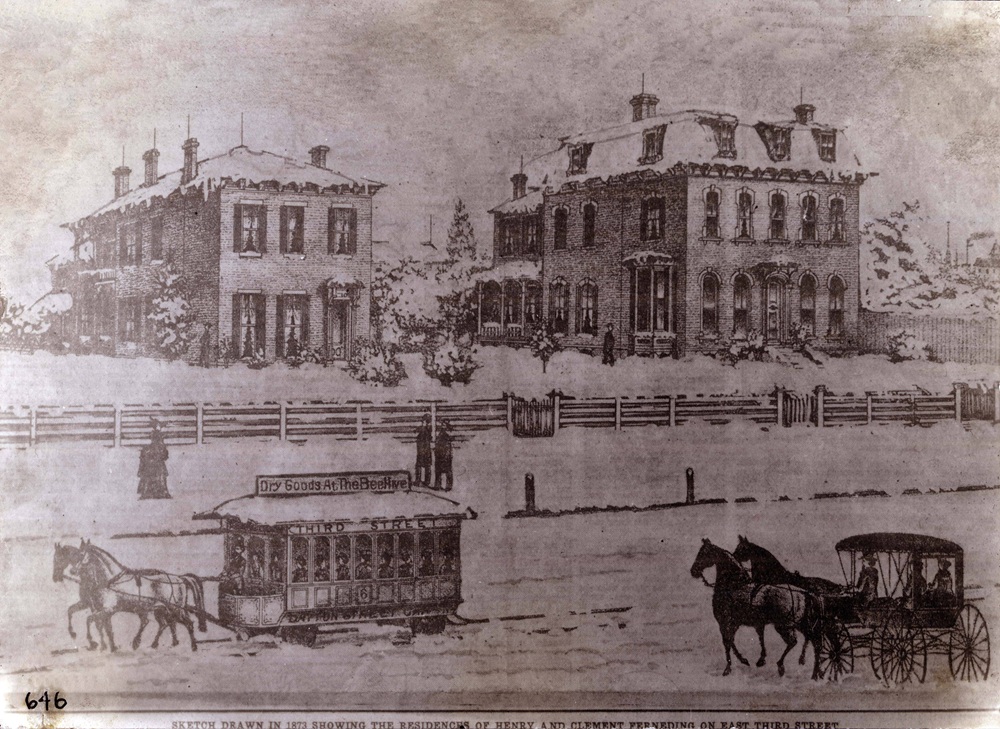
With Dayton having experienced a major snow storm this week which broke the record for single day snowfall (previously held by the blizzard of 1978), this is an appropriate historic image to look at.
It depicts two residences on East Third Street in 1873 “after a heavy snowstorm.”
The horse-drawn streetcar is a nice addition to the picture. The first line in Dayton was on Third Street and had just started service in 1870.
The caption for the photo also shared that the residences belonged to Henry and Clement Ferneding.
A few sources help us learn more about the family and these magnificent homes that have sadly been demolished for about 75 years.
The home on the left is the older of the two. It was built around 1852 by Henry Ferneding, who had come to Dayton in his early twenties to work on the digging of the Miami and Erie Canal.
He experienced a couple of major challenges, first having to give up his digging job due to an illness, and after he began working at a distillery, he was “painfully scalded a short time later.” But undeterred, he eventually became the owner of his own distillery and malt business which was very successful.
Clement Ferneding was Henry’s son, who partnered in his father’s business before becoming president of the Dayton Street Railway company. He was also a local civic leader, serving as chairman of the committees charged with constructing St. Elizabeth’s hospital, and relocating graves from the old St. Henry’s cemetery to then-new Calvary cemetery.
Clement built the larger home to the right of the image in 1872. An old newspaper article described it in some detail:
“Stone steps lead to the doorways of the Clement Ferneding house where the double portals are of solid white walnut. Inside, the house has beautifully carved woodwork, ornate ceilings and large white marble fireplaces. The comfort and luxury evident even today in the interior arrangements contrast sharply with the sombre, weatherbeaten appearance of the house’s exterior.
The outside doors give into a large hallway with the stairs ascending from the hall. The parlor is to the right of the entryway, a stone-floored basement is under the house. The dwelling was equipped with steam heat and a bathroom.”
The home was somehow not engulfed by floodwaters during the Great Flood of 1913 as many of those around it, and 17 people huddled there for safety during the disaster.
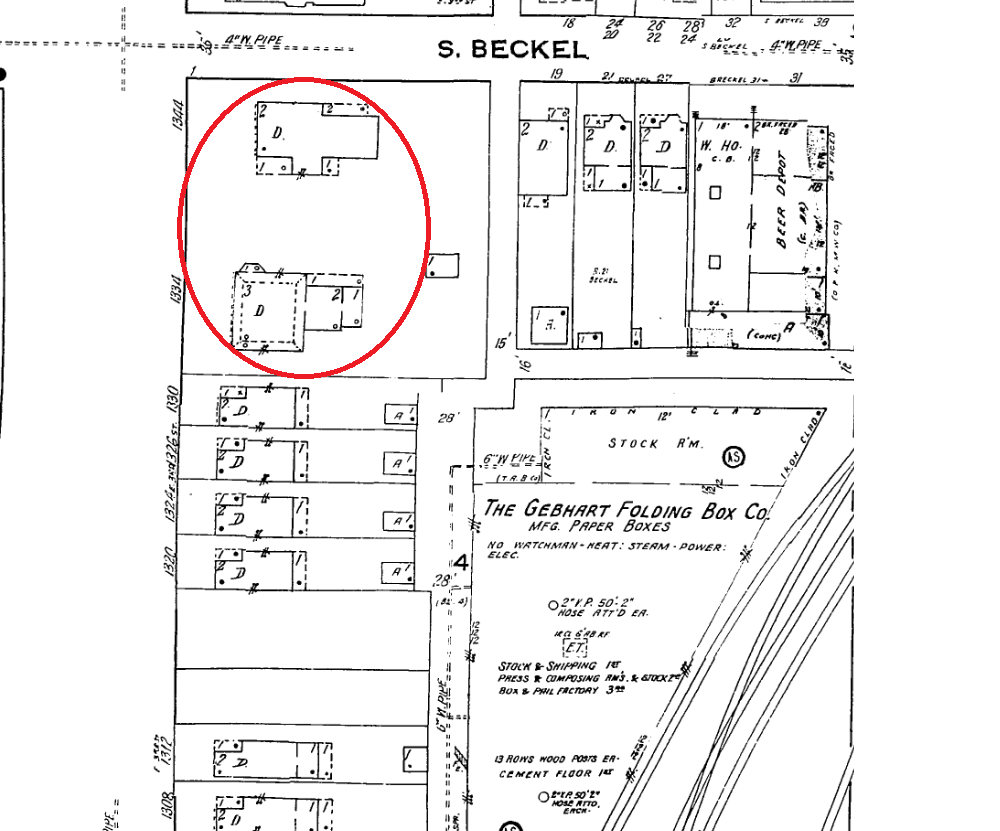
The old image predates the creation of Beckel Street, which would cut through right to the left of the older house.
By the 1940s the older home had been divided into multiple apartments.
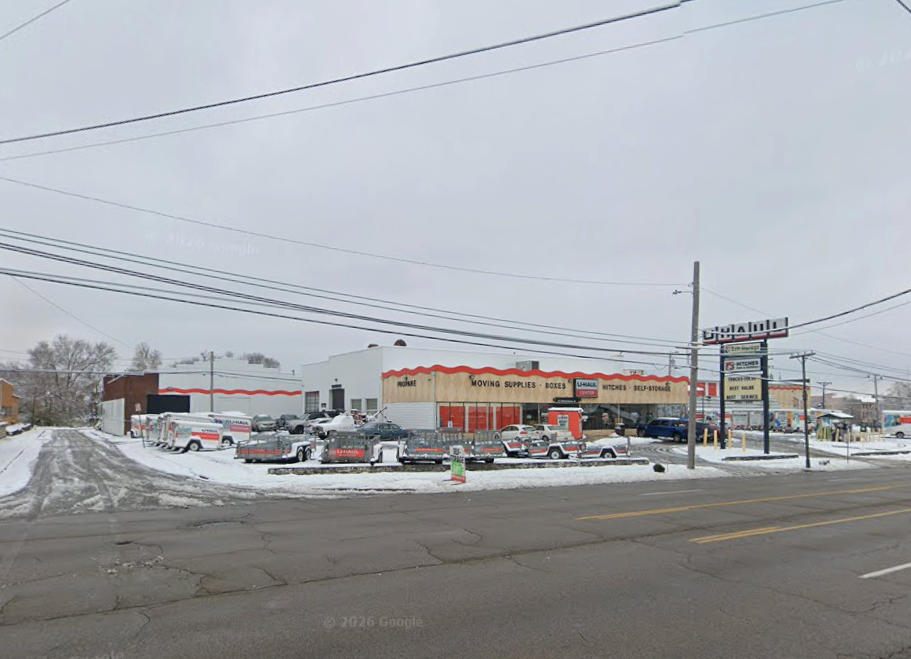
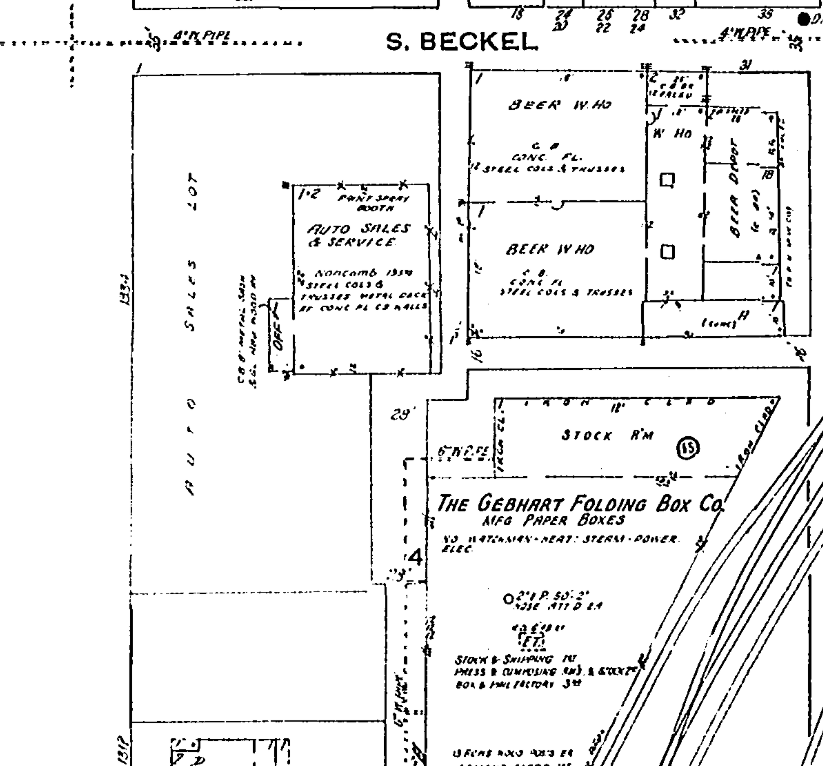
The homes would be demolished around 1950 for an auto sales lot, which today is surface parking in front of the U-Haul
This can be seen by examining the 1950 and 1955 Sanborn maps.
These two homes may have been removed, but on the lot just north of Beckel, 1400 E Third St, an old home remains which was later converted to office use.
It recently opened as the new indie bookstore Cozy Book Nook.
Leave a Reply