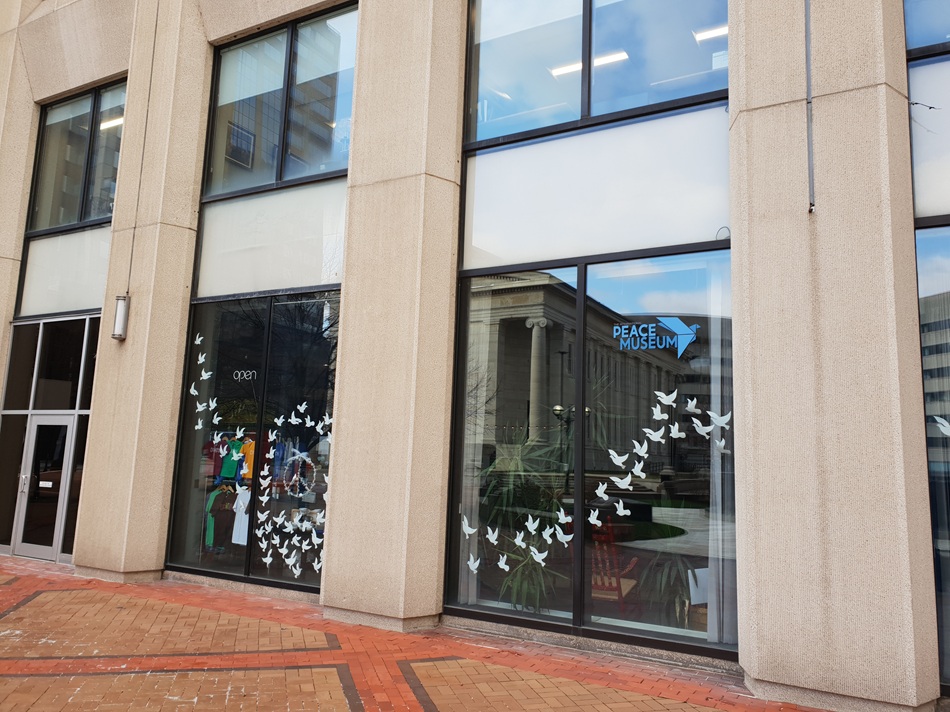
Editor’s note: I’ve written quite a bit about Courthouse Square and its history, challenges, and future as a central gathering place. One thing that can get overlooked in those conversations is the role of the institutions already in and around space today. This guest feature by an excellent local journalist, Ismael David Mujahid, takes a closer look at the International Peace Museum, which relocated to the square in 2022 from the Isaac Pollack House at 208 W. Monument Ave. It has become a meaningful cultural anchor right in the heart of downtown, and I was glad to publish this piece as a different kind of look at a place that deserves more attention.
On a cold winter afternoon, hundreds of commuters pass Dayton’s best-kept secret. Some walk, others are aboard the RTA that rounds the corner of West 2nd Street. Few jog or stumble by on their way somewhere else. Which is a shame, because tucked away just steps from the stoplight and a glass screen away from Courthouse Square is one of the city’s most profound museum experiences.
The International Peace Museum of Dayton is a perfect contrast to the brumal world beyond. It is warm in both the literal and figurative sense, bright in defiance to the onset of winter, hopeful despite the persistence of wintry blues.
In a time where conflict seems to plague every part of the globe, from cities across the U.S. to former bastions of peace like Ecuador, the story of its foundation could not be timelier. I was lucky to have two of the most important people in the museum’s history there to guide me down memory lane over tea and coffee. A trip we owe to Dayton’s proudest moment on the international stage: the 1995 Bosnian Peace Agreement.
First Steps
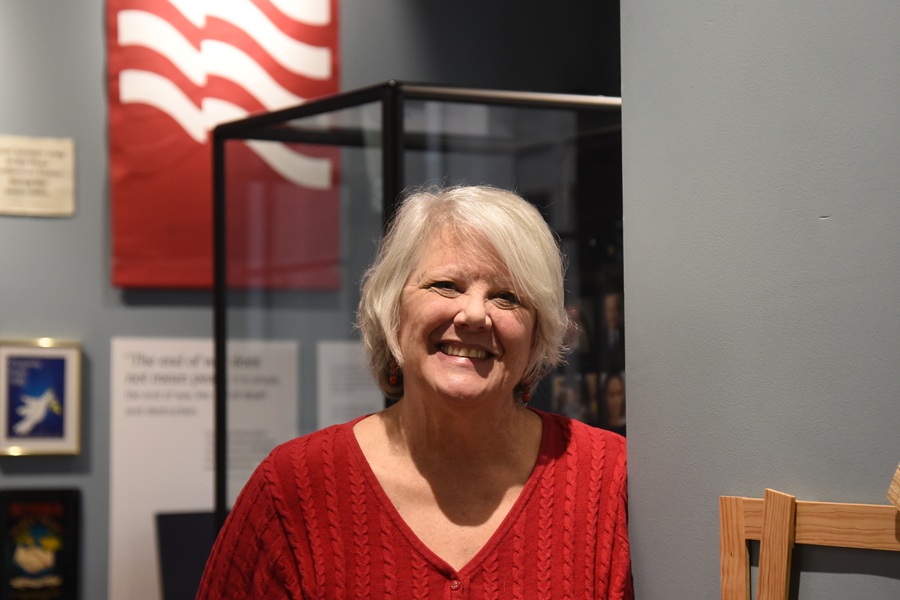
Dr. Mary Ramey has invested years of her life in the museum. Every corner and exhibit has at least a touch of the work she and her colleagues put into it. She began with a membership right around the time the museum opened in the mid-2000s before volunteering in 2017. Soon she was Volunteer Coordinator and by 2018 a member of the board. Her meteoric rise did not stop there.
“Then the next year they wanted to know if I could be vice-chair of the board. It was during that year we redid the peace accords exhibit,” Dr. Ramey said.
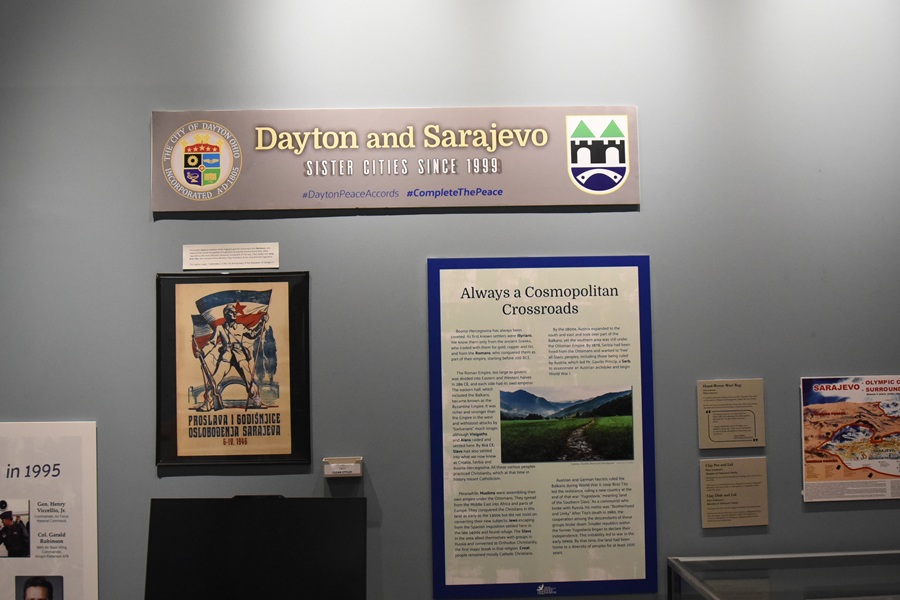
No visit to the peace museum is complete without a trip to the Peace Accords exhibit. It’s the cornerstone of what they do, its raison d’etre. The event itself was the driving force behind the museum’s foundation in 2004.
“The museum has always had at least a small exhibit on the Peace Accords but it would get taken down sometimes to make room for guest exhibits,” Ramey said. “I’m not sure the volunteers that were helping really understood that there was a chronology and logic to exhibits so it got kind of jumbled.”
A firm from San Francisco was hired to make it state-of-the-art. Today the story of the Balkans Crisis is told from beginning to its aftermath. In almost forensic detail, the conflict’s evolution is shown, artifacts from the war and conference displayed. Through interactive displays and videos, the museum aims to challenge preconceived notions about wars, their causes, and what happens once guns fall silent. By November 2019, the project was done and ready for the public.
Months later the pandemic would strike with a vengeance. The hard work did not stop there. Soon, they would move from their original home on Monument Avenue.
“Since we were closed, Kevin Kelly and I spoke with Christine and Ralph Dulle, who were two of the founders of the museum, about trying to find a space that was more accommodating to the public. The building on Monument Avenue was beautiful, we loved it but it was not very welcoming to people with any kind of mobility issue so we thought we could do better than that,” Ramey explained.
Kelly, who was director at the time, “worked tirelessly” to prepare the site, according to Ramey. The space had previously been occupied by two bank branches and had to be completely gutted. Dr. Ramey and the museum’s new director, Alice Young-Basora regaled me with tales of how the museum and their path to it came together. It’s no coincidence that both grew up in homes that prized advocating for what was right.
“I’ve always been involved with organizations that have a community focus and trying to alleviate problems since I was in school. I was raised that way, my parents were socially active. And when I came to Dayton I was looking for outlets around that,” Ramey said.
“A little bit similar to Mary, I grew up in a family that was always encouraging of if you see something that’s wrong speak up and do something about it,” Young-Basora shared. “My grandpa, as a doctor, saw people as people, people to help. Even when he died we found one full shoebox and a half full shoebox of uncashed cheques from his patients who he knew couldn’t pay but would take their cheques for their dignity and not cash them. It was his way of giving back without telling anyone.”
Young-Basora has worn many hats in a career that took her from the juvenile court system to animal rehab, art, and education. Shortly after the museum re-opened she was brought in as Director of Education.
“I feel extremely fortunate to be here especially in the current climate that we live in right now,” Young-Basora told me.
On the front page of any paper, domestic or foreign, are snippets of the climate she’s talking about. The world appears to be in greater turmoil than ever before. Turmoil that has forced the museum to confront a new challenge: protecting the very concept of peace itself.
The Meaning of Peace
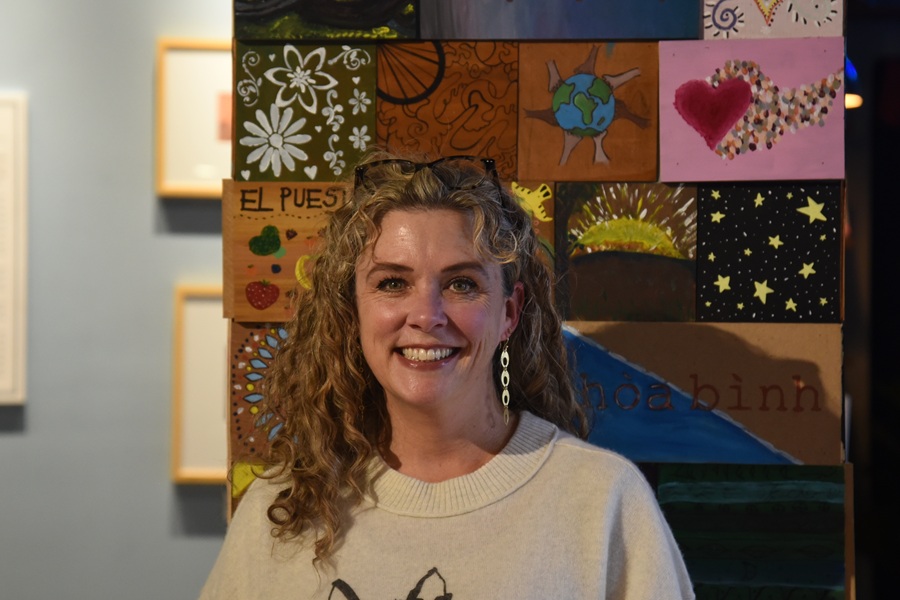
Peace is baked into the museum’s soul, its presence everywhere the moment a visitor walks in. It’s written in brilliant colors and multiple languages on the wonderful Peace Pole, challenging visitors from bookshelves and t-shirts. Make no mistake, peace isn’t just a slogan here. Through its exhibits, the word goes so much deeper.
“Peace is much more than just the absence of conflict and I think the museum is all about that,” Ramey said.
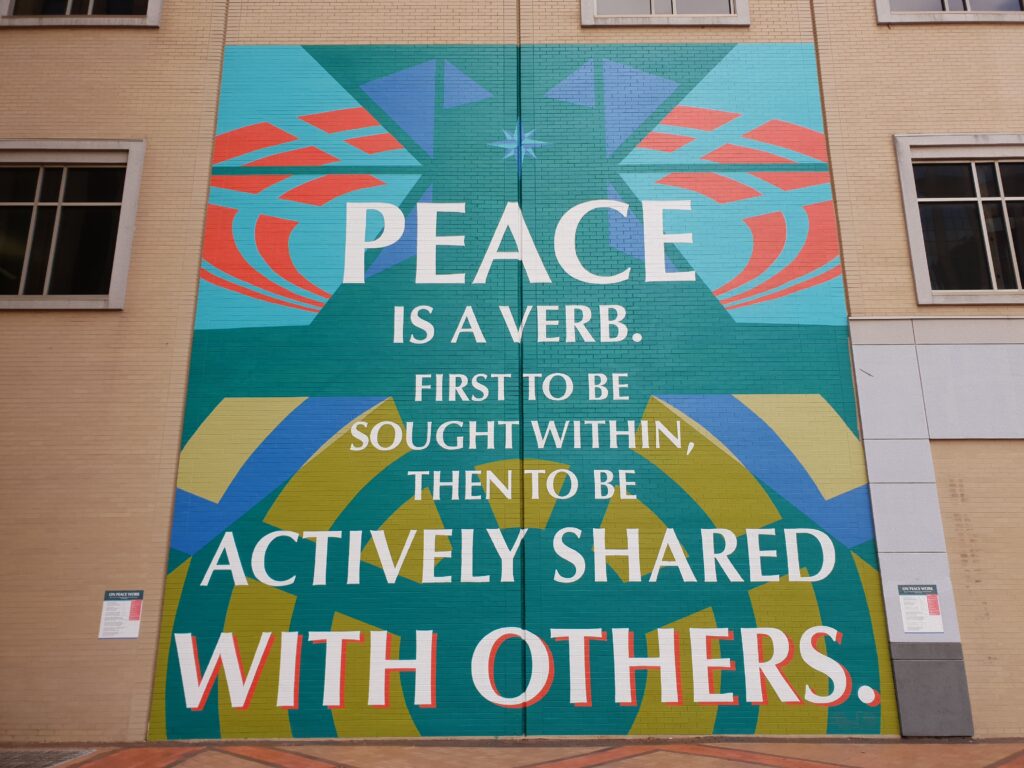
For Young-Basora, peace is tied to action. It is the end result of choices made on a day-to-day basis. And like any positive action, peace is best when shared.
“You know a rising tide lifts all boats. I think that’s the same way with peace, justice, and equality,” Young-Basora said. “It does more good for the world if we share it with others.”
While acknowledging the importance of inner peace, Dr. Ramey explained that outer peace is just as vital. And no societal peace is possible without justice. It’s a view shaped by her years of work as a psychologist.
“The longstanding adage is if you want peace work for justice and that’s so very important,” Dr. Ramey said.
Ramey’s work on the updated Peace Accords exhibit is a good example of this dichotomy.
“Most people in Dayton and the United States thought that there was this war back in the 90s, it was really horrible but we brought everybody to Dayton and they figured it out and thank God it’s over. But it’s not,” Ramey stated.
Bosnia today remains a land in stasis, locked behind the tripartite electoral system enshrined in the accords. In each of its three republics, saber rattling and posturing have never quite disappeared. Across the border in Belgrade, politicians like Serbian strongman Aleksandr Vucic regularly beat the drums of war.
A Future, Together
Partnerships with organizations across the greater Dayton area and beyond have allowed the museum to work to create peace. It’s not just exhibits and thought-provoking art within its walls. Connections with groups as diverse as the Dayton Democracy Fellows and Miami Valley Immigration Coalition has helped Young-Basora and her team expand their programming. That has meant inviting a wide range of groups to the museum to find common ground.
“This is a community problem and we don’t live in isolation. I think that there are so many other people trying to do the same thing. Its like we are all holding our flashlights but when we hold them together we’re so much brighter,” Young-Basora said. “It’s super important to have friendships among other organizations in Dayton because that’s who we want in here. We want Daytonians in here.”
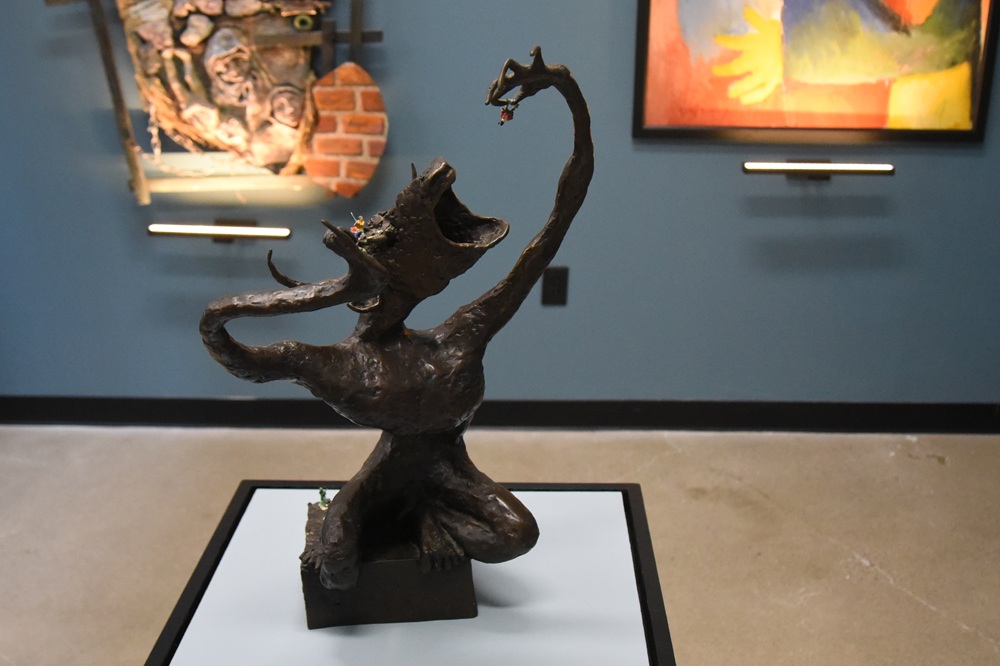
The success of the museum’s outreach efforts led to a visit by Wright-Patt’s base commander during the recent anniversary celebrations of the Peace Accords in addition to trips by members of the War, Peace, and Justice Project in Pennsylvania. Walking by the paintings of Beryl Bernay left me hopeful that such connections will have an impact far beyond the Gem City.
And just like any tour of the museum, my feet bring me right back to the Peace Pole. It’s an anchor not just for the way it attracts the eye but for the pervasive symbolism that adorns it. In part, it is a living example of Young-Basora’s philosophy of peace in action.
“One of my first tasks as Director of Education was to help coordinate the making of the Peace Pole. That was an amazing project that we did with Bing Davis, Tess Little, and Tristan Cup, three local artists, and Kathy Rowell helped out,” Young-Basora shared.
Teams were challenged to make images of peace, and the word itself was translated into the top 20 languages spoken in the Dayton area. Young-Basora has big plans and if they are anything like the Peace Pole the Gem City should be proud.
“I would love to make sure that we are around for the next 21 years. I really want to expand our programming for students, expand our connections with other organizations,” Young-Basora said at the end of our chat. “I would love for this space to be used as a hub for people to come and gather as a community and come to have the conversations that are difficult and just be a place where people feel safe to be heard, to be listened to and just be heard.”
About the author: Ismael David Mujahid is an award-winning writer and poet from Seattle, WA. His love for storytelling has taken him around the world, with a literary footprint ranging from Sumatra to Central Asia and Sao Paulo. He is currently based in Dayton, OH, where he regularly contributes to the Dayton Daily News and Springfield News Sun. Follow him on Instagram @thelitnomad00



Leave a Reply